

Waste Management Agency Explains Summer Landfill Fires
Uzbekistan’s Waste Management Agency has denied claims of intentional landfill fires, explaining that high temperatures, organic waste, and glass cause natural ignition.
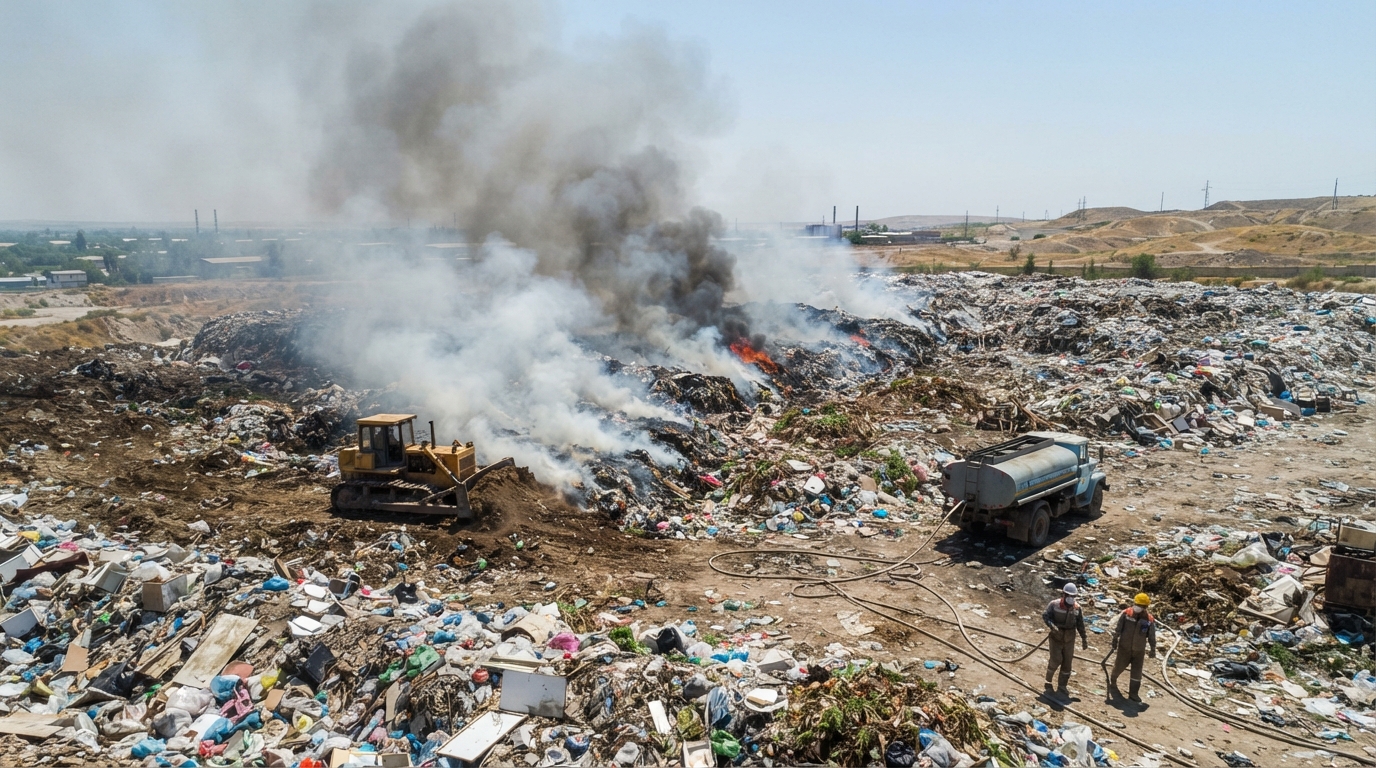
Waste Management Agency Addresses Summer Landfill Fires
Tashkent, Uzbekistan (UzDaily.uz) — The Waste Management Agency has dismissed rumors on social media suggesting that solid municipal waste landfills are being deliberately set ablaze to decrease waste volume. This clarification follows a significant fire at a solid municipal waste landfill in Ohangaron.
The agency stated that these claims are unfounded. They pointed out that arson is not beneficial for either the state or landfill operators, as extinguishing large fires incurs substantial costs for water, specialized equipment, fuel, soil, and the mobilization of numerous specialists.
Additionally, tenders for waste sorting operations have been announced for 98 of the country's 137 landfills. The agency highlighted that waste recycling offers a far greater economic incentive for businesses compared to managing the aftermath of fires.
Experts have identified four primary reasons for landfill fires during the summer months.
The first reason is organic waste, which constitutes approximately 44 percent of the total waste. In high temperatures, organic waste decomposes rapidly, producing methane and carbon monoxide. Methane is a highly combustible gas, meaning that even a minor spark or localized overheating can ignite a fire. The agency estimates that a one-hectare landfill can generate up to 350,000 cubic meters of methane.
The second reason involves aerosol cans, lighters, and other pressurized containers. Although they represent only about 0.9 percent of household waste, they can explode in extreme heat, serving as potential ignition sources.
Glass bottles and shards are another contributing factor. When exposed to direct sunlight, glass can act as a lens, focusing light and heating plastics, polyethylene, and other flammable materials to their ignition points.
The fourth reason is hot ash, which residents and food service establishments sometimes dispose of with household waste. The agency noted that even ash that appears to be cool can maintain high internal temperatures for up to two days, leading to smoldering and potential ignition once it reaches the landfill.
The agency also reminded that solid municipal waste landfills are designated as strategic facilities and cannot be privately owned. Following a presidential decree, all landfills are to be managed by the state Directorate for Landfill Management under the Ministry of Ecology. However, the transfer process for some facilities is still ongoing. At these sites, violations of waste disposal protocols, such as inadequate layered placement, compaction, and daily soil coverage, can heighten the risk of fires.
The agency pointed out that landfill fires are a widespread issue in many countries, including those in Europe, the United States, and India.
As of now, the agency has recorded 19 fires at solid municipal waste landfills in Uzbekistan since the start of 2026. In comparison, there were 44 such incidents throughout the entire year of 2025.
To facilitate quick responses, water pumps, tankers, and fire hoses are stationed at landfills. After a fire is extinguished, the affected areas are covered with soil and compacted to prevent re-ignition.
Finally, the Waste Management Agency urged residents and food service operators to refrain from disposing of hot ash and other potentially dangerous waste with regular trash, as this significantly raises the risk of fires.