

Land Without Auctions: How the Old Land Allocation System Led to Nearly 9,000 Illegal Properties
Land Without Auctions: How the Old Land Allocation System Led to Nearly 9,000 Illegal Constructions
Until recently, land acquisition without open bidding existed in Tashkent, Uzbekistan. Legislation provided for several mechanisms: land could be allocated by decisions of khokims, as part of investment projects, or special programs. However, after the introduction of mandatory auctions, the city began reviewing decisions made under the previous rules. These audits have already led to the repeal of thousands of orders, the termination of dozens of investment agreements, and the identification of thousands of illegal structures.
According to Anhor.uz, citing data from the Tashkent City Hall, 8,882 illegal structures with a total area of 166.84 hectares have been identified in the capital since 2024. To date, 5,984 structures have been demolished, freeing up 66.09 hectares of land. Legal proceedings regarding some of these structures are ongoing.
At the same time, 2,087 orders issued under Tashkent Mayor's Decision No. 574 of 2011 were rescinded. This document allowed for the allocation of land plots to individuals and legal entities for landscaping without auctions. A total of 712.38 hectares of land were allocated under this scheme.
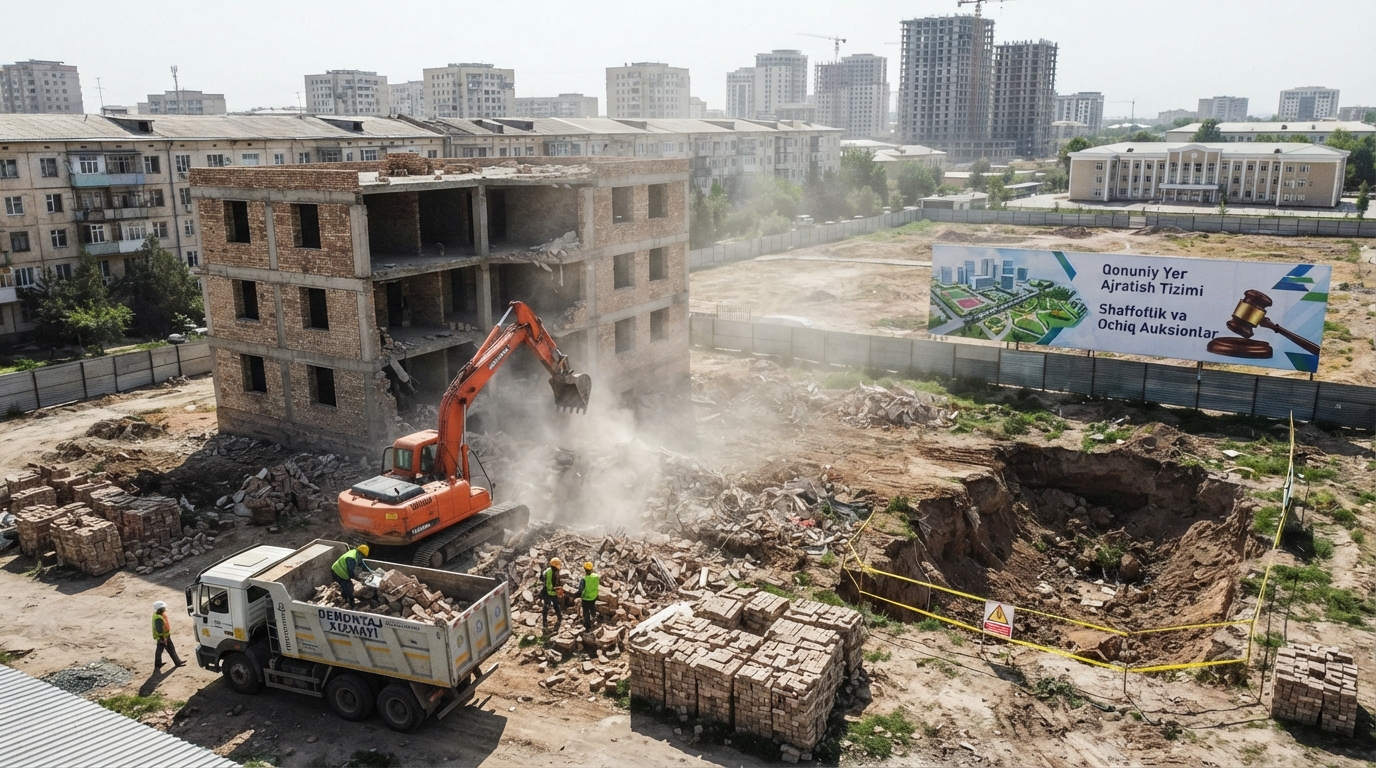
The collapse of soil at a construction site in the Almazar district on August 2 prompted renewed attention to the previous system of urban land distribution. While reviewing documents related to this project, journalists discovered that the site, previously occupied by School No. 243, was transferred to a private company in 2020 without an open auction. This occurred under the then-current mechanism for the sale of state property with investment obligations.
According to the documents, as of the end of 2019, School No. 243 was the legal owner of the building and land plot, totaling 3,006 square meters. As early as May 2020, the territorial office of the State Assets Management Agency entered into a property purchase and sale agreement with DONMAH-IMEX, with investment obligations. Ownership was registered in August 2022.
However, the transaction price, the reasons for selecting this particular company, the nature of the investment obligations, and the reasons for changing the purpose of the former educational facility remain unknown.
As noted in the investigation, prior to the introduction of mandatory auctions, several mechanisms for allocating land without competitive bidding were in place in Tashkent. In addition to khokims' decisions to allocate land plots for development, an experiment to improve the investment climate was in place since 2018, allowing entrepreneurs to obtain specific plots for investment projects without open bidding. Furthermore, state property purchase and sale agreements with investment obligations were also used.
The mechanisms themselves were stipulated by the legislation in force at the time and were not considered illegal. However, the lack of a competitive procedure makes it difficult to assess why a particular investor was selected, how reasonable the price of the properties was, and whether investment obligations were subsequently fully fulfilled.
Authorities are currently reviewing decisions made under these mechanisms. Illegal construction was discovered on 254 plots previously allocated under khokim orders No. 574. In 69 cases, the owners voluntarily dismantled the structures. Lawsuits were filed for another 44 plots, 36 of which have already been satisfied, while the remaining cases remain pending in the courts.
Projects that received land as part of the investment experiment were separately reviewed. As a result, 69 contracts with entrepreneurs who failed to fulfill their investment obligations were terminated. The vacated 74.1 hectares of land were returned to the city reserve and subsequently put up for public auction.
At the same time, the land distribution market itself has changed. While 390 land plots with a total area of 105.5 hectares were sold through open auctions in 2021–2023 for a total of 769 billion soums, from the beginning of 2024 to August 1, 2026, 967 land plots with an area of 204.1 hectares were sold for a total of 4.951 trillion soums.
According to the khokimiyat, not only has the number of auctions increased, but also the number of land plots offered for sale in the capital's central districts. However, the authors of the investigation note that direct comparisons of land prices from different years require caution, as the location of the plots, their size, their intended use, and other factors influence these figures.
A review of previously made decisions is ongoing. Authorities continue to clear urban areas of illegal construction, and legal proceedings for a number of properties are still ongoing. Meanwhile, Anhor.uz journalists are awaiting responses to inquiries that should clarify the circumstances of the transfer of the former School No. 243 site to a private investor and the terms of the concluded transaction.