

Zero Waste Fashion: from Uzbek traditions to eco-friendly fashion
On October 15, the "Zero Waste Fashion Festival" of sustainable fashion took place in Tashkent at the "Human House" art gallery. The aim of this event was to popularize conscious and eco-friendly consumption, as well as zero-waste production ("zero waste") in design and craftsmanship. Within the framework of the festival, items and clothing collections created by young artisans and designers according to the "zero waste" principle were presented. [...]
Zero Waste Fashion: From Uzbek Traditions to Eco-Friendly Fashion
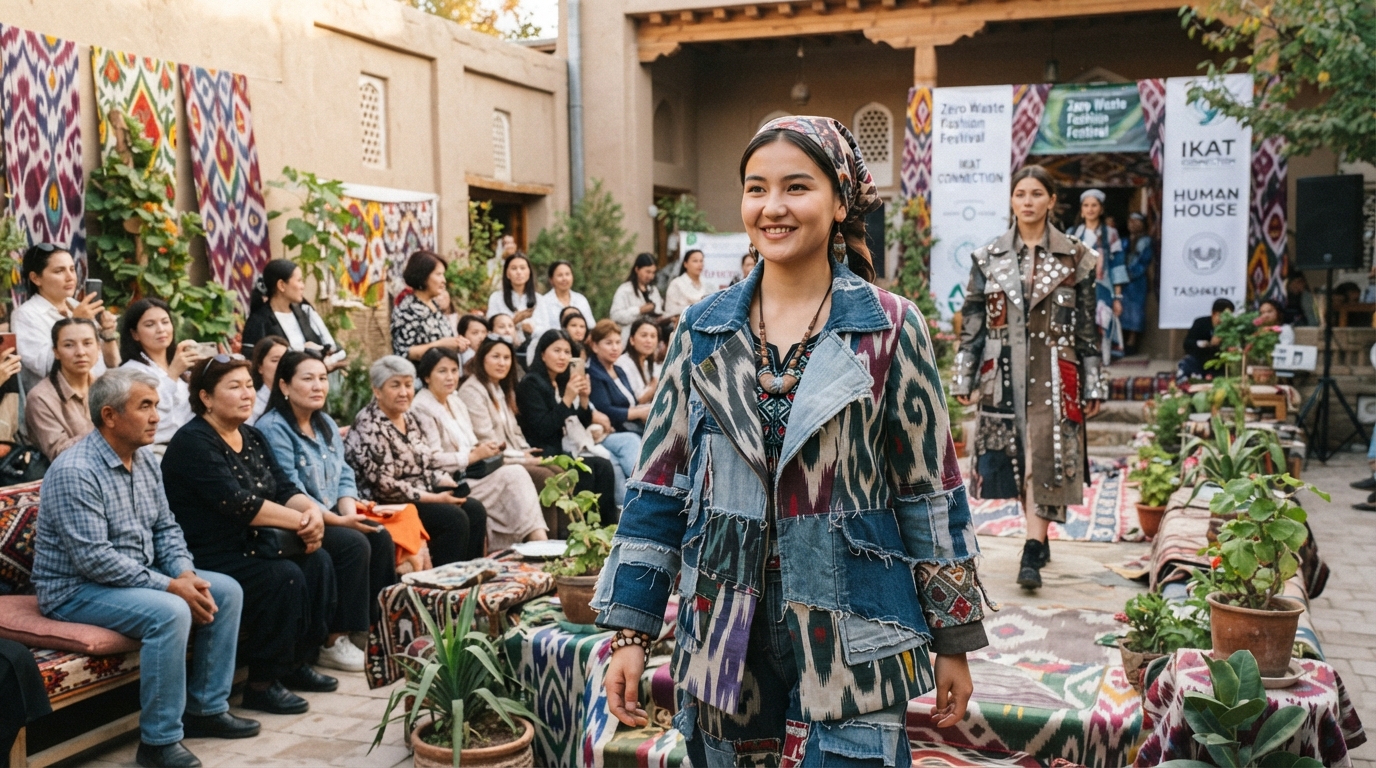
On October 15, the Tashkent art gallery "Human House" hosted the "Zero Waste Fashion Festival." Its goal was to promote conscious and eco-friendly consumption, as well as waste-free production ("zero waste") in design and craft.
As part of the festival, items and clothing collections created by young artisans and designers based on the "zero waste" principle were demonstrated. Among the exhibits were items made from discarded furniture and old metal parts, suits from recycled jeans, reusable diapers, and other works focused on waste-free production and eco-friendly consumption.
According to Lola Saifi, owner and art director of the "Human House" gallery, the idea for such a festival occurred to her long ago when she noticed how attentively today's youth treat ecology.
"We all think about how we will live on, about ecology. And I noticed that more and more young people are thinking about it," she explains. "We meet a lot of young people who recycle various items, separate waste, and care about planting trees. Or, for example, there are Telegram channels in Uzbekistan where young people swap different clothes so as not to throw them away."
A special emphasis at the festival was placed on the exhibition and fashion show of clothes made from abr fabrics. According to Lola Saifi, these fabrics are a great asset and value of the Uzbek people. She notes that in recent years, the market for abr fabrics has been almost completely dominated by Chinese manufacturers; therefore, preserving the traditions of making clothes from such fabrics and developing them in a modern design context acquire special significance. "They are complex, they are inconvenient, they are narrow, they sometimes fade and shrink — but nevertheless, we can work with them and make cool, stylish, modern things out of them that can be worn, that you won't be afraid to wash, and in which you can look spectacular," Saifi declares.
Since 2024, a major international project, "Ikat Connection," created by the National Association of Artisans "Hunarmand" with the support of the European Union and the Swiss "ALIPH Foundation," has been implemented in Uzbekistan, aimed at preserving and developing the traditions of abr fabric production. As part of the project, large-scale scientific research was conducted, and numerous publications were prepared in various languages. One of the directions of "Ikat Connection" was also the "Zero Waste Design Lab" training sessions, prepared jointly with "Human House" specialists.
During these training sessions, young designers — including professionals, beginners, and even students — learned how to properly work with abr fabrics and create modern, original costumes based on them. Following the results of the training sessions, all participants presented their own clothing collections, which combined traditional approaches, modern ideas, and the principles of waste-free production.
As Lola Saifi admits, during the preparation for the training, she made an unexpected discovery for herself.
"I started studying this topic, and it turned out that our grandmothers and great-grandmothers cut traditional chapans precisely in the 'zero waste' style," she says. "And here the circle closed. It turned out that the movement that is now such a trend all over the world, very fashionable, our grandmothers invented and made a long time ago. And that's cool."
Lola Saifi and her colleagues were pleased with the results of the "Zero Waste Fashion Festival" and the high involvement of young people in its preparation. Next year, they plan to hold the festival again — this time on a much larger scale.