

Silk connects East and West
As part of the celebration of the 35th anniversary of the state independence of the Republic of Uzbekistan, as well as in connection with the 100th anniversary of the Textile Museum in Lyon (France), a special fashion show "Silk: From Tradition to Modernity" was held at the State Museum of Applied Arts and Craft History of Uzbekistan. The event was organized by the Bahor France brand, the "Hunarmand" Association of Uzbekistan, and the State Museum of Applied Arts and Craft History of Uzbekistan. Uzbek [...]
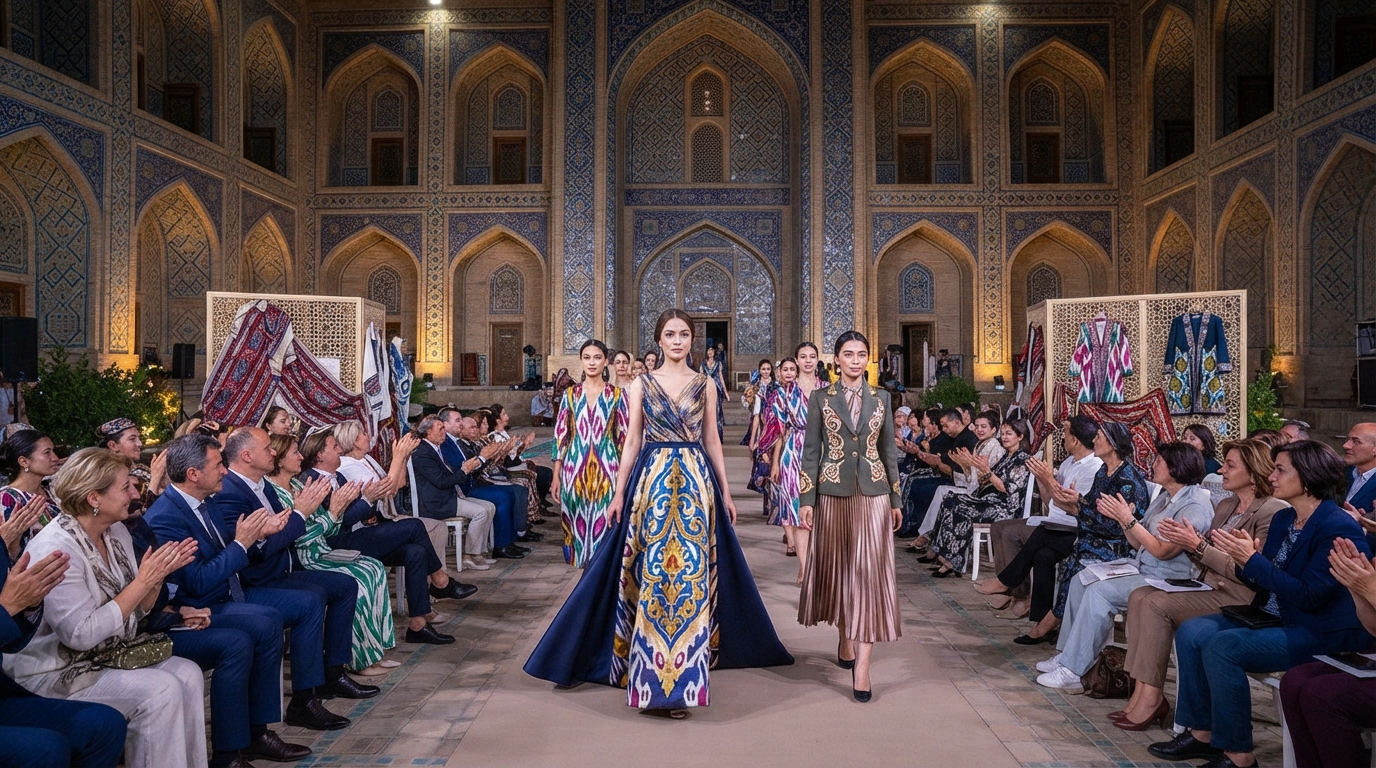
Silk Connects East and West
The State Museum of Applied Arts and History of Handicrafts of Uzbekistan hosted a special fashion show, "Silk: From Tradition to Modernity," dedicated to the celebration of the 35th anniversary of the state independence of the Republic of Uzbekistan, as well as the 100th anniversary of the Textile Museum in Lyon (France).
The event was organized by the Bahor France brand, the "Hunarmand" Association of Uzbekistan, and the State Museum of Applied Arts and History of Handicrafts of Uzbekistan.
Over the centuries, Uzbek silk weaving has shaped a unique culture characterized by a variety of fabrics, national ornaments, and the distinctiveness of decorative art. Lyon in France, in turn, is famous for its centuries-old school of silk and textile production, rich traditions of fabric creation, and significant contribution to the development of world fashion. The combination of Uzbek national color and French textile art with modern fashion trends inspired Navbakhor Bodo, the founder of the eco-brand and atelier Bahor France, to create a new clothing collection.
She was born in Khorezm, then moved to France and founded a premium clothing and home textile brand made of natural Uzbek silk in Lyon. The roots of Bahor lie in Uzbek soil, but it was in France, in Lyon, where they produced a blossoming tree. Lyon connected the fashion designer to her history with a thin and strong silk thread.
"The main source of inspiration for me was our history. In fact, this collection is a journey expressed through the prism of traditional colors. For the Bahor brand, such an abundance of color is an absolute debut, as we are usually associated exclusively with a black-and-white palette. I often visit Uzbekistan, spend a long time looking at local fabrics, and study traditional patterns. All of this provides a colossal creative impulse. Today, I can say with absolute confidence that I have learned to work masterfully and harmoniously with both Uzbek and Lyon silk. It was a deep understanding of the history of our art and cultural heritage that allowed me to take a bold step — to combine them and organically integrate the bright, rich palette of Uzbek colors into a collection that is French in its essence," shared Navbakhor Bodo.
In the atmosphere of the evening courtyard of the State Museum of Applied Arts and History of Handicrafts of Uzbekistan, against the backdrop of its unique facade, framed by samples of national costume by Khalida Kamilova, demonstrating the beauty and originality of women's clothing from each region of Uzbekistan, a magical performance unfolded.
The rich heritage of Uzbek silk weaving received a new sound, merging with the fashion culture of French Lyon. The show demonstrated the wide possibilities of using national fabrics and elements of traditional craft in modern fashion, emphasizing the natural connection between historical heritage and contemporary creativity.
"About three years ago, the 'Bahor' ensemble signed a joint activity agreement with the Bahor brand. We agreed to participate in its shows and implement creative projects together. This is our first joint show. For dancers, working as models is not difficult; they have good body control, know how to hold themselves on stage, and how to move. Therefore, this creative format is interesting to us, and we gladly continue our cooperation. A new big project is planned for next year, which, I hope, will also take place in Lyon. It will not be just a collection show: it is expected to include an exhibition of costumes, as well as musical and dance programs with the participation of the 'Bahor' ensemble," said Gulnara Musaeva, Director of the State Dance Ensemble of Uzbekistan "Bahor".
The event was attended by guests who arrived from Lyon and other regions of France. Among them were the president and representatives of the Association of the Lyon Textile Museum, specialists in the fields of culture, textiles, and fashion, partners of Bahor France, as well as representatives of French cultural circles. Within the framework of the show, an exchange of views and experience took place between designers, artisans, specialists in the field of art and culture, and representatives of the tourism and textile industries of Uzbekistan and France.
"Uzbekistan is an incredibly interesting, useful, and aesthetically beautiful destination. We discovered an amazing country. It is extraordinary, simply magical! The people of Uzbekistan are incredibly hospitable and sweet, your architectural monuments are magnificent, and their restoration has been executed flawlessly. Speaking of promoting Uzbek culture and traditions — for example, the fact that Uzbek atlas is now appearing on world catwalks — I believe that this process in Europe is only just beginning. There is still a lot of work ahead. In the minds of Europeans, the stereotype is still strong that Uzbekistan is just a former Soviet republic; people do not fully understand what the country looks like today and how developed it is. But having come here, we saw the colossal level of development with our own eyes. Now we want to become true ambassadors of Uzbekistan in Lyon and throughout France to actively popularize your stunning heritage," shared Henri Brinderas, President of the Society of Friends of the Museum of Textiles and Decorative Arts in Lyon.
Over the centuries, silk has connected East and West. Today, it acquires a new meaning, helping to promote the rich heritage of applied arts and handicrafts of Uzbekistan, creating new opportunities for the organic integration of national heritage with modern design, and becoming a symbol of cultural cooperation, creative dialogue, and friendship between Uzbekistan and France.