

Youth will make the planet cleaner
How to create an infrastructure that would utilize all resources? As the final of the Green Youth Cup eco-startup program demonstrated, this is precisely what the youth of Uzbekistan is thinking about, offering their own ideas and projects. On October 29, the final of the Green Youth Cup took place, where 16 finalist startups presented their innovative solutions in the field of green technologies to investors and experts. The program is implemented by the Innovation Center […]
**Youth Will Make the Planet Cleaner**
As shown by the final of the Green Youth Cup eco-startup program, this is exactly what the youth of Uzbekistan believe, proposing their own ideas and projects.
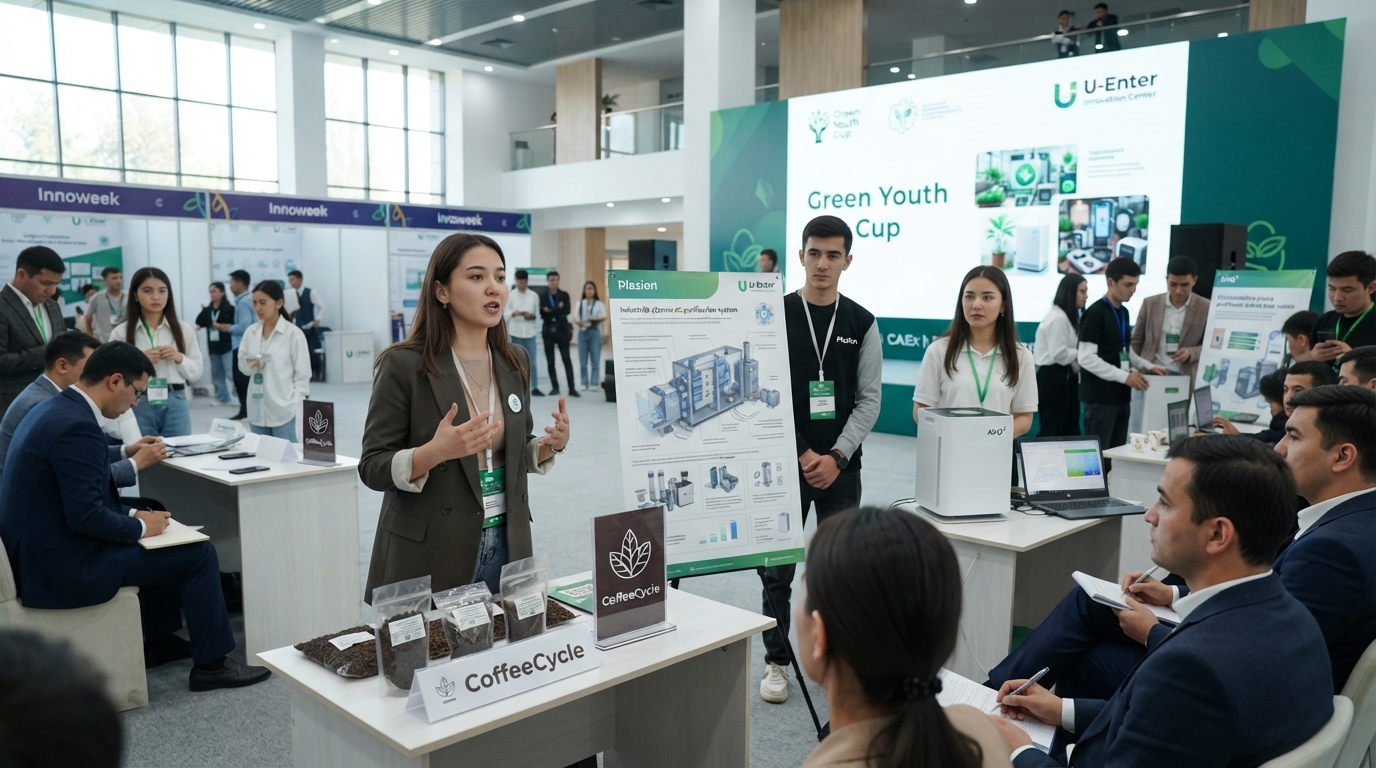
On October 29, the final of the Green Youth Cup took place, where 16 finalist startups presented their innovative solutions in the field of green technologies to investors and experts. The program is implemented by the U-Enter Innovation Center and Intro Group in cooperation with Virtual Accelerate, supported by the governments of Switzerland and the United Kingdom.
Having extensive experience in working with youth startups, the organizers held the final this time at an iconic venue — the CAEx exhibition center, which is currently hosting the Innoweek International Week of Innovative Ideas. Thus, creative youth received additional opportunities to be heard by partners and to get acquainted with innovations from all regions of the country.
The Green Youth Cup launched on October 7, receiving 118 applications, from which 55 startup projects were selected in the first stage. In October, the participants underwent 10 educational sessions with international trainers based at U-Enter, as well as 2 practical business tours.
The startups were presented in Uzbek, English, and Russian, accompanied by presentations and product demonstrations. The participants answered questions from members of a competent jury, and all of this took place dynamically within a strictly allocated timeframe.
As a result, the authors of the three startups recognized as the best receive the opportunity to attend the Web Summit Qatar in Doha, which will take place from January 31 to February 3, 2027.
One of the leaders was the Eco-project CoffeeCycle, which proposes the production of organic fertilizers from coffee waste. Presenting the project, team member Diyora Khasanova noted that this is one of the practical solutions for a circular economy, allowing the conversion of everyday waste into a useful product for plant growing. The innovative fertilizers contain not only coffee grounds, but also other organic components. Work on the composition is ongoing in cooperation with other young specialists, including those in the field of biotechnology. The project has united young people who care about the problem of growing waste and strive to find options for its recycling.
Two more finalists of the Green Youth Cup eco-startup program presented practical solutions to the air purification problem. The Plazion project is aimed at industrial air purification. The team, led by Bekzod Ergashev, consists of students from the Tashkent Institute of Irrigation and Agricultural Mechanization Engineers. The core of their work is a smart plasma air purification system for industrial applications and greenhouses.
Another approach to solving the same problem belongs to another leading project — the AirO² air purifier. The team led by Raykhona Abdiyeva developed a model of an electrostatic air purifier. It is designed for indoor use. Affordability is also among its advantages.
The youth of Uzbekistan demonstrated the brightness of their ideas, their applicability, and most importantly — their active desire to make their own contribution to making our planet cleaner and more environmentally friendly.
For example, the Eco Leaf project is already engaged in the production of original eco-friendly products — manufacturing briquettes from leaves for various uses. As the author of the idea, Ayatulloh Abdujabborov, explained, the leaves of fruit trees, such as dried apricots, sour cherries, and sweet cherries, serve as the basis for feed briquettes that can be fed to cows and sheep; leaves from almost any trees are used for fuel briquettes, which are an alternative to coal. In addition, stronger boards are made from this base, which are used in construction and renovation, for example, as wall insulation, as well as for furniture manufacturing.
Meanwhile, the author of the Ecogenesis project is still a schoolboy, a ninth-grader at one of the Presidential Schools. Otabek Erdonov created an educational product through a game in which participants manage climate and communities, observing how the system reacts. The startup gives a person the opportunity to concretely understand their share in the overall consumption of resources, draw conclusions, and raise people's eco-awareness to a qualitatively new level.
Seventeen-year-old Jasmina Ziyodullayeva — founder of the EcoDataHub startup — plans not just to recycle certain types of waste, but to make their entire system transparent. The young startupper sees eco-activists from different regions of Uzbekistan, pilot schools and organizations, and experts in the field of green technologies as her partners. The platform provides the ability for any concerned person to submit photos and location data, for example, regarding incidents of illegal dumping. Eco-activists can then take up this signal.
The organizers of the Green Youth Cup accomplished the main goal — they gave proactive youth the opportunity to feel the importance and power of their ideas. Investors, who are traditionally invited to the final of startup programs by U-Enter and its partners, are already taking a close look at their startups.