

Young men live in fear of being snatched off the streets and sold to Myanmar's army
A desperate junta is in a war of attrition against ethnic militias and and civilian resistance.
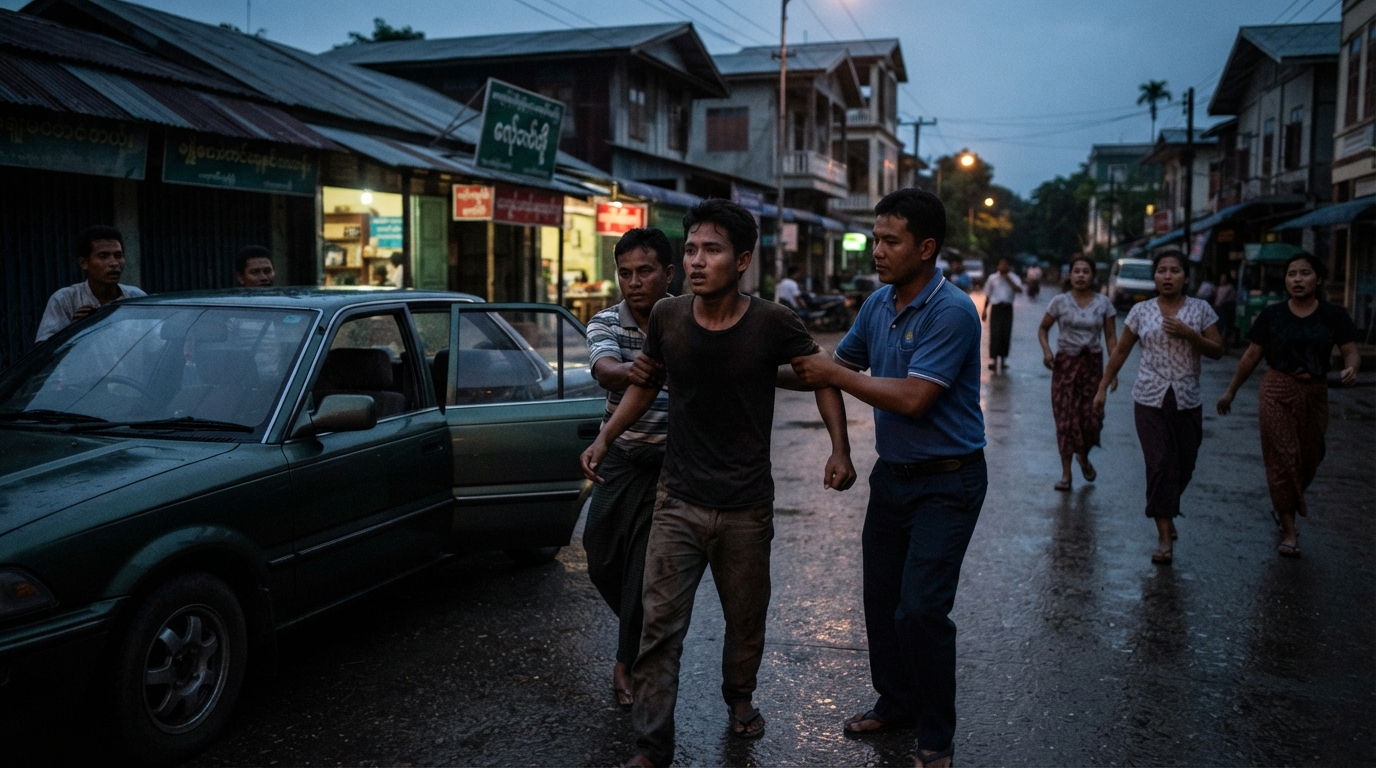
Young men in Myanmar fear being seized from the streets and handed over to the army
Officials in Myanmar have been instructed to push military recruitment quotas hard, a drive that has fueled corruption, extortion and abductions
If you are young and physically fit in Hpa-An, the capital of Myanmar’s southern Karen state, you do not go out after dark. In recent months, that has become common sense.
But Zaw Min has no such option.
“I worry, but I have to go out to work,” says the 26-year-old tuk tuk driver, who asked that his real name be withheld for safety reasons. “My family call me all the time and remind me not to drive passengers too far; to be careful who I take as a passenger... I have to be vigilant all the time.
“People are panicked and frightened,” he says. “Some people I know have been taken.”
Residents say plain-clothed members and supporters of the Myanmar junta have been patrolling the streets of Hpa-An, randomly arresting people in their teens, 20s and 30s and forcing them into military service.
Leaked documents seen by BBC Burmese show that authorities have been told to aggressively meet the military’s recruitment quotas across jurisdictions, strengthening the junta’s forces as it wages a war of attrition against ethnic militias, pro-democracy groups and civilian resistance movements.
Zaw Min is the only sibling in his family who is of recruitment age. Many other “kids” his age have fled, he says — to Thailand, or to relatives farther away. Those who stay are often under strict orders from their parents: be home before dusk.
Myanmar has been trapped in a bloody civil war since February 2021, when its military staged a coup d’état and removed democratically elected leader Aung San Suu Kyi.
Three years later, after a series of humiliating defeats, collapsing morale and rising desertions, the junta introduced a compulsory conscription law requiring all men aged 18 to 35 and women aged 18 to 27 to serve at least two years under military command. Anyone who refuses faces up to five years in prison.
According to Maj Naung Yoe, a military affairs official at the Myanmar Defense and Security Institute (MDSI) and a former military officer who defected and joined the anti-coup Civil Disobedience Movement, the law’s introduction “represents one of the most severe and impactful actions taken against the entire civilian population since the military coup”.
An estimated 100,000 young recruits have been conscripted by the junta since early 2024
Hpa-An is the latest place to be swept up in a dragnet that has already caught an estimated 100,000 young recruits over the past two-and-a-half years — many through coercion, extortion and abductions.
“Security forces track young people’s movements to arrest them, force them into service under the pretext of statutory military eligibility, extort money through threats of detention, and arrest individuals during guest-list inspections,” Naung Yoe says.
The BBC contacted Myanmar’s Central Body for Summoning People’s Military Servants about incidents mentioned in this report, including forced recruitment of conscripts and allegations of abductions in recent months.
They said they had no comment.
With the compulsory conscription law, the junta has built a human supply chain to keep its armed forces going. And it appears to have succeeded. Observers say reinforcements have been crucial in helping the regime regain territory. In many parts of Myanmar, the resistance is now on the back foot.
But the war is still far from over. And as more young people avoid conscription — either to join the resistance or simply to escape armed conflict against their own countrymen — the junta’s recruitment tactics have become increasingly extreme.
International rights groups including Amnesty International, Human Rights Watch and Fortify Rights say Myanmar’s military is abducting civilians and forcing them into military service.
Researchers found that missing-person notices for January rose from four in 2021, before the coup, to 82 in 2025, after the conscription law.
“In practice, much of [the Myanmar military’s] recruitment appears to be carried out through detention, coercion, and disappearance rather than formal call-up, and often without notice to families,” they concluded.
Men and boys made up most of the reported missing persons.
“They are spreading rumours all over the neighbourhood that I sold my husband.”
Ma Moe San Pan says the words through sobs and gasps for breath. She is in her kitchen at home in Yangon, where she last saw her 33-year-old husband, Phyo Wai, on the morning of 8 May 2025.
“We had an argument, and afterwards he left home,” she says. “I was upset and told my cousin about what had happened.”
Ma Moe San Pan’s cousin worked at the local ward administration office, and she asked him to bring her husband back. Two days later, Phyo Wai called her from a military recruitment centre on the other side of the city.
Ma Moe San Pan says the cousin had taken him to the ward office, which then sold him on to another ward for 4 million kyats ($900; £680) to meet that ward’s recruitment quota. The BBC was unable to reach Ma Moe San Pan’s cousin.
In a desperate effort to get him back, Ma Moe San Pan was then cheated out of 4.5 million kyats by strangers who falsely promised to secure his release.
U Maung Maung Lwin, the administrator of the ward where Phyo Wai was taken, later told the BBC that he had played a part in sending him to the military recruitment authorities.
Asked about claims that people were being conscripted outside their home township, he said transfers from other townships do happen when local quotas cannot be met.
But he denied that money was involved in such cases, or in Phyo Wai’s forced conscription.
“[Phyo Wai] told me they said they would help him and made him sign documents,” Ma Moe San Pan says.
“If my husband had been legally selected for conscription through the normal process, I could have accepted that. What I cannot accept is that our own ward administration office allegedly sold him to another ward.
“I also regret placing my trust in my cousin.”
Since Phyo Wai was taken, Ma Moe San Pan has filed police complaints about two issues: the sale of her husband into military service, and the 4.5 million kyats she lost to scammers.
She says police accepted her complaint, but refused her request to add human trafficking charges, saying a human trafficking case could only be filed if someone had been sold abroad.
She does not know where her husband is now.
Ma Moe San Pan’s case shows a grim twist in the junta’s compulsory conscription laws: pressure from the top of the regime has created perverse incentives lower down the chain of command.
Rising demand and shrinking supply have created an illicit market for eligible recruits. And with money involved, security officials have begun arresting young people at road checkpoints, tracking and ambushing workers during their daily commutes, setting traps through fake job ads, and forcibly entering homes, Naung Yoe says.
“Under the guise of the conscription law, these coercive arrests and recruitment drives have effectively transformed into a modern-day slavery and human trafficking enterprise.”
In late August, police in Yangon arrested a Fire Services Department member — part of the home affairs ministry — and his son-in-law for abducting four young men with the aim of selling them for military conscription.
The reserve fire brigade unit commander allegedly lured the men with promises of jobs, brought them to his house and trapped them in a set of purpose-built detention rooms. Police raided the property and arrested him on 25 August. He has since been charged with kidnapping or abducting in order to wrongfully confine a person, and faces up to 7 years in prison.
BBC Burmese made several attempts to contact the police station where he is being held, but was unsuccessful.
“Lower-level administrative bodies, military personnel and local criminal gangs employ diverse tactics to press-gang and arrest young people,” Naung Yoe says.
“They sell these individuals to military units and regional commands facing manpower shortages, or traffic substitute recruits on behalf of wealthier individuals seeking to buy their way out of service.”
Although conscription orders are, on paper, indiscriminate — requiring a quota of recruits from each village, ward or township in proportion to population — wealthier conscripts can simply pay to avoid the draft and be replaced by someone less financially secure.
As a result, the poor bear the burden disproportionately.
Naung Yoe also told the BBC that “these practices are escalating due to increasing difficulties in meeting monthly recruitment quotas and the lucrative financial profits made from recruit trading at the ground level”.
But the tightening grip of forced conscription also exposes the junta’s weakness, and its need for manpower.
It “seems to be another step in the junta’s efforts to enlist unwilling youth in a conflict that underscores its embattled position in the civil war,” says Dr Sandeep Singh, a research fellow who teaches military studies at the National University of Singapore.
The atmosphere around routine abductions, he adds, has “generated further difficulties on the youth of Myanmar, already affected by years of civil war, and their families”.
Beyond the daily anxiety of life in Myanmar, many would-be recruits now fear being forced into a deadly conflict they not only do not believe in, but actively oppose. That constant threat has driven massive internal displacement and severe labour shortages in an already struggling economy, and pushed people to flee to neighbouring countries.
After spending more than half a decade at war with its own people, the junta is now using the conscription law as another instrument of subjugation, observers say.
As the MDSI said in a statement published in June: “The generals have benefited by using military law to make the citizens fight against each other.”