

You rejoice too soon, citizens.
Public sector salaries and stipends will increase by 7%, and fines will be increased: what has changed in Uzbekistan since September 1, 2026
Don't be too quick to rejoice, citizens.
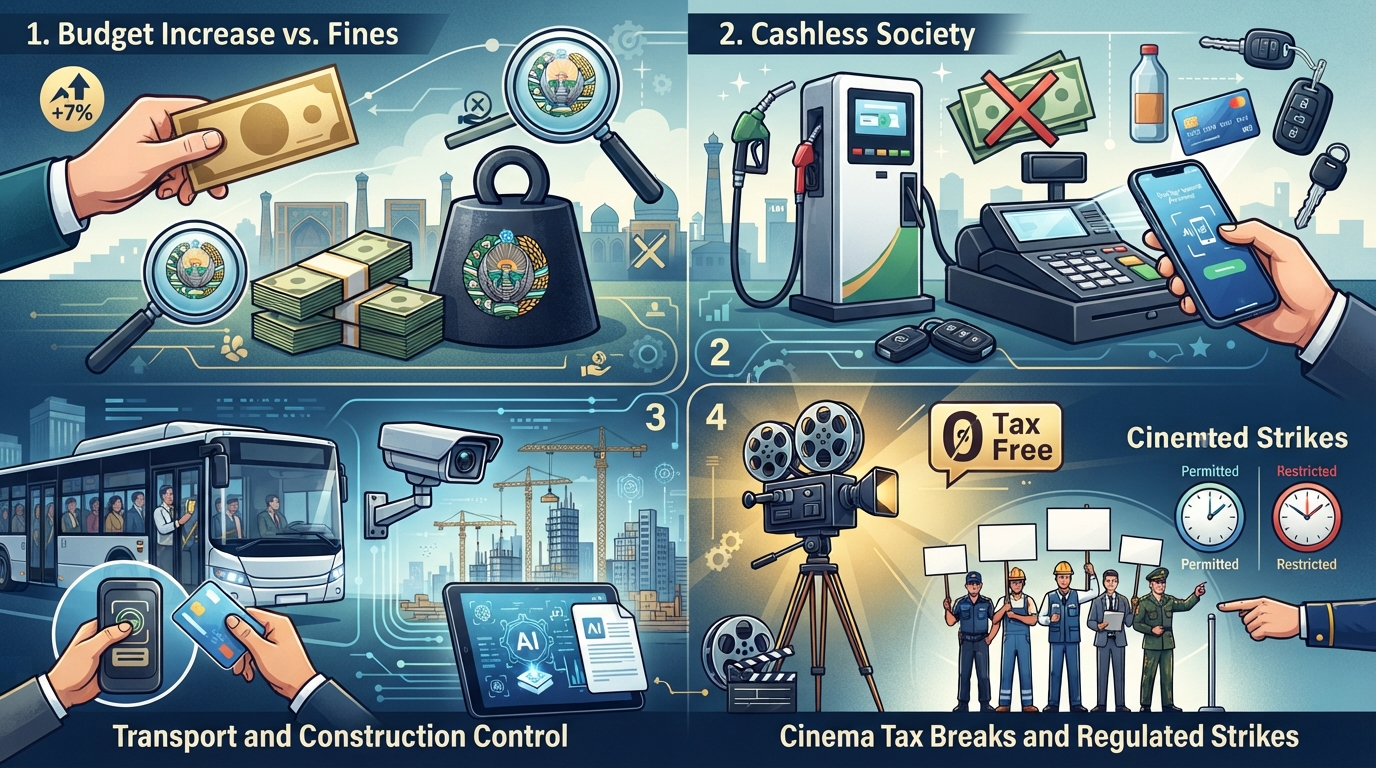
Starting September 1, the Uzbek authorities are introducing a number of changes: raising public sector salaries by 7%, significantly increasing fines, granting the film industry a ten-year tax holiday, and banning cash payments for purchases over 176 million soums.
Citizens' Wallets Under the "State Microscope"
These changes affect citizens' financial situations. The minimum wage (MW) is increasing to 1.36 million soums, and the Basic Calculated Value (BCV) to 440,000 soums. This isn't just a technical adjustment, but a catalyst for a chain reaction: vehicle registration costs, notary fees, state duties for entrepreneurs, and fines are all increasing. For example, registering a passenger car will now cost approximately 3.1 million soums, and the license plate fee will be 2.42 million. Notarial registration of a used car purchase will increase to 1.32 million soums.
The increase in the basic calculation value automatically entails increases in dozens of payments that the average citizen might not even have time to track.
Public sector salaries and stipends will increase by 7% according to a decree issued by President Shavkat Mirziyoyev on June 23. Pensions and benefits were indexed back in July. It's important to note that the costs of these increases, as stated in the document, "are covered by the State Budget and the extra-budgetary Pension Fund under the Ministry of Economy and Finance." The budget fully covers these costs.
At the same time, Uzbek authorities are restricting cash circulation. Any purchase exceeding 400 basic calculation values (176 million soums since September) can only be made by bank card or through an electronic payment system. Alcohol, tobacco, fuel at gas stations, real estate, and cars less than ten years old are now all paid for by bank transfer. In effect, the state is striving for digital transparency in the economy, weaning citizens off cash.
Cameras, validators, and a fare dodger for 440,000 soums
The transport reform will likely be the most noticeable change for ordinary residents. On buses operating under gross contracts, payment is now mandatory upon boarding. There are many payment methods: transport card, smartphone, NFC, QR code, biometrics, but the bottom line is the same: if you don't present your card, you're a fare dodger. The fine for a first offense is proposed to be increased to 50% of the minimum wage (220,000 soums), and for a repeat offense, to the full minimum wage (440,000 soums). This is five to ten times higher than the current 41,200 soums. The proposal is still under consideration by the Oliy Majlis, but the trend toward stricter regulations is clear.
At the same time, vehicles with gas-powered equipment are subject to digital control. If the vehicle fails the technical inspection, it won't be refilled. If the tank's expiration date has passed, it won't be refilled. Automatic verification is carried out through the U-Gas and Eco-Himoya systems. No amount of persuasion at the gas station will help.
The construction industry is required to install CCTV cameras at all new construction sites—from apartment buildings to hotels and industrial sites. Publicly funded construction projects are subject to this requirement if the project cost exceeds 3 billion soums. Furthermore, as-built documentation will be converted to digital format, eliminating the requirement to require paper copies. Construction permit applications will be analyzed using artificial intelligence.
Tax-Free Cinema and Scheduled Strikes
The most unexpected set of changes is cultural. From September 1, 2026, to January 1, 2036, film studios, concert organizations, private theaters, children's content creators, and non-governmental educational cultural institutions will be completely exempt from VAT, income tax, turnover tax, property tax, and land tax. Employees of these organizations do not pay income tax. Foreign companies involved in film production in Uzbekistan are exempt from withholding tax. Ten years of absolute tax freedom.
Winners of international competitions receive a one-time bonus of up to 300 million soums for the Grand Prix, and mentors receive a salary supplement of up to 100% for a year. Travel expenses are covered by the state. These changes are not simply a support for culture, but an attempt to transform Uzbekistan into a regional center for film production and other forms of popular culture.
The law on strikes, which comes into force on September 12, deserves special mention. Workers have the right to strike by giving one month's notice to their employer. Participation is strictly voluntary, and their jobs are protected. However, civil servants, military personnel, police officers, energy workers, communications workers, and water supply workers are prohibited from striking. The fine for an illegal strike ranges from 3 to 7 basic accounting units. The state provides a means of protest, but also clearly defines who cannot use it.
Starting September 1, 2026, Uzbekistan will simultaneously increase the minimum wage and introduce fines that could wipe it out. The film industry will be granted ten years of tax exemption, and cameras will be installed at every construction site. Strikes are now permitted, but also prohibited.