

What will change in Uzbekistan from September 1: salaries, taxes, cars, and new benefits
What will change in Uzbekistan from September 1: salaries, taxes, cars, and new benefits
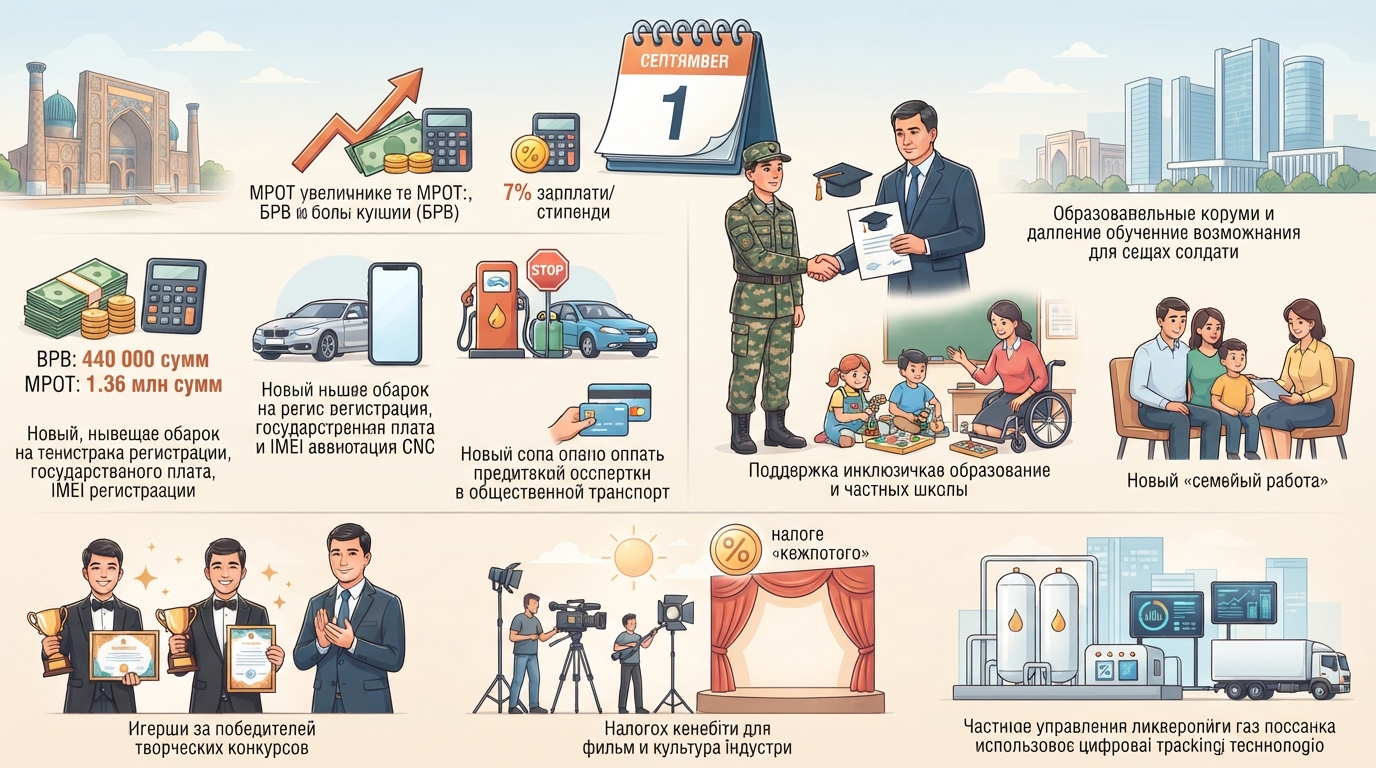
Starting September 1, 2026, a number of significant changes will come into effect in Uzbekistan, affecting various aspects of citizens' lives, including income, the tax system, transportation, education, social benefits, and culture.
In particular, the minimum wage (MW) and the basic calculation value (BCV) are expected to increase. Public sector employee salaries and stipends will increase by 7%. Car and mobile device registration rates will also be updated. The film industry and cultural organizations will receive significant tax breaks.
In its traditional review, Podrobno.uz analyzes the key September changes that will impact the financial situation of Uzbeks, the social sphere, education, and the functioning of certain industries.
**Wages and New Expenses**
One of the main changes is the adjustment of the basic indicators on which many payments and payments depend. Starting September 1, the minimum wage will be 1.36 million soums per month, and the minimum monthly wage will increase to 440,000 soums. This will automatically lead to changes in the fees and charges calculated based on the minimum monthly wage.
In particular, vehicle registration will become more expensive. Registering a passenger car will cost approximately 3.1 million soums, while registering an electric vehicle will cost 660,000 soums. The fee for obtaining a state registration plate will be 2.42 million soums, and for a registration certificate, 308,000 soums. The notary fee for purchasing a used car will also increase to 1.32 million soums.
Phone registration costs will also change. The standard IMEI registration fee, which amounts to 20% of the minimum monthly wage, will increase to 88,000 soums. If a device is registered after the established deadline, the fee, equal to 25% of the minimum monthly wage, will be 110,000 soums.
For individual entrepreneurs, the increase in the minimum monthly wage also means an increase in a number of mandatory payments. The state fee for registering as an individual entrepreneur through the government services center will be 440,000 soums, while for online registration, it will be 396,000 soums. The monthly social tax for individual entrepreneurs will increase to 440,000 soums.
Starting September 1, salaries and stipends for employees of public organizations will increase by 7%. This is stipulated by the presidential decree of June 23. The increase applies to payments effective September, while pensions and benefits were already increased on July 1.
**For students and military personnel**
Separate changes will affect the education of military personnel. Conscripts enrolled in universities on contract positions will be able to receive a preferential educational loan to cover the first year of tuition. Furthermore, starting in the 2026/27 academic year, they will be able to enroll in distance learning bachelor's degree programs.
New rules will also be introduced for children with special educational needs. Starting September 1, a "family-based" system will be launched in the country. Social workers will assist parents in accessing educational and social services for their children. Specialists will also monitor the child's receipt of necessary assistance.
**Assistance for Children and People with Disabilities**
Support for private schools serving children with special educational needs will be expanded. Institutions opening special education classes will be eligible for subsidies for each student. The amount will vary by region: 11 BRV, or 4.84 million soums, in Tashkent; 9.5 BRV (4.18 million soums) in regional centers and Nukus; and 8.5 BRV (3.74 million soums) in other cities and districts.
Adults with severe mental retardation will also begin receiving care allowances. Muruvvat boarding schools will be transformed into Gamkhurlik centers with expanded rehabilitation and support services. They will accommodate children with disabilities and adults with mental disorders of groups I and II who require care. In addition to basic care, they will have access to sports, creative arts, and programs to prepare them for independent living.
The cultural sector will also receive new financial incentives. One-time prizes will be awarded to winners and runners-up of prestigious international and national competitions. The Grand Prix or first place in an international competition will receive 300 million soums, second place 200 million, and third place 100 million. At national competitions, the prizes will be 100, 50, and 25 million, respectively.
Teachers and accompanists who trained the winners will be eligible for a salary supplement of up to 100% for the year. The state will also cover the participation costs of winners and runners-up of prestigious international competitions and their mentors. These measures will also apply to employees of private schools and creative studios.
**New Tax Breaks for Film and Culture**
Extensive tax breaks are provided for film and other cultural organizations. From September 1, 2026, to January 1, 2036, concert organizations, film studios, companies creating children's content, private theaters and theater studios, and non-governmental educational institutions of culture and art will be exempt from VAT, profit tax, turnover tax, property tax, and land tax. Their employees will also be exempt from income tax. Foreign companies will not pay withholding tax on income from participating in film production in Uzbekistan.
**For Drivers and Passengers**
The changes will also affect public transportation. On buses operating under gross contracts, passengers will be required to pay fare immediately upon boarding. Payment can be made using a transport card, social security card, or bank card, a smartphone, or devices supporting NFC, QR codes, or biometrics. Passengers who fail to pay their fare and confirm their eligibility for a discount will be considered fare dodgers and may be fined.
New requirements are also being introduced for owners of vehicles with gas-powered equipment. Starting September 1, vehicles without a passed technical inspection will no longer be able to refuel with gas. This restriction will also apply to vehicles with expired gas cylinders or those lacking the necessary permits. Inspection will be performed automatically through the U-Gas and Eco-Himoya information systems.
Another major change concerns the liquefied petroleum gas (LPG) market. Starting September 1, the functions of supplying liquefied petroleum gas to households and social facilities will be transferred to private operators under trust management and outsourcing agreements. Private companies will be selected through electronic tenders, and the reception, storage, and delivery of gas will be digitized. Face ID will be used to identify recipients, and cylinders will be electronically labeled for tracking their condition.