

You can't forbid eating beautifully
The restaurant bubble: how many establishments can Central Asian cities sustain
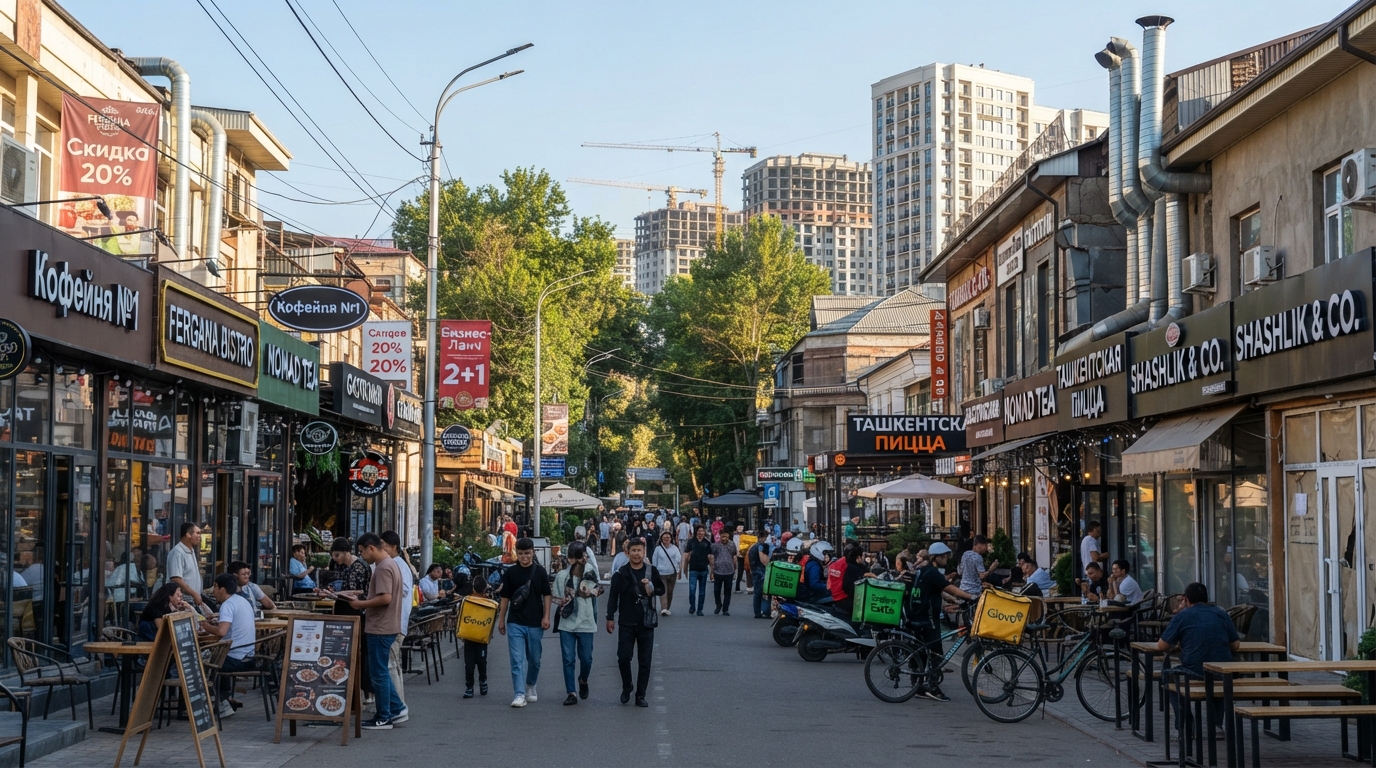
You Can't Forbid Eating Beautifully
Cafes in the cities of Central Asia are gradually ceasing to be a rarity and are turning into a common way to invest relatively small capital.
Just 15–20 years ago, opening a fully-fledged establishment was possible only with serious connections, access to a suitable space, a complex supply system, and significant investment. Now, equipment can be purchased in installments, furniture ordered from a local manufacturer, the menu assembled from semi-finished products, promotion conducted through social networks, and delivery outsourced to a digital platform. A small coffee shop is sometimes launched for $30,000–$50,000, and a medium-format cafe for $100,000–$250,000. In Bishkek, Almaty, Astana, Tashkent, Dushanbe, and other rapidly growing cities, public catering has become one of the most understandable types of business. People see queues at popular establishments every day and draw a simple conclusion: if the tables are occupied, the market continues to grow. But the visitor sees revenue, not expenses. They do not know how much rent costs, what percentage of products is written off, how many employees have changed over the year, how much debt has accumulated to suppliers, and what discount had to be given to the delivery service. The restaurant market can look prosperous even when a significant portion of its participants are already operating without profit. This is usually how the overproduction of cafes begins: establishments continue to open by inertia, even though the number of solvent visits is growing slower than the number of seats.
The market limit is determined not by the population size, but by how much money and free time city dwellers are willing to regularly spend outside the home. In a city with a population of 1 million people, almost all residents are theoretically potential cafe customers, but the permanent core of demand may be only 150,000–250,000 people. Some go to establishments several times a week, others once or twice a month, and still others only on holidays. If the average active customer spends $40 a month in cafes, then 200,000 such customers generate a turnover of about $8 million. If there are 1,000 establishments operating in the city, the average revenue of one will be $8,000 per month. For a small venue, this is sometimes enough; for a restaurant with a large area, it is not. If the number of establishments grows to 1,500 while total demand remains the same, the average revenue will drop to about $5,300. In practice, the distribution will be uneven: a few dozen popular places will take a significant share of the money, hundreds of establishments will remain on the verge of profitability, and the rest will constantly change names, owners, and concepts. Formally, the market will continue to grow because new legal entities will be registered and new signs will appear. In essence, however, the industry will enter a mode of constant rotation, where the opening of one cafe will be almost imperceptibly accompanied by the closure of another.
The first sign of saturation will not be the mass disappearance of establishments, but an increase in the number of discounts. Cafes will start selling breakfasts at cost price, introducing business lunches, giving away a free drink for registering in an app, lowering prices during unpopular hours, and buying advertising from dozens of micro-influencers. A paradox will arise: the dining room will look full, but the average revenue per guest will begin to decline. A customer who previously paid full price will learn to hop between promotions. With an average check of $10, a 20% discount reduces revenue to $8, but the costs of food, rent, and staff remain almost unchanged. If the cost of food is 30–35% of the check, payroll is 20–25%, rent is 10–15%, and utilities, taxes, delivery, marketing, repairs, and write-offs take another 20–25%, the net profit of a successful establishment rarely exceeds 10–15%. A reduction in the actual price of just 10% can wipe out most of the profit. Therefore, a restaurant can serve hundreds of visitors and still have no money to replace a refrigerator costing several thousand dollars. Large establishments with expensive interiors are particularly vulnerable. Their owners expect that the spacious dining room will be full in the evening and on weekends, but rent, heating, security, and part of the salaries must be paid 30 days a month. A table sitting empty on a Monday afternoon is not just a free space, but an asset that generates no income.
The next stage will be the struggle for staff. With an excess of cafes, the number of professional chefs, managers, baristas, and waiters does not grow automatically. New establishments begin to poach employees, promising a 10–20% salary increase. Turnover increases, service quality becomes unstable, and training costs rise. For a restaurant employing 30 people, replacing even a third of the team in a year means searching for, hiring, and training ten new employees. If each newcomer reaches normal productivity in four weeks, the business loses several hundred work shifts. At the same time, dependence on imported products and complex equipment grows. A coffee machine, oven, cold room, or ventilation system can halt the operation of an entire kitchen section. In a saturated market, repairs cannot be postponed until next month: a visitor who once received a cold dish or waited 40 minutes for an order has dozens of alternatives within a radius of a few kilometers. An excess of supply makes the consumer more demanding, but does not necessarily make the industry more resilient. Quality improves among strong operators, while weak ones try to save on raw materials, portions, ventilation, sanitation, and staff.
At this point, it will turn out that the scarcest resource in the restaurant market is not a name, a recipe, or a social media page, but the premises. A good cafe needs a ground floor, a visible entrance, sufficient electrical power, water, sewage, ventilation, the ability to accommodate a kitchen, access for suppliers, and at least minimal parking. It is desirable to have offices, housing, a university, a shopping center, or a pedestrian route nearby. There are far fewer such properties than it seems. An ordinary commercial space can be turned into a shop, salon, or office, but converting it for a kitchen requires dozens of technical solutions. A ventilation duct cannot be run through just any building, additional electrical power is not available everywhere, and complaints from residents about smell, noise, and night visitors can shut down a successful establishment. Preparing a 200-square-meter property can require $100,000–$300,000, excluding the cost of the business itself. Therefore, a space where a food service business has already operated gradually becomes an asset in its own right. The property owner gains an advantage over the brand owner: a restaurant can lose popularity in a single season, but a location with good traffic, ventilation, and approved infrastructure will remain in demand.
This is where consolidation will begin. Successful chains will be able to occupy vacated sites more cheaply, buy up the equipment of closed competitors at 30–50% of the original cost, and centralize purchasing. An independent cafe buys meat, vegetables, packaging, and household chemicals in small batches. A chain of 20 locations can demand a discount, fix prices for several months, and distribute products between establishments. It can maintain a shared production facility, accounting department, marketing department, repair service, and unified delivery. If a central kitchen prepares sauces, pastries, and semi-finished products for ten restaurants, each of them requires less expensive space and fewer skilled workers. A savings of 5% of turnover looks small for a single cafe, but in an industry with a net profitability of around 10%, it means a 1.5-fold increase in profit. Therefore, a saturated market usually does not destroy public catering. It changes the ownership structure: instead of hundreds of completely independent establishments, groups emerge, each managing several brands. To the visitor, it seems they are choosing between a Georgian restaurant, a coffee shop, a burger joint, and a family cafe, even though all four establishments may belong to the same operator and use the same warehouse.
At the same time, a division will occur between daily and event-driven demand. A significant portion of establishments in Central Asia depends not only on regular lunches, but also on weddings, birthdays, family gatherings, corporate events, and hosting guests. This demand remains culturally resilient, but it is also limited. A large hall for 200 people cannot be filled with celebrations every day, and an urban family will not celebrate events twice as often just because the number of restaurants has doubled. In the daily segment, convenience, speed, a clear price, and proximity to home or work will win. In the event segment, capacity, reputation, parking, and the quality of organization will prevail. Establishments caught between these formats will find themselves in the most difficult position. They will be too expensive for a regular lunch, too small for a wedding, and not distinctive enough for a special trip across the city. This middle zone will be the main source of closures.
Delivery will not save every cafe. It expands the service area, but simultaneously intensifies competition: the customer compares dozens of menus on a single screen and pays less attention to the interior, atmosphere, and waiter's service. The platform's commission, the discount, and the cost of packaging can take 25–35% of the order price. A dish sold in the dining room for $10, after all additional expenses, may bring the establishment less than a sale of $7 directly to a walk-in customer. As a result, kitchens without dining rooms, designed only for delivery, will appear, and some restaurants will reduce their seating areas. However, this market is also quickly saturating. If 50 virtual brands operate in one district, the winner will not be the one with the most original name, but the one that cooks faster, makes fewer mistakes, packages better, and buys products cheaper. The restaurant business will become less romantic and more industrial. The owner will have to calculate the preparation time for each item, staff utilization by the hour, the volume of write-offs, the cost of customer acquisition, and profit per square meter.
For cities, an excess of cafes will have mixed consequences. On the one hand, competition will improve service, expand choice, and force owners to pay closer attention to sanitation, street design, and product quality. On the other hand, the constant turnover of tenants will create vacant spaces, debts, and unstable employment. The renovation of one cafe can last three months, its operation eight months, after which the next entrepreneur will dismantle the interior again. A significant portion of investment will go not toward developing the industry, but toward repeatedly re-equipping the same spaces. Municipalities will have to consider the load on parking, garbage removal, ventilation, water supply, and residential courtyards. One restaurant seems like a small facility, but a street of 30 establishments forms a separate utility system: it needs unloading areas, night waste removal, noise control, and safe pedestrian traffic.
When there are too many cafes, the market will not stop in one day. First, profits will shrink, then the rotation of concepts will accelerate, after that used equipment will become cheaper, and only then will large operators begin to form. Brands will emerge and disappear, while the best spaces will go to those capable of weathering several weak seasons. In the end, the value of a cafe will be determined less and less by the beauty of its name and more and more by the lease agreement, the technical condition of the kitchen, traffic, the database of regular customers, and management efficiency. Central Asia will not stop going to cafes: urbanization, a young population, and changing lifestyles will continue to support demand. But the era when it was enough to open a beautiful dining room and wait for visitors will end. The overproduction of establishments will turn public catering from a fashionable investment into a tough operational business, where the winner will not be the most visible, but the one who most accurately calculates every table, every hour of operation, and every square meter.