

Year after Charlie Kirk's death, conservative students struggle to fill void he left
The assassination sent shockwaves through the conservative youth movement, which students say has lost momentum and a vital figurehead.
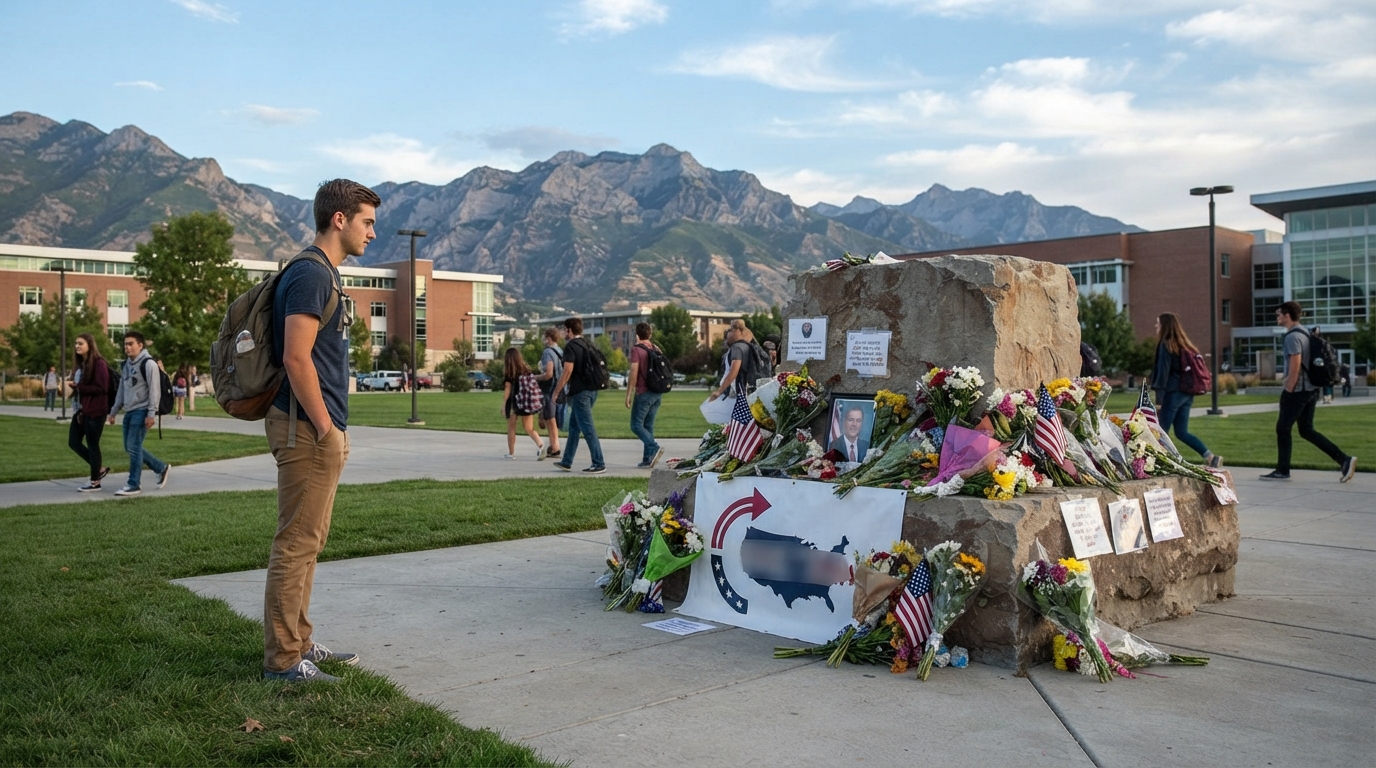
A year after Charlie Kirk’s death, conservative students are still trying to fill the gap he left behind
Jeb Jacobi saw Kirk’s killing at Utah Valley University
Jeb Jacobi still recalls the sound of the gunshot that killed Charlie Kirk.
He was volunteering at a Turning Point USA event at Utah Valley University (UVU), where Kirk was due to take part in one of his well-known live debates on 10 September last year.
But when the conservative activist fell after being struck by a bullet from a sniper rifle, witnesses such as Jacobi say they watched their hero turn into a martyr in front of them.
“It feels like there’s a forever stain on us here,” the third-year university student tells the BBC as he looks back on the year since Kirk’s death. “This is where Charlie Kirk was killed.”
In the aftermath of the assassination, Jacobi and many others believed Turning Point USA (TPUSA), the group Kirk founded, would only expand as Kirk’s name spread even further as a conservative activist.
Now, he says, nobody has managed to fill the gap.
“It’s not the same organisation,” he says. “It just doesn’t have the same power, the same impact.”
By contrast, one TPUSA chapter leader elsewhere in the US rejected any idea that the organisation was no longer what it had been under Kirk, telling the BBC: “this is quite literally just the beginning”.
Right after Kirk’s death, TPUSA saw a surge in support. Five days after the killing, a spokesperson wrote on X that the organisation had received “over 32,000 inquiries in the last 48 hours to start new campus chapters”.
Since then, though, people like Jacobi say the pace has slowed. Current members say there has been internal conflict between more moderate and right-wing factions in the organisation. In Arkansas, one chapter changed its name entirely to distance itself from the Kirk-founded group, unhappy with the direction students felt it was taking.
Utah Valley is in a conservative region, where registered Republicans outnumber Democrats by more than seven to one. But the shooting and its political fallout sparked a kind of culture war, both on campus and beyond it.
Jacobi says his campus now feels more divided than ever.
“The culture has gotten more hostile,” he says.
“I love for everyone to have their own viewpoints and [be] sharing them,” he adds. “The debate is good for society. It’s what Charlie did.”
Kirk built his profile by holding debates on college campuses, where he would argue with people who disagreed with him. His popularity on campuses and online turned him into a rising figure in the Republican Party, and President Donald Trump said Kirk helped get young men to vote for him in the last election.
Critics, however, said Kirk’s debates were meant only to provoke outrage and attract social media attention, while advancing misogyny, racism and homophobia.
Since his death, some UVU students have protested a campus memorial to the conservative activist. They have also tried to block an event marking him from going ahead on Thursday, the anniversary of Kirk’s death.
Anthony Shinkle, another UVU student, points out that the school’s TPUSA chapter and socialist clubs are often at odds on campus.
He worries that Kirk’s shooting, and the politically charged aftermath, have made some supporters afraid to express their political beliefs and pushed others further toward more extreme or fringe views.
“These are impressionable people, impressionable youth,” he said, noting how they watched their political hero “be murdered very, very graphically”.
“I feel like the assassin got exactly what he wanted,” Shinkle, who turns 21 next month, says. “It really feels like there’s not anyone who can fill [Kirk’s] shoes.”
Earlier this month, a judge in Utah cleared the way for the trial of Tyler Robinson, the man accused of shooting Kirk. Robinson denies aggravated murder, a capital offence in the state, along with six other charges.
Jacobi says many people have tried to step into the void left by the 31-year-old activist and father of two.
“Sure, they can echo the conservative message, but they can’t do what Charlie did,” he says. “He had such a way with his words to draw people in, to make them think, to debate, to get people involved.”
“You just don’t see that with anyone else,” he adds. “I don’t know if there will be another him.”
A decline like this is not unusual after the assassination of a central founding figure such as Kirk, says Mark Brewer, chair of the political science department at the University of Maine.
“You have a movement that was started and led by this kind of charismatic figure, and the charismatic figure goes away,” he said. “A little bit of loss of momentum isn’t exactly surprising.”
He says Kirk’s “personal status as a martyr remains very strong. You can see plenty of folks on the right who are trying to claim the… affiliation with Kirk.”
“In some ways, that maybe has only increased,” he said. “Kirk himself, in his own influence of his legacy, I don’t think that’s going anywhere.”
Still, he says, there is “a vacuum”.
Macy Gunnell, 22, launched a TPUSA chapter at St Mary’s College in Indiana after Kirk’s death.
She says she had spent years trying to start one, but only after his death did she get approval.
Gunnell acknowledges divisions inside the organisation, but takes a more hopeful view.
“While there are flying accusations out there that Turning Point is dead, Turning Point’s become something that it never was, Turning Point became everything Charlie hated - that could not be further from the truth,” says Gunnell, 22, who has since graduated and now works in media in Washington DC.
Still involved as a debater with TPUSA, Gunnell visited its headquarters over the summer and met Erika Kirk, the founder’s widow who became CEO, as well as the organisation’s spokesman Andrew Kolvet.
“I’m confident that Turning Point’s not going anywhere, and this is quite literally just the beginning,” she says.
Gunnell is one of the speakers in TPUSA’s new Pick Up the Mic campaign, which is sending debaters to campuses and high schools across the country to continue Kirk’s tradition of engaging in rhetoric. It starts this semester.
Back at UVU, Jacobi also hopes and believes TPUSA will continue to grow. He points to a fellow student who had never been interested in politics but, after Kirk’s death, now helps run the school’s chapter of the group.
“I think it’s still building,” he says.
Kirk’s killing has unsettled Shinkle, whose family in Alabama always told him Utah would be much safer than his home state.
“I kind of feel a weird sense of guilt,” he says. “I feel like it’s a common sentiment, that everyone wishes they could have done something.”
Jacobi, meanwhile, says he turned to religion rather than deepening his ties to politics.
“When Charlie died, I took a look at myself,” he says. “There are so many people who make politics their entire identity. It’s so unhealthy for you.”
“It really made me realise I needed and wanted a relationship with Christ like Charlie had,” he adds. “Ever since I got more involved, I’ve felt much happier and more peaceful of a person.”
And what becomes of Turning Point, Prof Brewer says, is still uncertain.
“The final part of the story hasn’t been written yet,” he said. “So I think a lot will be determined over the next six, 12, 18 months.”