

The blockade in the Gulf will remain, the US wants to bomb drug cartels - daily digest
We will introduce you to the most important events and news that happened in the world over the past day in our daily newsletter.
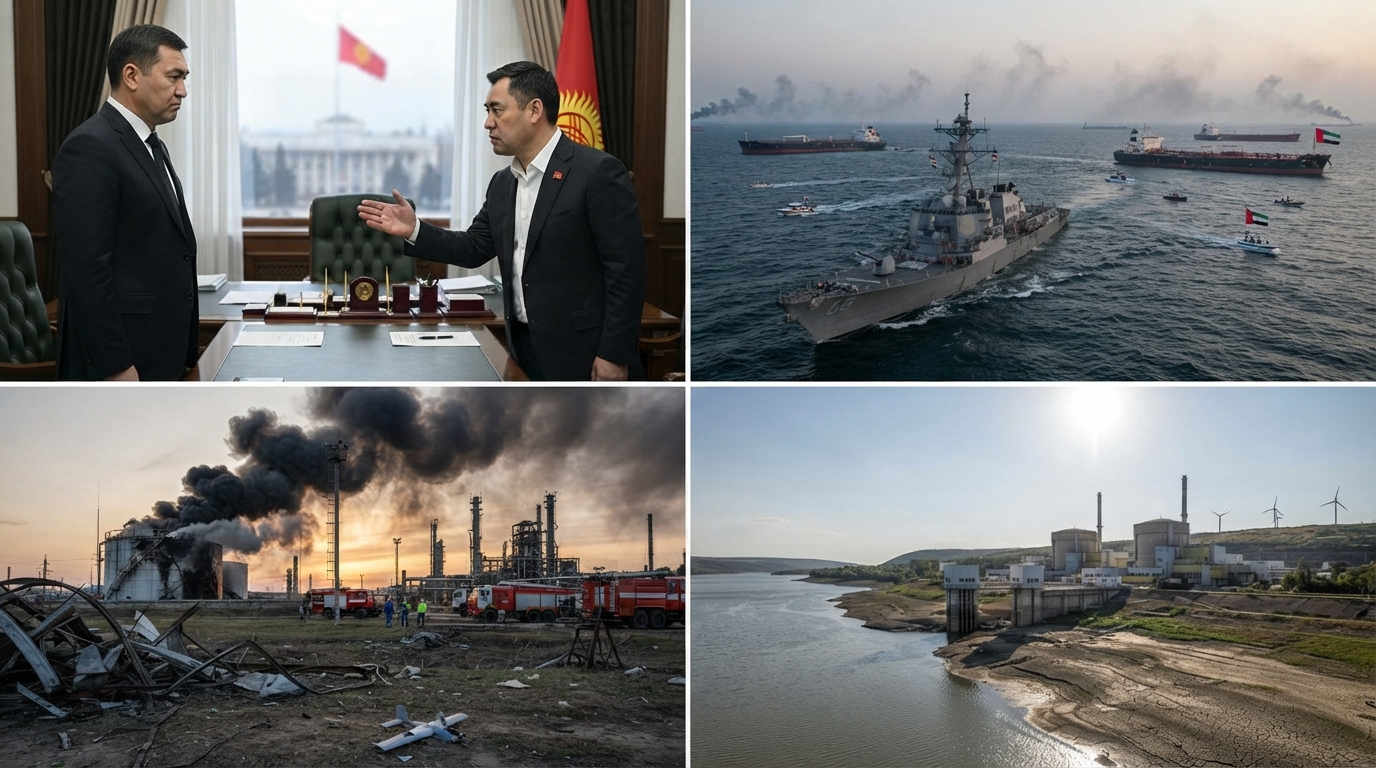
**Blockade in the Gulf continues, US intends to bomb drug cartels - daily digest**
We present a review of the most important events and news that occurred in the world over the past day.
**Japarov spoke about Tashiyev**
Kyrgyz President Sadyr Japarov announced that he plans to leave office in 2027 and support Kamchibek Tashiyev as his successor. However, according to Japarov, he later came to the conclusion that his long-time political partner is not ready for the presidency.
In an interview with journalist Ali Toktakunov, Japarov revealed the canceled succession plan. "Khamchi will become president, and I will resign. I had such a plan," Japarov said.
The president told Tashiyev about this plan about a year ago and urged him to prepare for the presidency. Japarov later concluded that "Tashiyev is not ready for this." He cited the actions of some of Tashiyev's staff and associates, the "letter of 75 people" and signs of division in parliament as reasons for this.
Japarov said he summoned Tashiyev and told him: "This cannot be done, people cannot be divided." He also said he warned Tashiyev that he would be removed from his post.
He noted Tashiyev's work in the security services and his great contribution, but said he needed to rest and think about where he had made mistakes.
Japarov also personally confirmed that he intended to run for another term in 2027. "I intend to run for another term and continue my work," he said, according to Reuters.
**US to increase pressure on Iran**
US officials have said that Iran could maintain its naval blockade indefinitely and will increase economic pressure on Tehran.
"The US Navy can maintain such a blockade indefinitely because we are replacing ships as we have been doing and we will continue to do so," US Defense Secretary Pete Hegseth said.
Treasury Secretary Scott Bessant said the US is planning to inflict further financial damage on Iran.
"Stay tuned for new announcements coming next week because we are going to take measures that have never been seen before in the history of economically isolating a country," he said.
These days, ceasefire talks in the Middle East have collapsed, global oil supplies are shrinking and regional tensions are escalating.
After the initial agreement in June collapsed, Iran is trying to influence Washington by controlling the Strait of Hormuz in response.
In particular, on Thursday evening, two ships belonging to a UAE state company were attacked. The UAE government condemned this as an Iranian attack.
US President Donald Trump has come under pressure to end a war that his people do not fully support. Trump has repeatedly stated that the US has "complete control" over the strait. But Iran denies this.
**Russia-Ukraine war**
Military actions between Russia and Ukraine continued on Thursday. In particular, the Wildberries company reported that a fire broke out at its facility in Bashkortostan as a result of an air strike. This is at least the 18th fire at the marketplace warehouses since July.
On Thursday morning, Ukrainian drones attacked the city of Salavat, where the Gazprom oil refinery is located.
In Orenburg, for the second time in recent days, drones attacked the city of Orsk, where the oil refinery is located. According to the governor, the plant has been suspended and repairs may take six months.
The Russian Defense Ministry attacked ports in the Odessa region on Thursday night.
In addition, a Russian drone hit a passenger train locomotive in the Odessa region. According to the BBC, the driver and his assistant were killed as a result. The train passengers were evacuated, none of them were injured.
**US-Colombia relations**
US Defense Secretary Pete Hegseth raised the possibility of a joint strike on armed groups in Colombia.
Colombia has authorized “joint military operations to eliminate terrorists and terrorist networks,” Hegseth said at a meeting of the anti-cartel coalition in Panama.
He confirmed that joint strikes against armed groups such as the National Liberation Army and the Revolutionary Armed Forces of Colombia were discussed.
“Designated terrorist organizations, together with partner governments, are legitimate targets of the United States government, including in Colombia,” he said. Hegseth compared drug traffickers to al-Qaeda or ISIS terrorists.
According to analysts, President Trump’s Latin American policy has expanded far beyond the Panama Canal. Since last September, more than 200 people have been killed in U.S. military raids on suspected drug trafficking boats. In January, U.S.-led special forces overthrew and kidnapped Venezuelan President Nicolas Maduro.
Colombia's newly elected president, Abelardo De La, promised in his inauguration speech to "completely eradicate the scourge of illegal crops." He also pledged to join the "American Shield" program launched by Trump.
**Romania's only nuclear power plant is being shut down**
Romania has begun shutting down its only operating nuclear reactor in the country due to low water levels in the Danube River. The Cernavode plant uses this water to cool its reactors.
The first reactor at the nuclear power plant was shut down in late July. Officials say the second reactor must also be shut down "due to a significant and sustained drop in water levels in the Danube."
Electricity needs are now being met by alternative sources, particularly wind power. Romania has declared an energy emergency for the entire month of August, asking everyone to reduce their electricity consumption.
According to the Romanian Water Resources Management Agency, the Danube is expected to start rising again on August 15th, as rains from the upper reaches of the river gradually reach this part of the river. However, it is not yet known when the NPP will resume its work.
Hungary also announced the suspension of the Paks NPP due to the decrease in water levels on the Danube. In 2026, the Danube became very shallow due to the anomalous heat waves and droughts that have been observed in Central Europe several times.