

Worth Its Weight in Gold: The History of Money – From Rice to Crypto
If cars had existed a thousand years ago, buying one would have required a truckload of salt. At one time, salt was the equivalent of money.
**Worth Its Weight in Gold: The Evolution of Money – From Rice to Crypto**
If cars had existed a thousand years ago, purchasing one would have required a whole truckload of salt. Salt was the currency of the time. Throughout history, this role has been fulfilled by a wide variety of items – from rice and tea to the feathers of rare birds and dog teeth. Alpari experts explain how and why payment methods have changed.
**Economy Without Wallets**
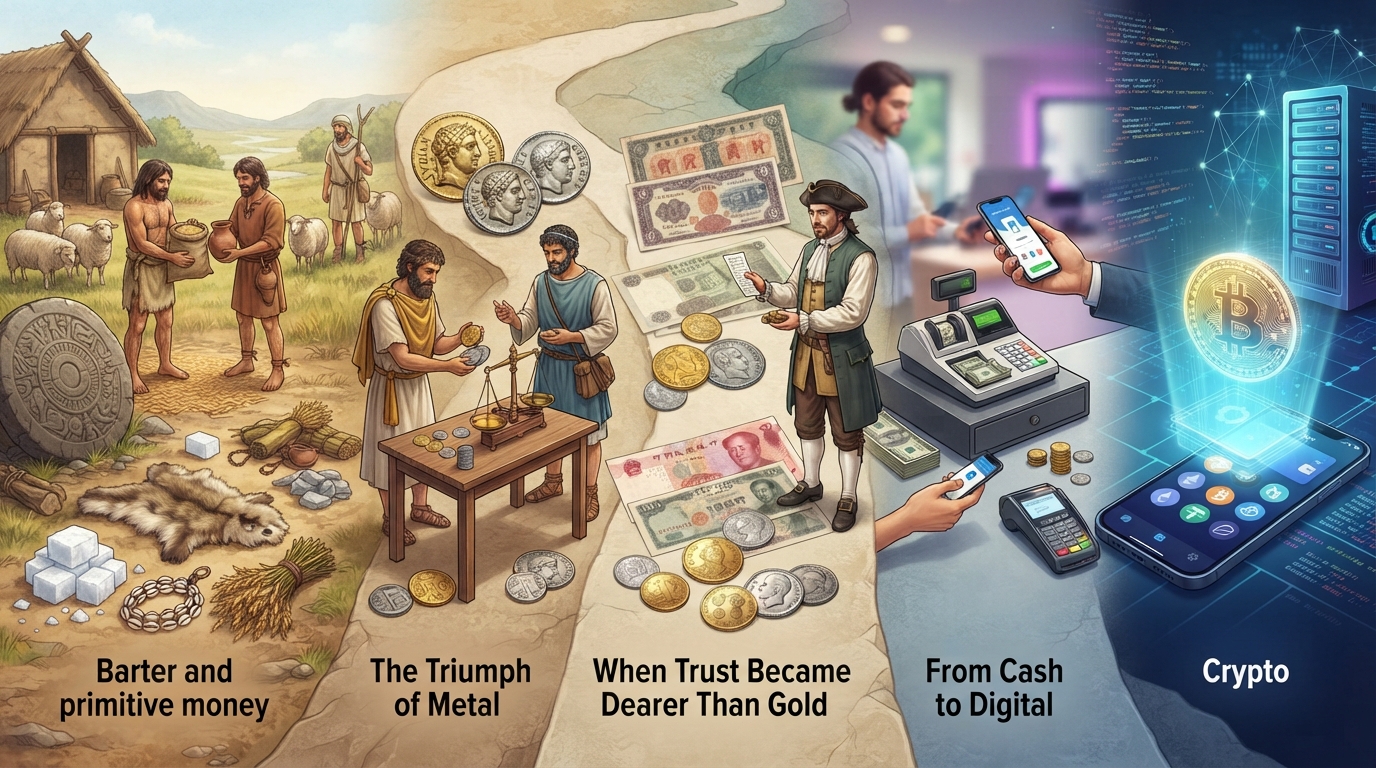
The first human societies were subsistence farmers. People produced everything they needed for life: food, clothing, and tools, so trade as such was nonexistent. If a need arose, they simply traded one good for another. For example, a farmer might exchange part of his harvest for a blacksmith's work, or a hunter might exchange animal skins for pottery. "Money" could literally follow its owner – like a herd.
The difficulty lay in the need for both parties' interests to coincide for a transaction to be completed; otherwise, exchange was impossible. It was also difficult to determine the precise value of a commodity. How many pots is one cow worth? How many kilograms of rice is one pot worth? There was no universal answer.
The problems worsened as crafts developed and trade expanded. Specialists specialized in only one type of activity emerged, and the range of goods constantly expanded. Finding someone who simultaneously needed your product and could offer you what you needed became increasingly difficult. The more diverse the economy became, the more exchange combinations arose. Terms had to be renegotiated for each transaction, and uniform rules of valuation simply did not exist. The economy required a common equivalent of value. Various, sometimes quite unexpected, objects became money.
**When Money Grew on Trees and Grazed in Meadows**
People began to use goods that were universally valued as a unit of exchange: that is, those that were sufficiently rare and durable. Throughout history, salt, furs, tea, cocoa beans, livestock, grain, cloth, whale teeth, cowrie shells, and even dried grasshoppers served as prototypes of money. On the island of Yap in Micronesia, enormous stone disks, some weighing several tons, were used as units of account. The stone was never physically moved; after the transaction, it simply became the property of the seller.
However, there was no universal solution. Some goods perished, others took up too much space, and still others were difficult to divide or transport. Furthermore, not every commodity could be divided without losing value. While grain or salt allowed for precise measurement, livestock or furs were poorly suited for small transactions. This complicated settlements and undermined trust between the parties involved.
**Triumph of Metal**
Then humanity mastered metalworking. Money was made from copper, silver, and gold. During transactions, the metal was weighed and its quality checked, which was time-consuming and inconvenient. The solution was coins, which appeared in the 7th century BC in the kingdom of Lydia, in what is now Turkey.
It was the name of the Lydian king Croesus that became synonymous with wealth. This ruler instituted a monetary reform, during which gold and silver coins were minted separately. Before Croesus, coins were made from an alloy of these two metals, and the amount of each varied in each coin, making it difficult to determine the value of any given coin. A piece of precious metal was stamped with the ruler's official mark, confirming its weight and metal content. Thus, for the first time, the state became the guarantor of the value of money. Buyers no longer had to check the quality of the metal each time, nor did sellers have to convince their counterparties of the integrity of the transaction. If a coin was issued by the state, it was accepted with virtually no additional checks.
The development of trade presented new challenges. Merchants had to deal with dozens of different coins, varying in weight, purity, and value. Large transactions required significant volumes of silver and gold, the transportation of which was expensive and risky. The next step was the idea of abandoning the idea that the value of money was necessarily determined by the amount of metal it contained.
**When Trust Became Worth More Than Gold**
Centuries later, in the 7th–11th centuries AD, during the Tang Dynasty in China, merchants began using paper receipts instead of heavy bundles of metal coins. Gradually, other countries also began to abandon the idea that money necessarily contained precious metal. This is how the first banknotes emerged.
The transition to paper money did not happen overnight. For quite some time, metal coins and banknotes circulated side by side. People gradually became accustomed to the idea that a document certifying the right to a certain amount could be as convenient a means of payment as gold or silver. Just a hundred or two hundred years ago, most currencies could be exchanged for a specific amount of gold or silver. Today, this is no longer the case.
Almost all national currencies are fiat money – their value is determined not by the value of paper or metal, but by trust in the government that issues them. A modern banknote has virtually no material value of its own. But it allows you to purchase goods and services because millions of people daily agree to use it as a medium of exchange. Money has become a social contract. And goods can be purchased with it, including virtual ones. For example, in Forex, you don't buy oil or metals themselves, but a derivative—a kind of bet on the future price of an asset.
**From Cash to Digital**
The past few decades have seen the most rapid change in the history of money. Today, most money exists exclusively in electronic form. For most people, their salary never turns into cash: it's deposited into their account, stored in the banking system, and then used for non-cash payments.
At the same time, the payment infrastructure itself is changing. Money transfers, which could take several days just a few decades ago, now often take a few seconds. For consumers, this seems like a natural development in technology, but behind it lies a fundamental change in the role of money: it is becoming more than just a means of payment, but part of a digital environment where speed and convenience are as important as value itself.
The next stage was cryptocurrencies. Their main difference is the lack of a single issuing center. While traditional currencies are issued by central banks, cryptocurrencies operate on distributed networks and cryptographic algorithms. The most popular cryptocurrencies today are Bitcoin and stablecoins. Cryptocurrency has not replaced traditional money. It has become a new class of digital assets, developing alongside the existing financial system. Some view cryptocurrency as an investment vehicle, while others see it as an alternative way to store wealth or conduct international payments. Thirty-five percent of people would like to use cryptocurrency for everyday purchases (Bitget research).
At the same time, some countries are issuing central bank digital currencies (CBDCs). 41 countries have already launched pilot projects for their implementation. However, the disappearance of cash in the foreseeable future is unlikely. 46% of payments worldwide are made using them. In Uzbekistan, this figure is 53%. In many countries, banknotes and coins remain in demand – as a reserve means of payment, a tool for financial inclusion, and a method of payment independent of communications, electricity, or banking infrastructure. Therefore, today, we are not talking about replacing one form of money with another, but about their coexistence.
Over several millennia, money has evolved from everyday objects to mathematical algorithms. But it was the form that changed, not the purpose. Money continues to serve as a measure of value and a store of value. Perhaps its current form is far from its final form.