

Online currency exchange is growing more slowly than traditional exchange offices in Uzbekistan.
From January to June, individuals exchanged $7.48 billion through remote banking services—27.2% more than the previous year. Through exchange offices, turnover increased by 33.3% to $11.16 billion. Against this backdrop, the share of online exchange decreased to 39%.
Online Currency Exchange in Uzbekistan: Growth Continues, but Slower Than Traditional Channels
According to a review by the Central Bank of Uzbekistan, remote currency exchange transactions continue to grow, but their pace lags behind traditional exchange methods.
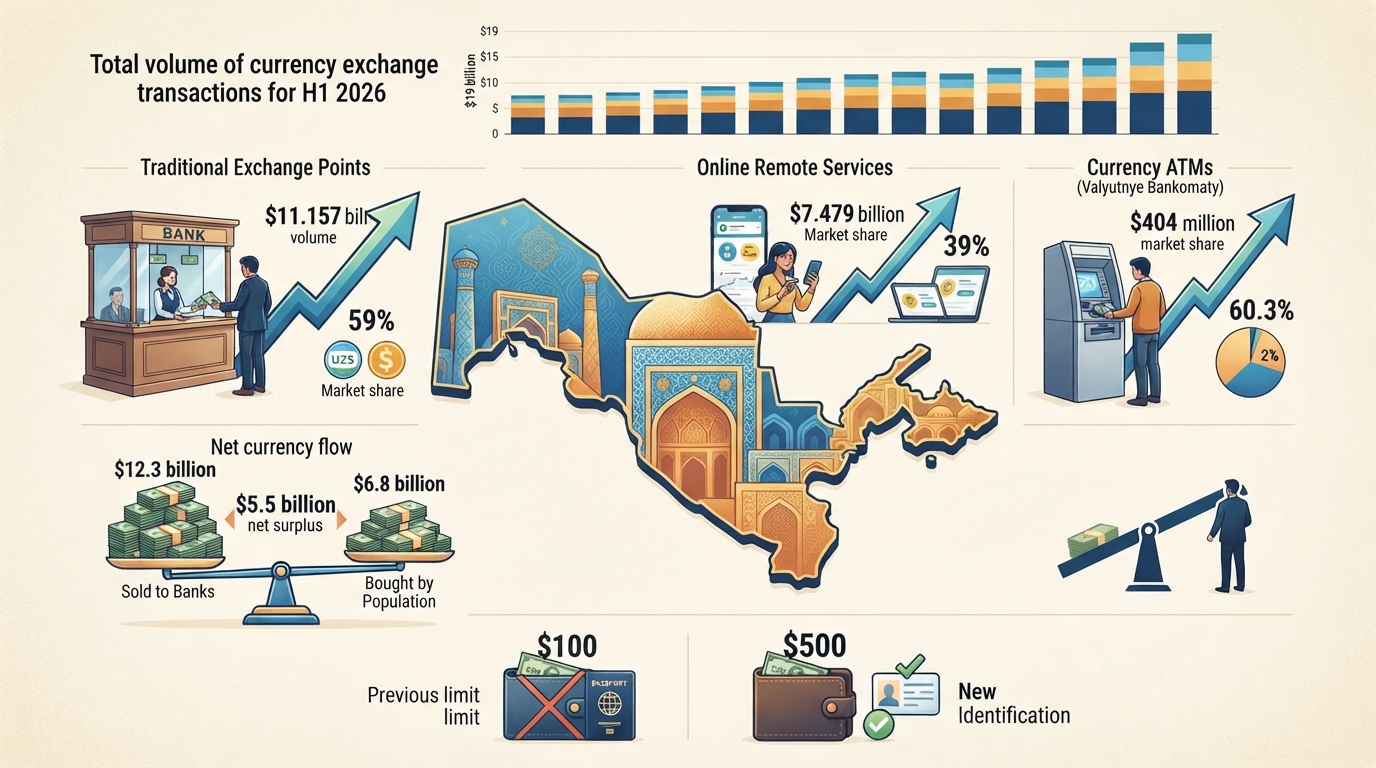
From January to June of this year, bank exchange offices processed $11.157 billion in currency transactions, a 33.3% increase compared to $8.369 billion in the same period last year.
Individuals exchanged $7.479 billion through remote banking services, a 27.2% increase compared to $5.879 billion in the first half of 2025.
Foreign currency ATMs demonstrated the most dynamic growth, with the volume of transactions through them increasing from $252 million to $404 million, an increase of approximately 60.3%. Despite this, this segment remains relatively small, accounting for just over 2% of total household foreign exchange transactions. By comparison, traditional exchange offices account for 59% of transactions, while remote channels account for 39%.
In total, approximately $19 billion worth of transactions were processed through exchange offices, online services, and currency ATMs in the first half of the year.
Notably, despite rapid growth in absolute terms, the share of remote currency exchange in total turnover has declined over the past year. In the first half of 2024, online channels accounted for 37% of foreign exchange transactions; in 2025, this figure rose to 41%, and in the first half of 2026, it fell to 39%.
Currency exchange offices demonstrated a reverse trend: their share decreased from 62% in 2024 to 58% in 2025, after which it increased again to 59% in the first half of this year.
The Central Bank links the development of remote services and 24-hour currency ATMs to the population's increased access to digital banking services. The regulator notes that digital channels ensure 24-hour transactions, reduce transaction costs, and increase the availability of financial services.
Over the first six months, individuals sold $12.3 billion in foreign currency to banks, a 35% increase from the previous year. The volume of currency purchases by the population increased by 26%, reaching $6.8 billion. Thus, the population sold approximately $5.5 billion more foreign currency to banks than they purchased (last year, the difference was $3.7 billion).
The population remains a large net seller of foreign currency. The ratio of net currency supply by the population to total foreign exchange turnover increased from 26% in the first half of 2025 to 29% in January-June 2026.
As a reminder, amendments to commercial banks' internal control rules came into effect on August 9. One of the amendments increases the transaction threshold for which customer identification is not required from $100 to $500. When purchasing foreign currency in cash within the established limit, the requirement to present a passport, ID card, or equivalent document is no longer required.