

Worried Indians turn to start-ups to help care for ageing parents
Changing family structures in India are driving demand for start-ups offering services for eldercare.
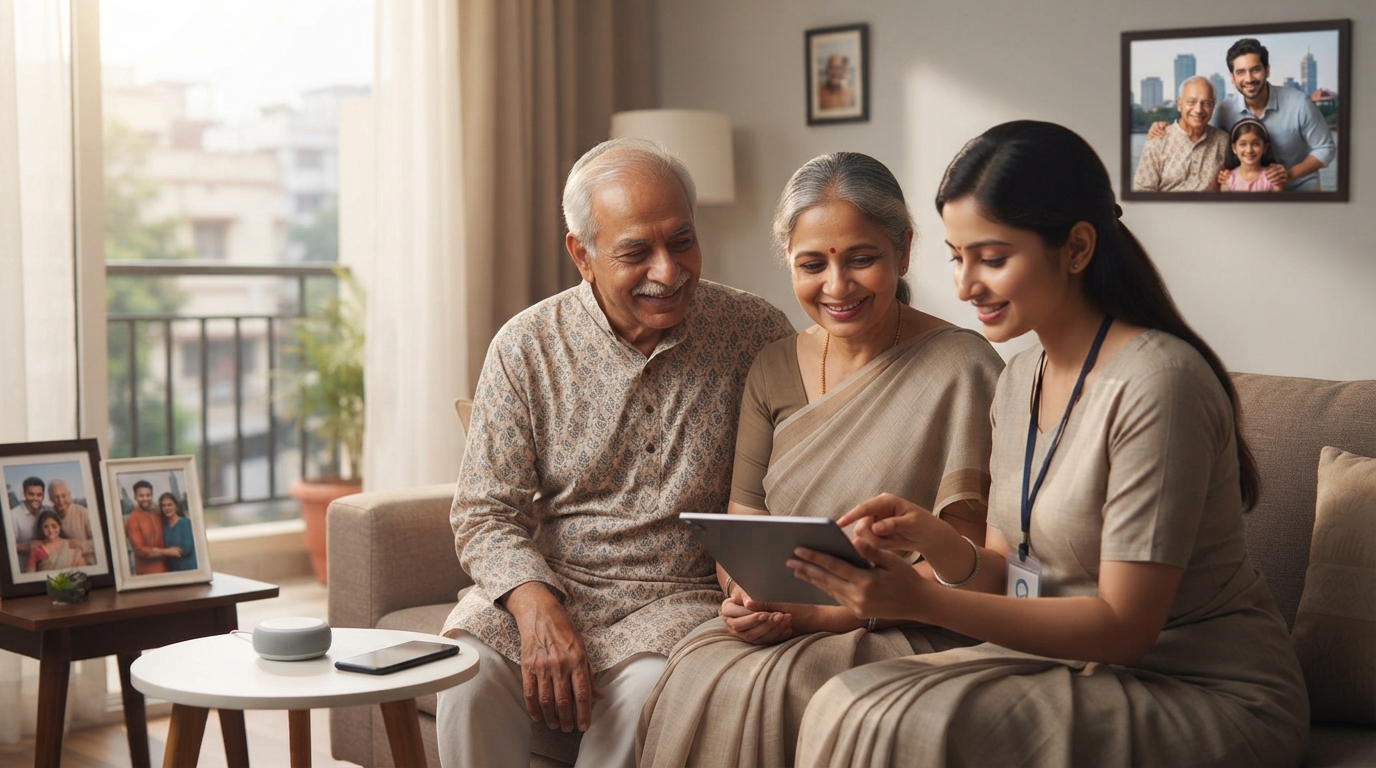
Worried Indians are turning to start-ups for help in looking after ageing parents
One in five Indians will be above the age of 60 by 2050
Arindam Bhattacharyya, an advertising executive in Jakarta, got an unexpected wake-up call in 2024.
His parents, who live in Kolkata in India, were visiting him when his father suffered a health crisis. Bhattacharyya was able to arrange medical care, but when it came time for them to return home, he was left with a question many Indians know well: how do you care for your parents when you cannot be there in person?
According to the United Nations Population Fund (UNFPA), the number of people aged 60 and above worldwide is expected to double between 2020 and 2050, reaching 2.1 billion. India is set to follow the same trend - by 2050, one in every five Indians will be over 60, making up close to 21% of the population.
The UNFPA notes that until a few decades ago, there was little debate in India about elder care because the assumption was that families would take responsibility.
That has become more complicated because of factors such as the decline of joint families. As younger people move away from home, and with limited social infrastructure available to support older people, experts say the gap is only growing.
Some see this as an opening.
Government think-tank NITI Aayog says India’s senior care industry is worth about $7bn (£5.56bn) and is expected to expand quickly, creating major opportunities for healthcare firms.
A number of start-ups are already entering the space. They are targeting areas such as senior living, home care and technology-enabled services. Although their aim is to help older adults live and age more independently, their customers are often the children of the people they serve.
Bhattacharyya says he now depends on two start-ups to track his parents’ health, coordinate care and organise emergency medical help.
"These services are a big help but I still monitor everything closely [from Jakarta]," he said.
One area seeing growth is organised senior living, driven largely by rising incomes and changing family structures. But some experts say demand is far ahead of supply.
Companies such as Manasum Senior Living, Primus Senior Living, Ananta Living and Vedaanta Senior Living are developing projects specifically for senior housing and care, while traditional real estate developers are also showing increasing interest.
Real estate management firm Colliers International Group estimates that current demand for senior living in India is about 2-2.2 million units, while only around 25,000 units are available.
Anantharam Varayur, a former tech executive, co-founded Manasum Senior Living after seeing many older people in India living more restricted lives than their counterparts in the US.
In 2015, when he set up a promotional stall at an event organised by a large Indian community in the US, hoping to attract younger Indians who were familiar with the concept, almost no one came to ask questions. He believes that was because of the "stigma" attached to leaving older family members in an "old age home", as they are traditionally called in India.
But the situation has changed - his company already has 900 operational units, mostly in Bengaluru and Goa, and plans to expand to 10,000 units by 2030, including a luxury project.
It receives enquiries from senior citizens whose children live overseas, couples with adult children who have special needs, older single people, and even younger people planning ahead.
At the same time, many older people still prefer to remain in their family homes or apartments and need support there.
In the past, attendants and nurses were viewed as an extra layer of help for family caregivers. Today, they are often the main caregivers.
What was once a fragmented, highly local market run by small agencies is now seeing the emergence of companies offering end-to-end home-care services and using technology to grow. Among them are Emoha Elder Care Services, Care24 and KITES Senior Care.
But because caregiving is such a sensitive and personal field, recruiting the right staff and keeping them is a major challenge.
"Failure to adequately train the workforce will lead to an acute shortage of skilled people amid rising demand," warns a report by ratings firm CareEdge.
The problem is not only about skills. Caregivers also need careful vetting and specialised training to support a group that is vulnerable to fraud, financial scams and other forms of exploitation.
NITI Aayog has acknowledged this and stressed the need for a national caregiving policy to create a professional and inclusive caregiving ecosystem in India.
Entrepreneurs are also trying to meet clients’ social and emotional needs.
In 2022, former Tata Group chairman Ratan Tata’s investment in start-up Goodfellows drew significant public attention. The company’s tagline sums up its purpose - "Everything Grandkids Do!"
Founder Shantanu Naidu says the goal is not to replace family, but to fill a gap by providing lively, empathetic young companions for elderly clients, whether for some quality time together or simply to help with technology.
While Naidu’s start-up relies on human emotional intelligence, some entrepreneurs are turning to artificial intelligence to tackle practical problems.
In Bengaluru, companies such as Kubo Care and NoBlink.ai combine AI-powered monitoring services with wall-mounted radar devices in homes to track people’s movements and alert emergency services if they faint or fall.
Prajith Nair, co-founder of NoBlink.ai, says the aim is to "build at scale so that it is available at economical and affordable cost".
He says the company currently sells these systems to senior living projects for 13,500 rupees ($141.74; £106.42) per device, plus a monthly monitoring fee starting at 50 rupees per room - one tenth the price of some similar products overseas.
But even though many start-ups are trying to keep prices low, affordability remains a major concern.
The challenge for India is not only senior care but affordable care
Varayur says that buying a one bedroom-hall-kitchen unit in a senior living project can cost 6m rupees, with extra charges for maintenance and food. The price can vary depending on the facilities selected.
Demand is strong, but this remains beyond the reach of most elderly Indians.
NITI Aayog says 78% of India’s elderly population has no pension, which may limit access to these services. Households with at least one elderly person have a lower monthly per capita income of around 3,568 rupees, compared with 4,098 rupees for a household without an elderly member.
That is why experts say start-ups cannot be the only answer.
Japan has tackled the challenges of an ageing population through a combination of long-term care insurance, public nursing facilities, social exchange programmes and community-based support systems. India’s neighbour China has spent years dealing with an ageing population, introducing measures to encourage younger people to marry and increase births as its workforce shrinks.
Earlier this year, Kerala became the first Indian state to pass a landmark law for senior citizens focused on rights to affordable care, legal aid, digital inclusion and safe public spaces.
Industry experts say India still has time before it reaches a demographic crossroads. But caring for millions more elderly citizens will require strong support systems. A robust ecosystem of businesses serving senior citizens could help bridge that gap.