

From 'dog fruit' to darling: India's avocado boom
Demand for avocados is booming in India and local growers hope to grab more of the market.
**From ‘dog fruit’ to darling: India’s avocado boom**
Demand for avocados in India has surged.
Fifteen years ago, there was barely any market for avocados in India, recalls Sunil Bopaiah.
He says ripe fruit would drop from trees and be eaten by dogs, which gave avocados the unflattering nickname “dog fruit.”
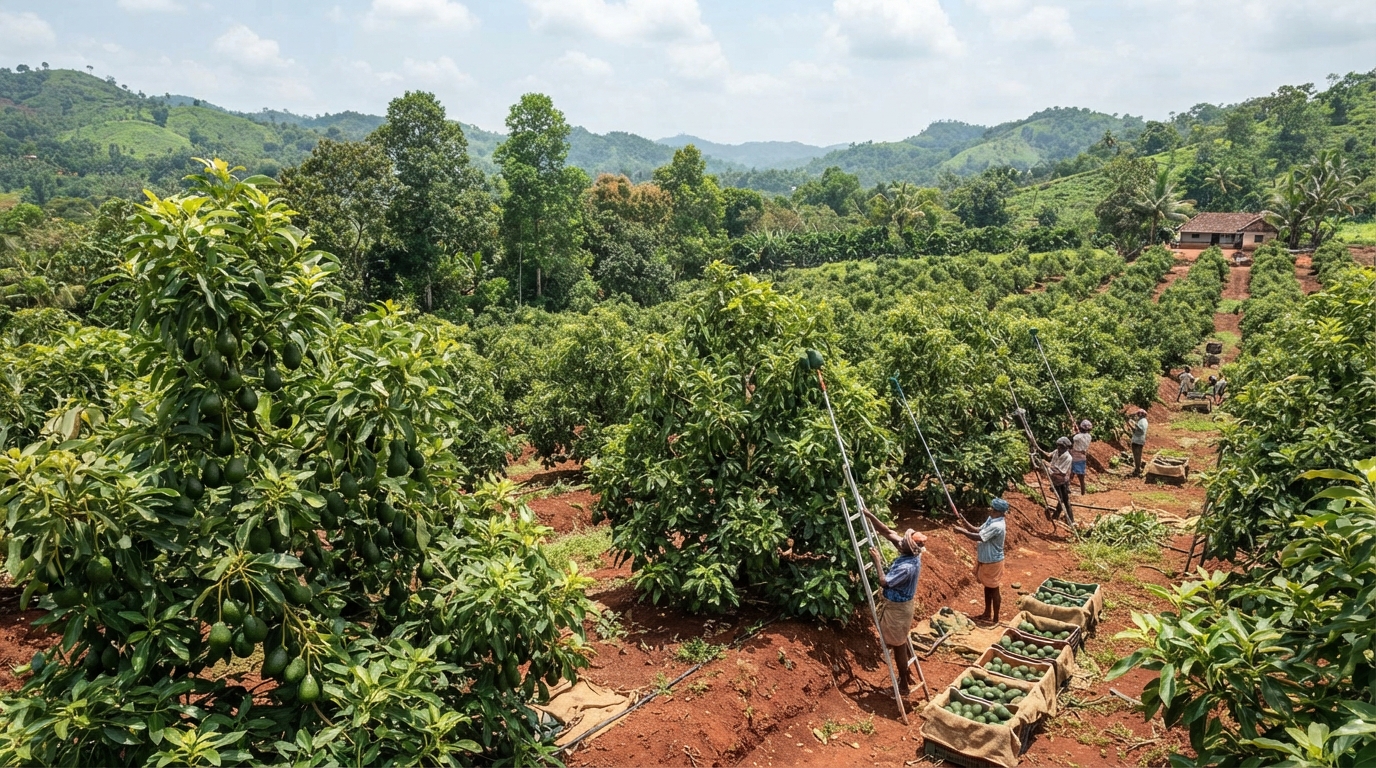
Bopaiah has spent 26 years in India’s plantation sector and is now group manager at Cottanad Plantations, which grows cocoa, rubber, coffee, spices and fruits, including avocado, in the hills of Wayanad in the southern Indian state of Kerala.
“We never planted avocado as our main crop. We introduced it as a shade tree for coffee plantations, and only later realised it could become a profitable business,” he says.
He says the key moment came around 2011, when Bollywood star Shilpa Shetty said she used avocado for skincare.
“Overnight, prices doubled and then kept rising,” he says.
Cottanad has met that demand by planting avocado trees across 40 acres. Last year, it harvested between 10 and 15 tonnes of fruit. In three or four years, it hopes to increase that to 40 to 50 tonnes.
There has been a great deal to learn.
“We completely changed the way we grow avocados after learning from South African experts. Today we use raised beds, wider spacing and different planting methods because avocado roots are highly vulnerable to diseases,” Bopaiah says.
There is significant room for Indian farmers to expand production.
“When we studied the market, we found a huge gap between demand and supply. India imports around 15,000 tonnes of avocados every year, while domestic production is only about 8,000–9,000 tonnes,” says Manilal Palliyath, who helps promote India’s avocado industry.
He sees major potential for farmers, especially as traditional crops have struggled.
“Coffee and pepper have suffered because of changing climatic conditions, making diversification essential for farmers.”
Indian restaurants are serving more avocado dishes
Although demand is rising in India, it is not always for locally grown fruit.
“Indian-grown avocados are improving and there are some great farmers working with local varieties, but the quality and availability can vary significantly depending on the season and region,” says Hussain Shahzad, executive chef at Hunger Inc. Hospitality.
The group owns four restaurants in Mumbai, including Veronica’s and The Bombay Canteen.
“We have explored different varieties of avocados available in India, but the imported ones currently offer the consistency we need in terms of flavour, texture, size, and ripening,” he says.
Still, like many in the catering business, he would prefer to buy locally.
“We are always interested in exploring better local produce as it evolves. Supporting Indian agriculture and working with indigenous ingredients is central to how we approach food.”
In India, there is demand for foreign varieties such as Hass
For some Indian entrepreneurs, the aim is to match the quality and consistency of imported fruit.
Harshit Godha is the founder of Indo-Israel Avocado Nursery in Bhopal, in the central Indian state of Madhya Pradesh.
He launched the nursery business in 2021 after spending a month in Israel learning about the industry.
Since then, business has been strong. Over the past five years, Godha has supplied about 18,000 avocado plants to farmers across India.
All of the saplings are international varieties such as Hass and Pinkerton.
“Israel grows avocados on approximately 13,000 hectares - a small country with almost no rainfall for eight months of the year. This is precisely why Israeli avocado technology is the most advanced in the world,” Godha says.
Setting up a commercial orchard is not simple. It is very different from the traditional way avocados have been grown in India, where they were planted among other crops for shade.
For one thing, you cannot simply grow a tree from seed. A commercial tree consists of a rootstock, selected for its tolerance to local conditions, grafted to the upper half, which determines the type of fruit produced.
After that, the trees require a great deal of care.
“When you put in a professional orchard, you have to know the techniques of pruning. A tree can grow up to 25 feet within six to seven years, and harvesting at 25 feet is next to impossible,” Godha says.
“Aggressive” pruning is needed to keep the crop at a height that workers can manage.
On top of that, an avocado tree cannot easily pollinate itself. To produce fruit, two different varieties of avocado trees must be planted right next to each other. One variety needs to be open as a female at the exact same time the other variety is releasing pollen as a male.
“If a farmer gets this planting ratio wrong, the trees will fail to produce fruit, no matter how advanced the irrigation tech is. This single botanical detail is what separates a highly profitable, high-yielding orchard from one that looks great on paper but fails in reality,” says Godha.
The Arka Supreme is a domestically developed avocado variety
Using popular foreign varieties is one way to modernise India’s avocado industry. Another is improving trees that have existed in India for generations.
“The biggest issue with the avocado trees in India are that every backyard tree is genetically different,” says Dr Ganeshan Karunakaran, principal scientist at the ICAR-Indian Institute of Horticultural Research (IIHR), Bengaluru.
“That is why Indian markets are flooded with mixed fruit of varying quality. Standard varieties are essential if we want a reliable commercial market.”
For 25 years, he has worked on a breeding project that has released two varieties based on local trees.
“Our objective is to provide farmers with uniform, high-yielding, good-quality planting material rather than thousands of different unnamed trees,” Karunakaran says.
He is also worried about unregulated nurseries selling unidentified or diseased plants.
“Farmers may unknowingly buy diseased plants. The trees may look healthy initially, but after five or seven years they can suddenly die, causing huge financial losses,” he says.
Despite the difficulties, farmers see promise in moving into avocado cultivation.
Shiju Sebastian was an early adopter. Eight years ago, he devoted two acres of his farm in Wayanad, Kerala, to the crop.
“Farmers are willing to grow avocados, but they need proper guidance and assured markets,” he says.
This year, he is harvesting 3,500kg of the fruit, all of which is sold in the city of Bengalaru.
“Avocado will never fail you. It’s such a loving and lovable fruit. I have fallen in love with this fruit now. I’m planning to plant another three acres — only avocado.”