

Uzbekistan plans to expand meat imports from India and cultivate jute on 50 thousand hectares
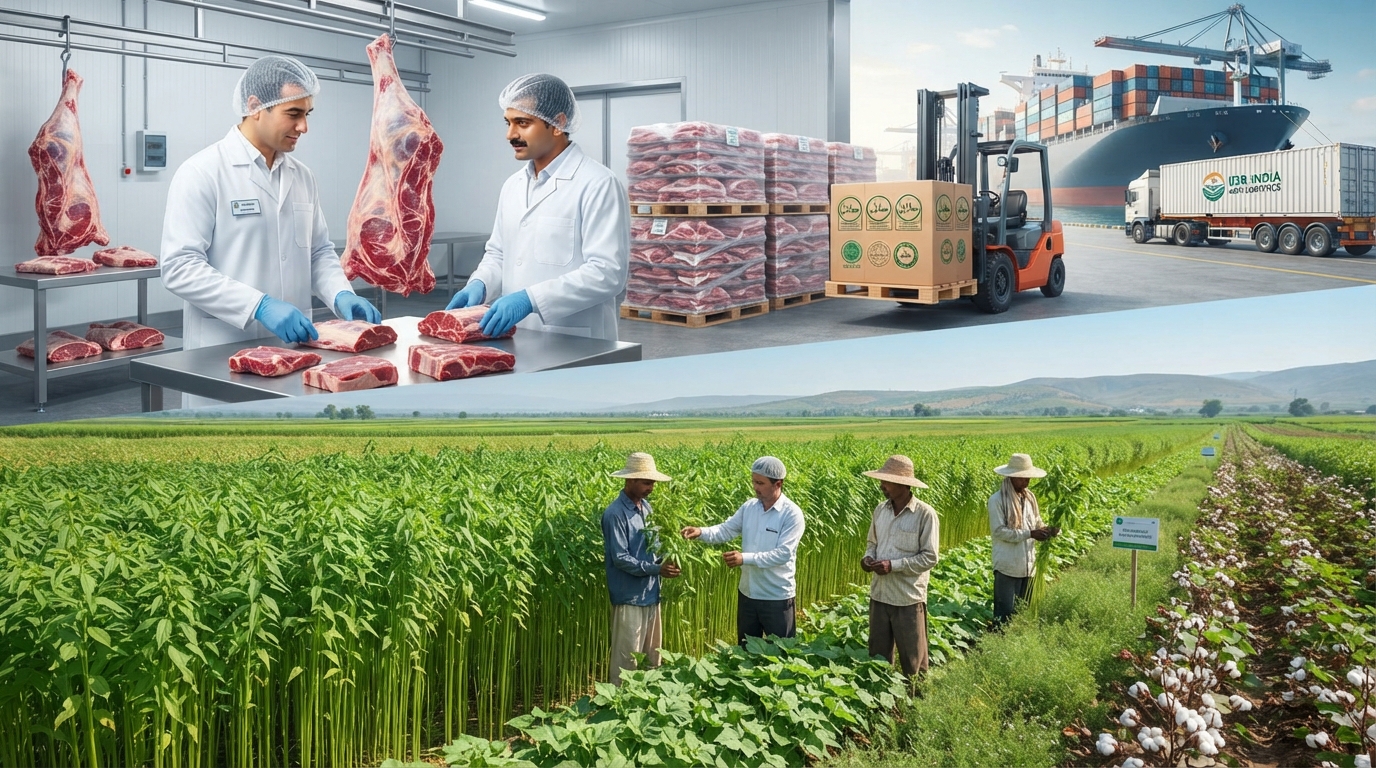
When expanding meat imports from India, Uzbek companies and specialists will participate in its preparation directly on-site, including slaughter and control of compliance with halal requirements. Deliveries are planned to be developed, among other ways, through Turkish partners and the port of Mersin.
Uzbekistan intends to increase meat imports from India and cultivate jute on 50,000 hectares
Uzbekistan and India plan to expand cooperation in agriculture and the food sector. Minister of Agriculture Ibrokhim Abdurakhmonov shared this in an interview during Indian Prime Minister Narendra Modi's visit to Tashkent.
According to the minister, seed production remains one of the key areas of cooperation. Indian agricultural companies are already operating in Uzbekistan, and new crop varieties are being introduced.
"Especially [this concerns] salt tolerance: we are currently testing cotton varieties in Khorezm on an area of 12,000 hectares. New varieties have been imported for cultivation on saline lands. Along with this, we have transferred new seeds of vegetable and fodder crops to Uzbekistan," he said.
Abdurakhmonov emphasized that specialists from Uzbekistan and India are also jointly working on breeding new crop varieties.
Another major area is cooperation in the meat industry. According to the head of the Ministry of Agriculture, Uzbekistan is interested in increasing supplies of cheaper meat from India.
"In terms of meat and animal husbandry, we are doing a lot of work on supplying cheap meat from India to Uzbekistan. Joint ventures have now been established, and we have very large plans for the coming years with the Allana Group. During this visit, a number of new agreements were reached," the minister stated.
He added that the cooperation includes both meat imports and projects for its production.
Abdurakhmonov also reported that the trade turnover of agricultural products between the two countries has more than tripled in recent years.
"On one hand, we receive meat products, and on the other, we are working on exporting more than 30 types of our products to India. Permits, phytosanitary permits, and licenses have been obtained. The Indian market is open to us, especially in terms of legumes," he noted.
According to the minister, Uzbekistan has also switched to direct supplies of products to India, whereas previously part of the exports went through third countries.
According to the National Statistics Committee, in January–June 2026, Uzbekistan imported 72,000 tons of beef worth 359.5 million dollars. Compared to the same period last year, the volume of supplies increased by 6,000 tons, or 9.1%.
India became the largest supplier with 33.9 thousand tons, or about 47% of all imports. 19.6 thousand tons were imported from Belarus, 10.6 thousand tons from Kazakhstan, and 4,000 tons from Pakistan. Other countries accounted for another 4,000 tons.
Separately, the minister was asked how compliance with halal requirements would be ensured as imports of Indian meat expand.
"Of course, the first requirement in this matter is the availability of halal certificates. The second is that our food industry enterprises prepare the meat there themselves and then arrange its export," Abdurakhmonov replied.
To a clarifying question on whether this means that specialists from Uzbekistan will travel to India for animal slaughter, the minister answered in the affirmative.
"Specialists will travel and conduct the slaughter. There [will be] enterprises in the slaughter and meat industry there, which is why joint ventures [are being created]," he said.
According to the head of the Ministry of Agriculture, logistics remains another issue. Deliveries are planned to be developed with the participation of Turkish partners through the port of Mersin.
"The most important thing there is international certificates, meat cleanliness, safety, and the halal certificate. We have reached agreements that our enterprises will prepare this meat there and then [organize] the export," the minister said.
Another new area of cooperation will be the cultivation of jute, an industrial crop used to obtain natural fiber.
According to Abdurakhmonov, the cultivation of kenaf was previously developed in Uzbekistan, but in recent years less attention has been paid to this area. Now, together with India, the cultivation of jute, which belongs to the same family, has begun.
"We are currently growing jute on almost 2,000 hectares. The reason is that we import natural fibers worth almost 30 million dollars," the minister reported.
He noted that natural fibers can be used together with cotton to produce new types of textile products.
"Therefore, we are starting a very large new cooperation on jute within the framework of this visit. The initial work has begun, and now we are expanding it. In subsequent years, jute will be planted on at least 50,000 hectares," Abdurakhmonov stated.
For comparison, according to him, this crop is grown on approximately 1 million hectares in India.
Uzbekistan is also studying the Indian experience of growing cumin (zira). This year, more than 10 tons of seeds of early-maturing varieties were imported from India and tested in various regions of the country.
"As part of agricultural diversification, we are now planting cumin between the rows of cotton. This has become a very major practice starting this year. We are also currently [obtaining] cumin seeds from India because they have early-maturing, fast-ripening varieties there," the minister said.
According to him, the crop must ripen before the cotton begins to flower. The trials were conducted throughout the republic jointly with the Indian company Nath bio-genes.