

World Press Review
Based on materials from Deutsche Welle, Reuters, and the European Commission, information was prepared regarding the financial results of the SpaceX company, South Korean companies' modernization of memory chip production in China, the European Union's updated Arctic strategy, and the impact of Chinese antibiotic imports on penicillin production in Europe.
World Press Review
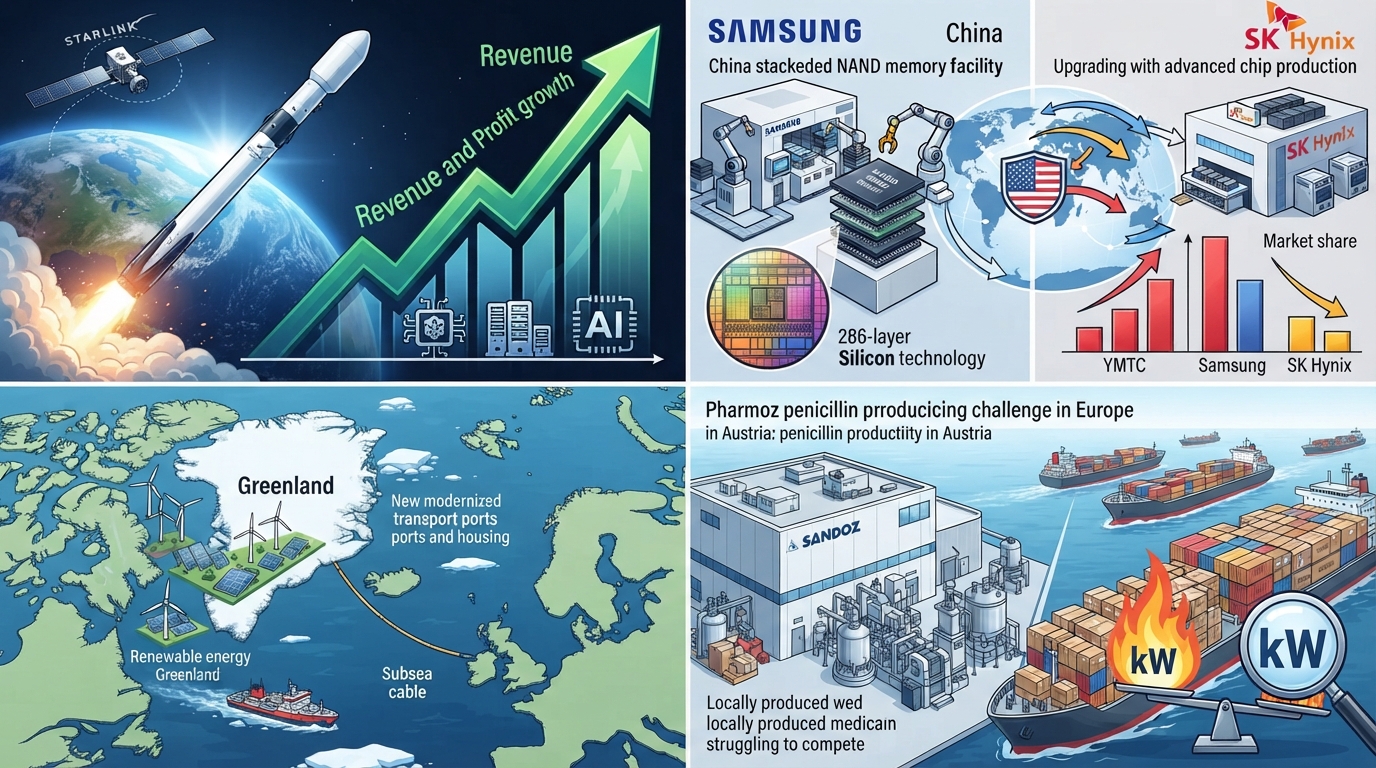
SpaceX's revenue grew by more than 2.5 times. According to the results of Q3 2026, SpaceX's revenue rose by 161 percent to reach $14.58 billion. Net profit amounted to $4.4 billion, which was more than double analysts' forecasts. Following the release of the financial report, the company's stock price increased by 4 percent.
Revenue from the artificial intelligence sector surged by more than 9 times to $7.6 billion. This was mainly achieved through the leasing of computing power. The development of the Starlink satellite network also contributed to revenue growth.
SpaceX's capital expenditures reached $19.6 billion, of which $16.4 billion was directed toward artificial intelligence infrastructure. In June, the company conducted the largest initial public offering (IPO) in history. Its market value is estimated at $2 trillion.
South Korean companies are upgrading memory chip production in China. Samsung plans to increase the production capacity of 286-layer NAND flash memory chips to 40 thousand semiconductor wafers per month at its plant in Xi'an, China, by the end of 2027. These chips are used to store information in smartphones, computers, and data processing centers. Meanwhile, South Korea's SK Hynix intends to switch to producing 240-layer memory chips at its plant in Dalian, China.
According to data from the analytical firm Omdia, the share of China's Yangtze Memory Technologies (YMTC) in the domestic NAND market grew from 28 percent in 2025 to 38.5 percent in Q2 2026. During the same period, the shares of Samsung and SK Hynix shrank to 33.5 and 17 percent, respectively.
Upgrading plants in China depends on US export permits. A US license is required to supply advanced microchip manufacturing equipment to China.
The European Union presented an updated strategy for Arctic development. On October 20, European Commission President Ursula von der Leyen presented the EU's updated strategy on the Arctic. The document was revised for the first time in the last five years.
In particular, the European Union will invest 200 million euros in Greenland to develop renewable energy, raw material extraction, transport, and housing construction. Laying an subsea cable between Greenland and Europe is also envisaged.
Under the European Defence Fund, 260 million euros have been allocated to the development of technologies, aviation, and equipment. Plans are in place to expand the icebreaker fleet and satellite surveillance systems.
The strategy also entails accelerating the Rail Nordica railway project, developing transport and digital networks, strengthening critical mineral supply chains, and protecting the Arctic environment.
The growth of Chinese antibiotic imports threatens penicillin production in Europe. According to Eurostat, China's share in European Union imports of penicillins and their derivatives increased from 44 percent to 86 percent between 2019 and 2025. Europe's only plant covering all stages of penicillin production is located in Austria and belongs to Switzerland's Sandoz. This plant is facing growing competition from Chinese manufacturers.
Despite 200 million euros invested in expanding the facility, cheap imported products and high electricity costs are negatively affecting its profitability. In 2025, electricity prices in energy-intensive EU industries were 50 percent higher compared to China. Meanwhile, state procurement of medicines in Europe prioritizes the lowest price.
In March 2026, Sandoz filed a complaint with the European Commission regarding the dumping practices of Chinese amoxicillin manufacturers. The company demands an anti-dumping investigation and the potential imposition of protective tariffs. China, on the other hand, rejects allegations of unfair competition, stating that state support measures for the industry comply with World Trade Organization (WTO) rules.