

World Press Review
The Center for Economic Research and Reforms analyzed the latest changes in the global economy based on materials from Reuters, Financial Times, and other international sources. The latest review examines the recovery of oil supplies from the Middle East, the growth of China's foreign trade, as well as the IMF forecasts regarding the prospects for the global economy and financial stability.
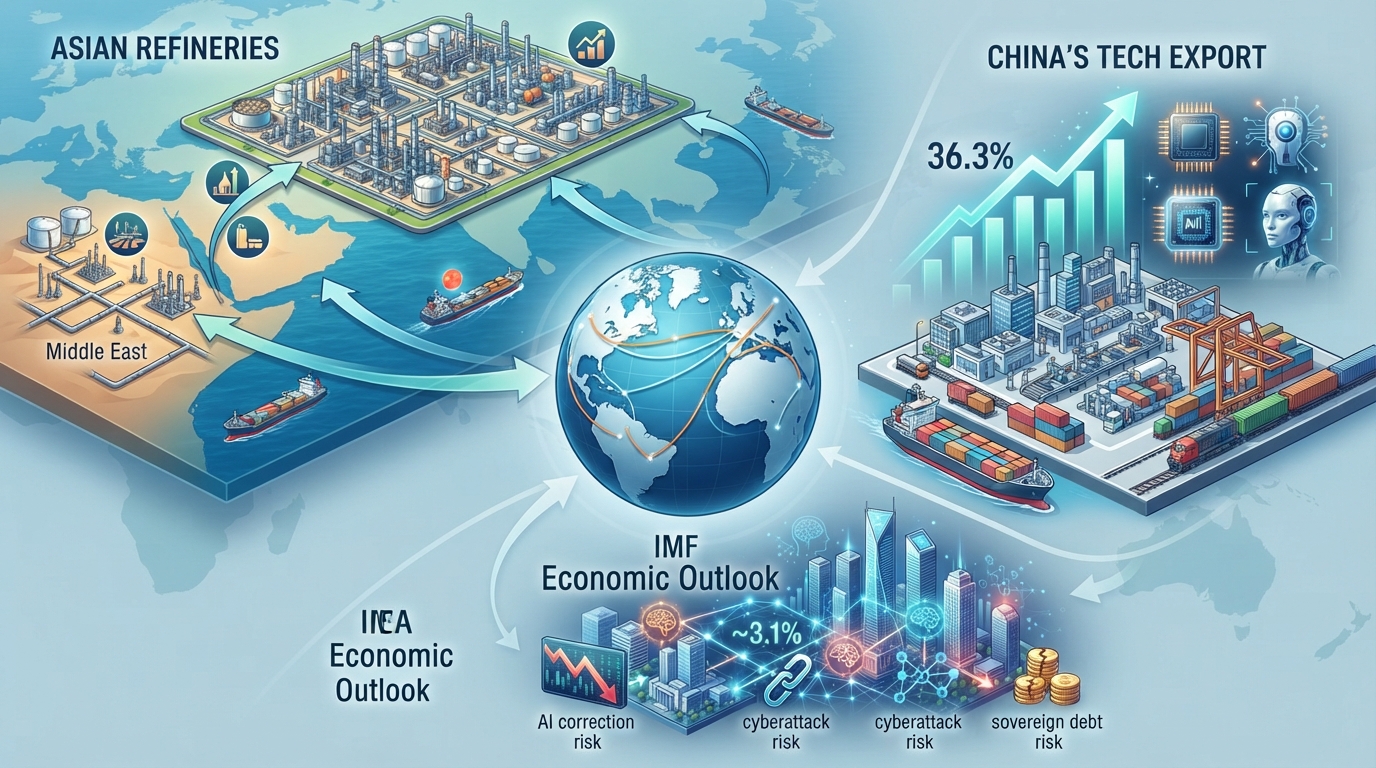
Global Press Review
Asian Refineries to Increase Oil Processing Thanks to Recovery of Middle East Supplies
According to analytical firm Kpler, in September crude oil and condensate exports from the Middle East, excluding Iran, recovered to 18.11 million tons per week, matching the pre-conflict level of February 2026 (18.22 million tons).
At the same time, exports of petroleum products from Middle Eastern countries remain below half of pre-war levels due to refining facilities. Asian refineries could offset this reduction by increasing crude oil processing and fuel exports.
According to the Energy Institute, Asia accounts for 37% of global refining capacity. In 2025, the Middle East supplied 60% of Asia's crude oil imports.
According to estimates by the International Energy Agency, due to supply cuts in April 2026, Asian refineries reduced processing volumes by 6 million barrels per day. The recovery of supplies will allow facilities to increase capacity utilization.
India's refining capacity stands at 5.1 million barrels per day. China possesses the world's largest refining capacity at 18.8 million barrels per day. South Korea and Singapore could also increase production and exports of petroleum products.
High fuel prices are boosting refining profitability. The recovery of Middle Eastern oil supplies will enable Asian refineries to increase production and fuel exports to Europe, Africa, and other Asian countries.
China's Exports Rise Amid Strong Demand for Tech Products
According to Chinese customs data, in September 2026, the country's exports grew by 36.3% year-on-year (25% in August), exceeding the forecast (25.5%) and reaching the highest rate since February (39.6%). Imports increased by 31% (28.2% in August), surpassing the forecast (24.5%).
Export growth is supported by strong demand for Chinese semiconductors and AI technology products. Increased shipments are supporting China's industrial production amid weak domestic consumption and investment activity.
In September, rare earth element exports grew by 6.7% year-on-year to 4.27 thousand tons. However, compared to August, exports fell by 9.8%, and for January–September 2026 they dropped by 9.6% to 43.7 thousand tons.
For January–September 2026, China's trade surplus reached $938.11 billion. If current export paces continue, the trade surplus could exceed $1 trillion in the coming months.
Resilient exports are supporting China's economic growth and reducing the need for additional government stimulus measures. The country's GDP growth target for 2026 is 4.5-5%. Potential trade restrictions from the US and the European Union remain among the main risks.
IMF: Global Growth Supported by Artificial Intelligence, but Financial Risks Escalate
The IMF has raised its forecast for global economic growth in 2026 from 3.0% to 3.1%, while maintaining its forecast for 2027 at 3.4%.
At the same time, the fund expects global inflation in 2026 to reach 4.7%. Investment in artificial intelligence stands out among the factors supporting economic growth, whereas high energy prices, public debt, and geopolitical risks exert an opposing influence.
According to the forecast, 95% of global economic growth is driven by 32 countries. This reflects a growing concentration of economic activity in countries benefiting from the technology investment cycle and favorable external conditions.
In its Global Financial Stability Report, the IMF highlighted three main risks: a potential correction in the valuations of AI-related companies; rising yields on government bonds; and large-scale cyber incidents capable of disrupting the financial system.
The global economy is becoming increasingly divided between countries involved in new technology value chains and those remaining consumers of technology.