

Women-only carriages on trains — how right is this decision?
"Kazakhstan Temir Zholy" is launching a "women's carriage" as part of the Almaty-Tashkent train. The company describes the service as highly in demand. The founder of Nemolchi.uz, Irina Matvienko, said that she would choose such a carriage herself. However, gender segregation has a downside.
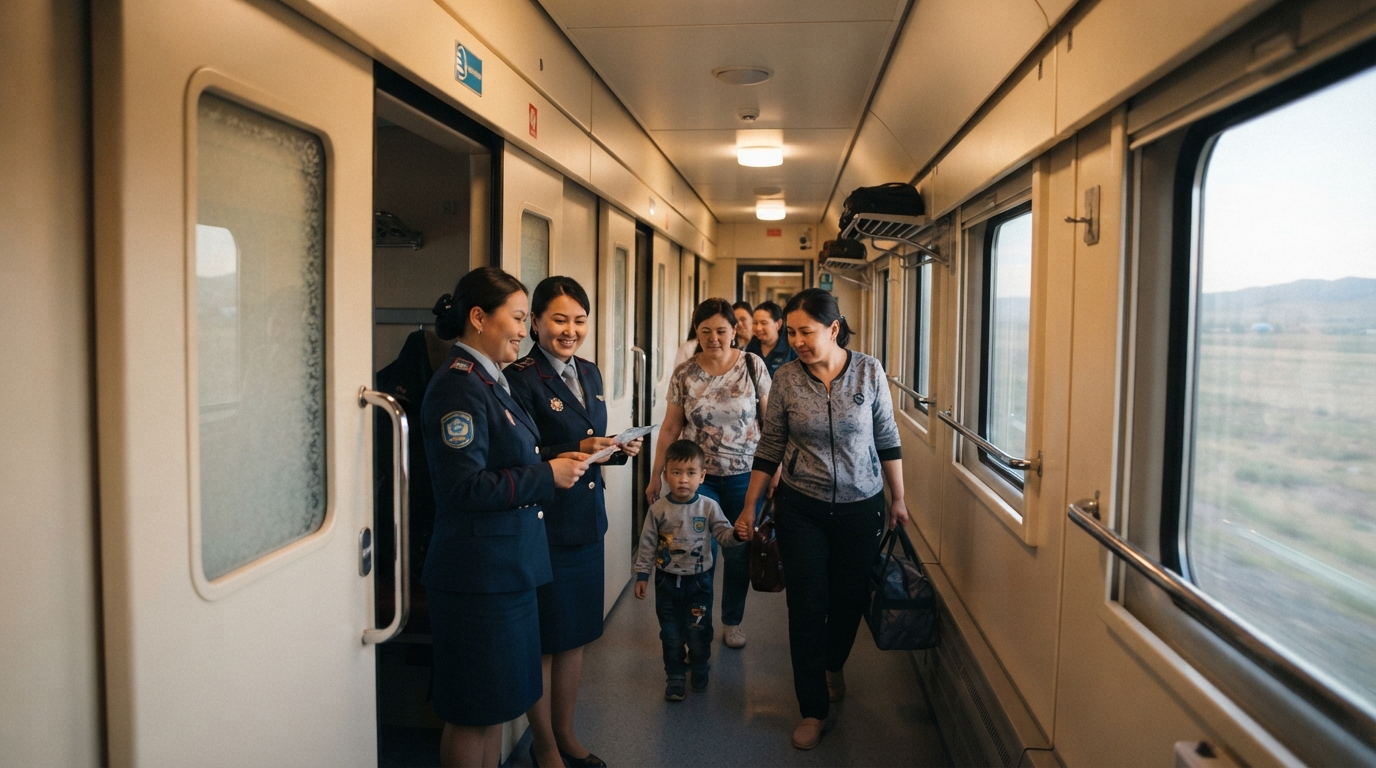
Women-only train carriages — how right is this decision?
Kazakhstan's national railway company, Kazakhstan Temir Zholy, has announced the launch of a "women's carriage" on the Almaty-Tashkent-Almaty train starting October 1.
Tickets for this carriage will be sold only to women, and it will be staffed exclusively by female conductors. Boys aged up to and including 7 years old will be allowed to travel alongside women.
Anuar Akhmetzhanov, head of the Passenger Transportation company, reported that the "Women's Carriage" service is in high demand on domestic routes, having already been used by more than 946,000 passengers. With the launch of the new carriage, the number of such routes will increase to 14.
She said that, on the one hand, this decision is understandable, and she herself would choose such a carriage. On the other hand, gender segregation has a downside — in the long term, it will not make the world safer.
— I have a mixed attitude towards the launch of a women's carriage on the Almaty-Tashkent route. On the one hand, this measure is understandable to me. Women in Central Asia often face harassment in public transport: on buses, in taxis. In Kazakhstan a few years ago, train conductors who raped a female passenger were criminally prosecuted. Unfortunately, they were released early.
However, this is not just a problem of our region. Despite the fact that the safety of citizens is the responsibility of the state, women all over the world live in conditions where they must take care of their own safety.
For example, when traveling, I choose women's compartments or women's rooms in hostels, paying extra for them — this is a rational choice in an environment that I did not create.
If I were traveling by train to Almaty, I would most likely also prefer a women's carriage or compartment. I think I am not the only one. However, such a choice, like gender segregation in general, has a downside — in the long term, it will not make the world safer.
Back in 1985, British feminist scholar Maxine Molyneux argued that the concept of "women's interests" is too abstract, and divided them into practical and strategic gender interests. Practical interests arise from the concrete conditions of women's lives within existing realities (food, housing, health, safety here and now). They do not challenge the system of gender inequality itself, unlike strategic gender interests. The latter are aimed at changing the very structures of subordination: the abolition of discrimination, reproductive rights, equality in politics, and the fight against violence. A women's carriage is the realization of a practical interest.
In her book "States of Injury," American scholar Wendy Brown showed that the liberal state tends to respond to gender inequality not through the logic of transformation and eradication of discrimination, but through the logic of protectionism. Brown also points to a paradox: protection through gender segregation reinforces victim status.
A woman in a women's carriage is safe because she is represented as a vulnerable subject who needs to be isolated from threats. At the same time, the fact that under the Constitutions of both Uzbekistan and Kazakhstan, a woman is a citizen with equal rights to public space is lost. But the protectionist logic negates this principle, replacing it with the status of a protected subject.
Protectionism is politically convenient: it creates the illusion of care without requiring either a rethinking of male power or real institutional changes. The "women's carriage" is a perfect example of a protectionist measure: the state, as it were, says, "We are protecting you," without asking the questions, "Who are we protecting you from? Why do you need to be protected in this particular way? What will happen to those who pose a threat?"
No one stops to think: if there is a "safe" carriage for women, what does that say about the other carriages?
It is as if a woman is safe in the "women's carriage," while in the others she travels at her own peril and risk. I would not be surprised if, in the event of any incidents, accusations are made: "What did she expect? She chose to sit in a general carriage herself." As if a woman who bought a ticket for another carriage made the "wrong choice."
In fact, the responsibility for safety is shifted from the state and the perpetrator to the woman herself — just in a softer, almost caring form. This is protectionism in action.
It is also important to note that this measure addresses the symptom, not the cause.
A man prone to harassment in transport will not become less prone to it just because women are placed in a separate carriage. He can continue this in other carriages, on buses, on the streets, and in other places. Moreover, the practice of introducing separate "women's carriages" in other countries has shown that men can also enter them.
I see news about the launch of a carriage for women, but I do not see news about what the state is doing to change the environment. Have conductors and security guards received training on how to recognize and respond to harassment? Is there a clear complaint procedure for a woman who encounters harassment on any train and in any carriage? Is this initiative planned to be accompanied by public communication about the unacceptability of harassment?
And finally, where is the adequate punishment for this? Five days of detention for harassment in Uzbekistan has long since become a meme. Despite the fact that six months ago it was acknowledged that this measure is insufficient, there have still been no legislative changes.
I am glad that women traveling this route have been given an alternative option. I would like to see this option as part of a systemic approach to safety in transport. Until there are detailed answers and actions regarding the questions raised above, it is premature to speak of systemic transformations.