

Wise energy. What can be seen at the Center for Contemporary Art in Tashkent (+photos)
The Center for Contemporary Art (CCA Tashkent) has opened in the capital. It is housed in a historic building from the early 20th century, which once served as a tram depot and later as a diesel power station. "Gazeta" columnist Dmitry Povarov took a look at the new cultural location and its first exhibition, Hikmah ("Wisdom").
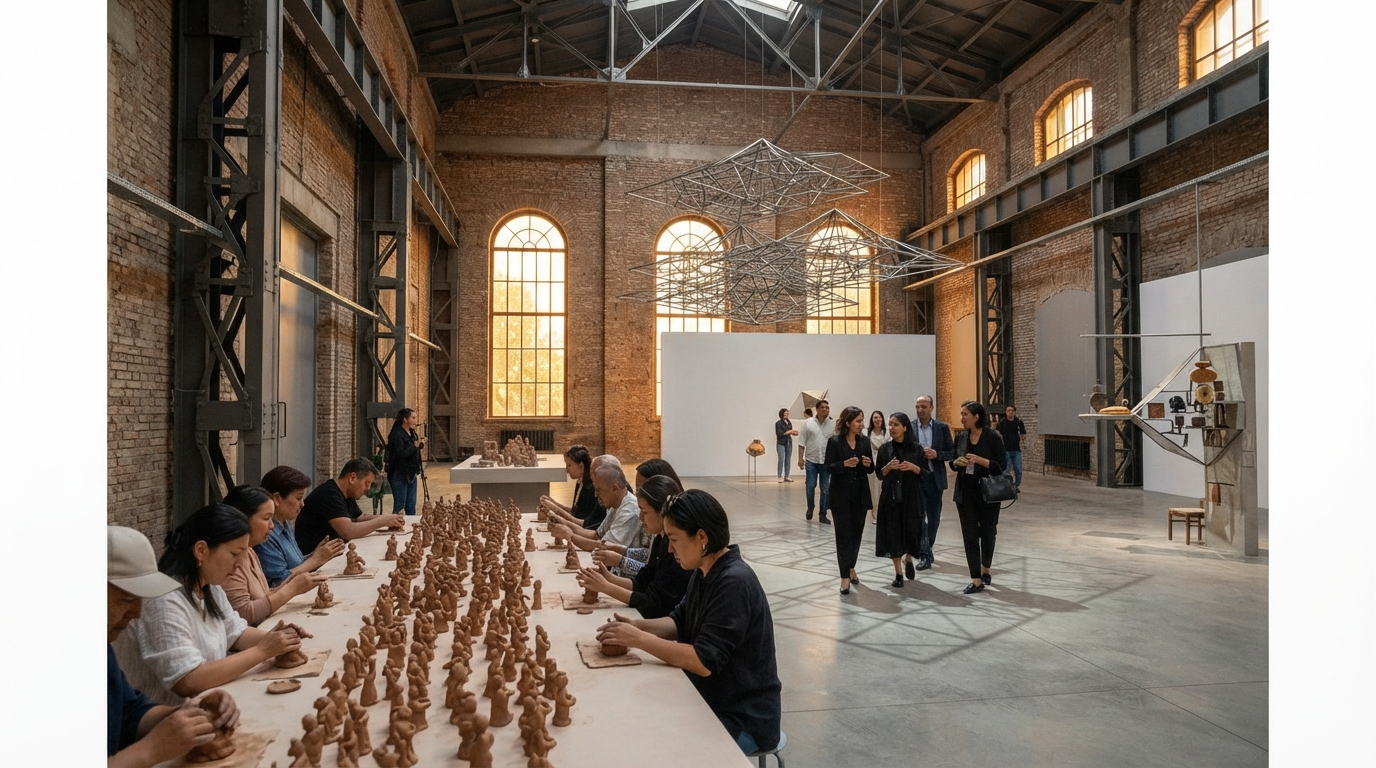
Wise Energy. What to See at the Center for Contemporary Art in Tashkent (+photos)
It is not difficult to find a space for contemporary art in Tashkent, let alone build something from scratch. It is much harder to find a building that is capable of telling a story on its own. The new Center for Contemporary Art (CCA Tashkent) is housed not in a faceless modern structure, but in a building with a rich biography tied to the capital of Uzbekistan.
Designed by the head of the construction department of the Turkestan Region, architect Wilhelm Heinzelmann, and erected in 1912, it started out as a tram depot, then became a diesel power station, and will now generate cultural energy.
The architectural concept for its new life was developed by the French bureau Studio KO. Its team faced a task familiar from many European projects of industrial heritage revitalization: not to turn the historical building into a vintage stage set, but also not to leave it as a static museum object.
Massive metal doors and details of the old architecture do not clash with the new interior here and have not been declared museum exhibits. As a result, the historical appearance of the building and its industrial character have been preserved, while the internal space has been adapted to a completely different function. Infrastructure has been created around the center — for conversation, research, education, and the production of art.
At the media preview, the artistic director and curator of CCA Tashkent, Sara Raza, quickly ceased to be a tour guide in the traditional sense. She led journalists, artists, and representatives of Tashkent's cultural scene through the building, but the tour soon transitioned into a conversation, and the dialogue, as they say, began to flow.
The route is designed so that you first enter a concept store with books and souvenirs bearing the center's logo, then descend into a kind of tunnel where a piece by electronic musician Sabina Inoyatova plays. Only after this do you find yourself in the exhibition space, with your gaze already tuned to what is about to be shown and discussed.
"It is very important to have a cultural institution within the country and to create a meeting place for all artists, all creative people, all communities within the country, as well as for an international audience, so that art is truly visible in the country," said Gayane Umerova, Chairperson of the Art and Culture Development Foundation of Uzbekistan, setting the tone for the discussion.
The center opens its doors with the exhibition Hikmah ("Wisdom"). The exhibition features 11 works by renowned artists, some of which are site-specific — created especially for the project in Tashkent — alongside global masterpieces.
"Flying Carpets" (2011) — the most famous installation by Nadia Kaabi-Linke, a Tunisian artist living in Berlin — has moved to CCA Tashkent from the Guggenheim Museum in New York. It is a rather austere geometric structure suspended in the air. The title ceases to be a metaphor and becomes almost literal — the carpet indeed seems to have taken flight, leaving only its shadow behind.
A completely different conversation is sparked by the work of South Korean artist Kimsooja, who works between New York and Paris. Her "Archive of Mind" requires the direct participation of the viewer. Fresh clay lies next to the installation, from which every visitor can mold a small figure and leave it within the space of the artwork. The result is an archive without a catalog or an inventory number.
Nari Ward, an American artist of Jamaican origin, works with a different type of memory. He collects materials on the streets of Harlem — strollers, shoelaces, carts, bottles, various everyday items — and transforms them into sculptures and installations. For the Tashkent exhibition, he uses, among other things, a chekich — a traditional tool used to stamp patterns on Uzbek flatbread. In his work, an ordinary kitchen utensil turns out to be not just an everyday object, but a symbol of culture, labor, and the transmission of knowledge.
The participants are not only international artists. Four masters of contemporary domestic art are also represented here: Vladimir Pan, Shokhrukh Rakhimov, Bakhtiyar Saipov, and Daribay Saipov. This is an important step toward integrating the Uzbek school of art into a broader international context.
The choice of theme for the inaugural project seems entirely understandable. The tradition of hikmah — wisdom, knowledge, comprehension — has deep roots in the intellectual and spiritual history of the region. In Uzbekistan, it is connected, among other things, to the tradition of the Khwajagan, the "Masters of Wisdom," from which one of the most influential Sufi traditions, the Naqshbandiyya, later emerged. This is why the gesture of the hand acquires so much meaning here: molding something from clay, assembling found objects, applying a pattern, leaving a trace.
The new center emerges in a building that is itself a kind of archive of memory. First, trams moved here, then energy was produced, and now art, culture, and history will be discussed. At the same time, the past does not become an object of worship — it turns into material for a new conversation.
"The opening of the center should set a new standard, a new tone for future modern construction in Tashkent, and serve as a wonderful example of what modern aesthetics means and how vibrant it can be," art historian and former director of the Tretyakov Gallery Zelfira Tregulova shared her impressions with Gazeta.
This is an opinion, as they say, with a view to the future. For CCA Tashkent, Tregulova is a person involved in the center's grand plans. It is known that the art historian will curate a solo exhibition of iconic figures in the conceptual world — Ilya and Emilia Kabakov — planned for next spring.
It is this openness, it seems, that should distinguish the new center from a conventional exhibition institution. This will perhaps be the most interesting test for the project. Bringing a major foreign exhibition to Tashkent is already quite possible today. It is much more difficult to create a professional environment here that can function between such exhibitions — with its own artists, research, discussions, and debates.