

Winter will ask a strict question
Is Kyrgyzstan's energy sector ready for winter? Summer consumption record demonstrated systemic risks for the republic
**Winter Will Ask Strict Questions**
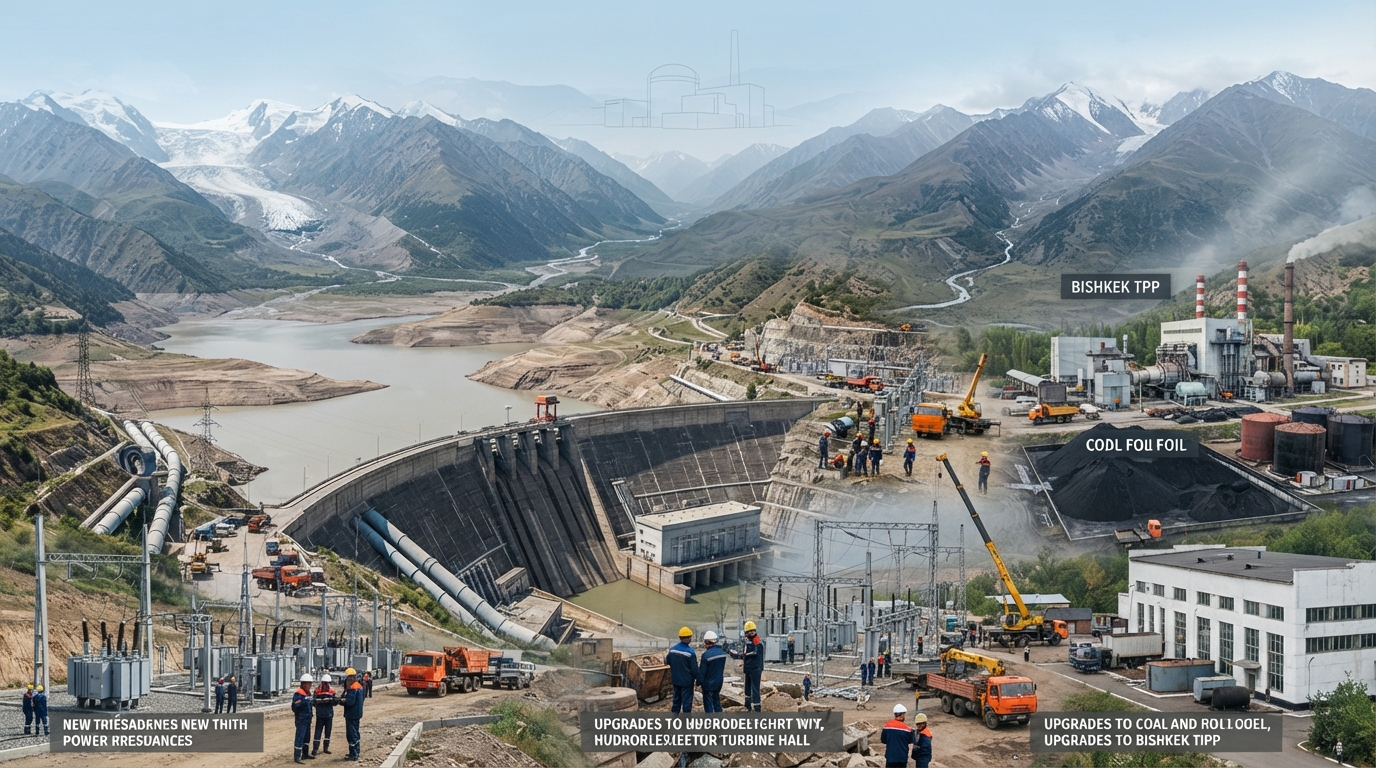
Kyrgyzstan is entering the final stage of preparations for the 2026–2027 autumn-winter season. By October, it is necessary to complete repairs and reconstruction of energy facilities, prepare generating equipment for peak loads, and build up fuel reserves. At the same time, the already approved energy balance shows how tense the upcoming period will be: with a projected domestic consumption of 19.6 billion kWh, it is planned to produce 15.5 billion kWh internally, and cover the deficit of 4.1 billion kWh through imports. An additional threat is posed by the water level in the Toktogul Reservoir, which in August remained lower than last year's.
Work is being carried out in several directions at once. At the Bishkek CHP, boiler and turbine units are being repaired, energy enterprises are increasing coal and fuel oil reserves, and equipment is being upgraded at power grid facilities. The country's total requirement for the heating season is estimated at 3.4 million tons of coal and 45.5 thousand tons of fuel oil. But repairs, fuel reserves, and imports primarily solve the task of the upcoming winter. The key question is whether the current generation model is capable of withstanding further growth in demand.
A partial answer was provided by the summer peak in consumption. On July 19, 2026, daily electricity consumption in Kyrgyzstan exceeded the psychological threshold of 50 million kWh — this is 7.6 million kWh, or 18%, more than last year's maximum. Consumers quickly felt the significance of this record: the National Electric Grid of Kyrgyzstan announced regulatory measures in areas with the most severe overloads, primarily in Bishkek and the Chuy Region. The duration of outages was limited to two hours per day.
The localized deficits that have manifested are just the tip of the iceberg. The problem is systemic in nature and is becoming a serious brake on the country's social, economic, and technological development. This is evidenced by the causes of the emerging and intensifying imbalances.
First, the current power generation system was created under fundamentally different technological and socio-economic conditions. Its foundation is hydropower: in years with favorable water availability, it accounts for up to 90% of generation. This structure is explained by the natural advantages of the Kyrgyz Republic. The country possesses significant hydropower potential: the total annual volume of renewable water resources is estimated at 46.5 km³, and there are more than 3.5 thousand watercourses on its territory, including 30 major rivers. The mountainous terrain allows for the formation and accumulation of large reserves of fresh water, in which the republic holds one of the leading positions in the region.
But this potential cannot be viewed in isolation from interstate obligations and the interests of neighbors. The region's water resources are linked by a common runoff system, so the regime of their use requires coordination with Kazakhstan, Uzbekistan, and Tajikistan. Thus, Kyrgyzstan's natural advantages are limited by the need to maintain the water and energy balance and good-neighborly relations in Central Asia.
Second, the problem of climate change is becoming increasingly acute. Temperature fluctuations and abnormal heat accelerate the melting of glaciers, whose contribution to the water balance is estimated at approximately 26–26.5%. The future reduction in glacial feed poses serious risks to the entire hydropower generation system.
Third, the water use infrastructure and a significant portion of energy facilities were created back in the Soviet period. The depreciation of fixed assets is growing: according to expert estimates, by the beginning of the 2020s, almost half of the generating capacity had exceeded its standard service life. This applies not only to production but also to transmission and distribution of electricity, where depreciation is even higher. The condition of the grids leads to technical losses and increases the risk of emergency outages.
The situation is exacerbated by rapid growth in demand. It is fueled by population growth, the construction of new housing, social, and industrial facilities. Like other countries in the region, Kyrgyzstan is faced with the fact that electricity consumption is growing faster than the capacity to produce and deliver it. The current energy model already struggles to cover the needs of the economy and society, and in winter this imbalance becomes particularly noticeable.
The experience of Kazakhstan and Uzbekistan shows that nuclear generation could become one of the options for diversification. For Kyrgyzstan, this direction is not new: in 2022, the Rosatom State Corporation and the government of the republic signed a memorandum of cooperation on the construction of a small modular nuclear power plant. The potential implementation of the project will require the development of nuclear infrastructure, training of scientific and technical personnel, a thorough assessment of economics and safety, as well as public discussion.
A small NPP will not solve all the industry's problems and will not be the answer to the deficit of the coming winters. However, in the long term, it could reduce the load on hydropower during periods of seasonal deficit, decrease dependence on imports, and make the generation structure more resilient.
It is precisely the reliability of energy supply that is becoming a condition for the country's transition to a new technological paradigm. Here, the speed of strategic decisions is important: establishing a nuclear industry requires significant costs, reliable institutions, and time, and the full project implementation cycle can take eight to ten years. Therefore, preparations for winter should be viewed not only as an annual repair campaign but also as a test of the state's ability to consistently modernize its entire energy model.