

Kazakhstan blamed the massive blackout on problems at a hydroelectric power station in Kyrgyzstan.
The shutdown of two hydroelectric generators at the Toktogul Hydroelectric Power Plant in Kyrgyzstan led to disruptions in the Central Asian power grid. As a result, several regions of Kazakhstan were left without power.
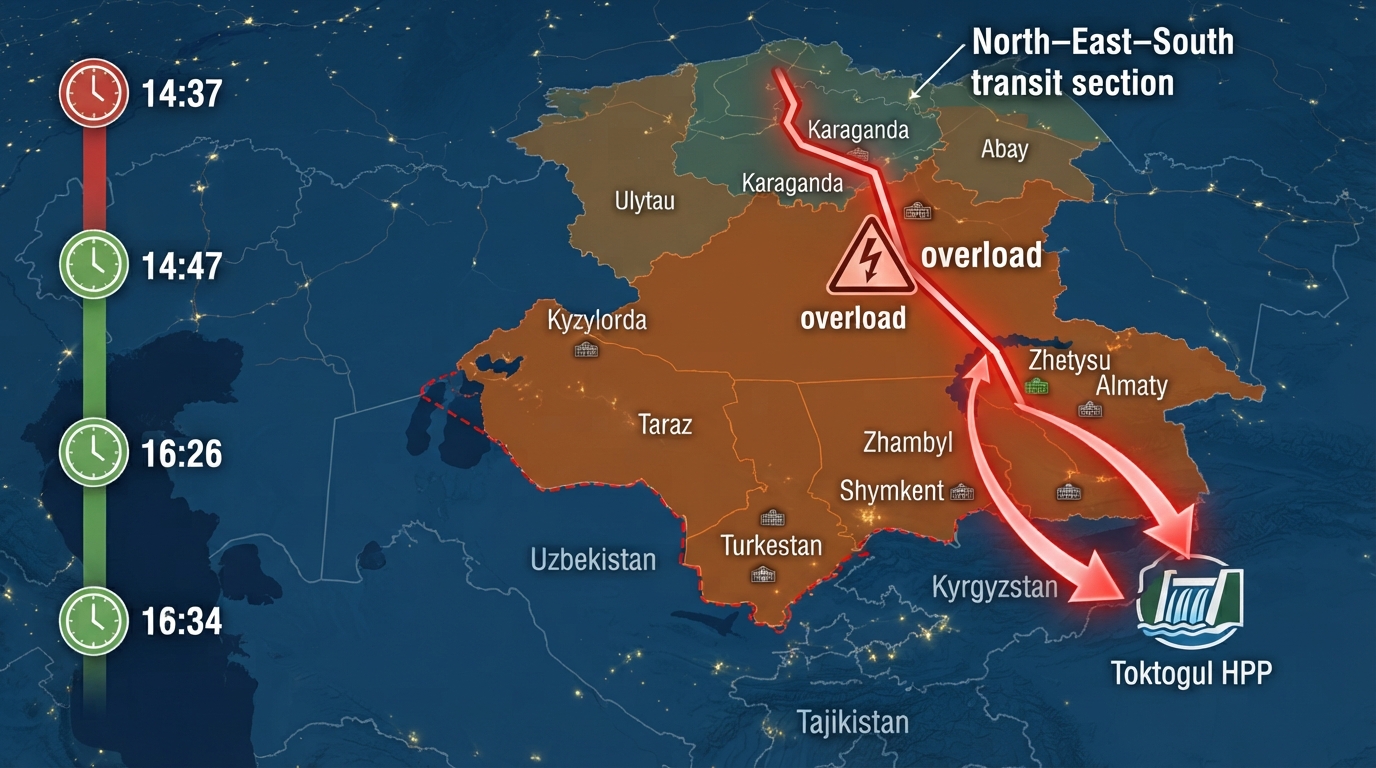
Kazakhstan attributed the large-scale power outage to problems at a hydroelectric power station in Kyrgyzstan.
According to Tengrinews, citing the KEGOC press service, two hydroelectric generators at the Toktogul Hydroelectric Power Station, with a combined capacity of 600 MW, shut down on August 14 at 2:37 PM. This resulted in an overload on the North-East-South transit section of the Unified Energy System of Kazakhstan, resulting in the Southern Zone being isolated from the Central Asian power grid.
Residents of the Almaty, Zhambyl, Turkestan, Kyzylorda, and Zhetysu regions, as well as the Karaganda, Ulytau, and Abay regions, were left without power.
Power supply to consumers was restored in stages: by 2:47 PM in the Karaganda, Ulytau, and Abay regions; by 4:26 PM in the Almaty and Zhetysu regions; and by 4:34 PM in the Zhambyl, Turkestan, and Kyzylorda regions.
The causes of the technological failure will be investigated by a special commission.
Earlier, the Ministry of Energy of Kazakhstan reported a power outage in several regions caused by a failure in the Central Asian power grid. The sudden change in power flow triggered an overload and the activation of emergency control systems.
The total volume of power supply restrictions to consumers reached approximately 2,810 MW. By 2:47 PM, restrictions in the Karaganda, Abay, and Ulytau regions had been lifted for 295 MW.
Kazakhstan's Ministry of Energy has denied claims that the outages in Uzbekistan were caused by an accident in Kazakhstan's power grid.
KEGOC serves as the system operator of Kazakhstan's Unified Energy System. The company's main shareholder is the National Welfare Fund Samruk-Kazyna, which owns 85 percent of the shares.