

Will a gas hub be created in Central Asia?
155 billion cubic meters of production — and less than 3 billion in intraregional trade: why Central Asia's gas is currently bypassing its neighbors Natural gas and electricity are of strategic importance for Central Asia. At the same time, gas resources are distributed extremely unevenly among the countries. Turkmenistan accounts for more than 80% of the region's proven gas reserves and about half of its production. It is followed by Uzbekistan […]
Will a Gas Hub Be Created in Central Asia?
155 billion cubic meters of production and less than 3 billion cubic meters of intraregional trade: why Central Asian gas is still bypassing its neighbors
Natural gas and electricity are of strategic importance for Central Asia. At the same time, the distribution of gas resources among the countries is extremely uneven.
Turkmenistan accounts for more than 80% of the region's proven gas reserves and about half of its production. It is followed by Uzbekistan with 5% of reserves and 32% of production, and Kazakhstan with 14% of reserves and 17% of production. Kyrgyzstan and Tajikistan possess only negligible reserves, and there is virtually no domestic gas production in these countries.
In 2022, the combined gas production in the five Central Asian states reached 155 billion cubic meters. This is almost four times more than in the European Union and roughly comparable to the figures of Australia, the world's seventh-largest gas producer.
Out of the total volume, about 108 billion cubic meters was consumed within the region, and another 47 billion cubic meters was exported.
However, the gas balance of Central Asia is gradually changing. Since 2018, surplus gas volumes have been shrinking: production is growing noticeably slower, while domestic consumption is increasing. Uzbekistan and Kazakhstan, which have traditionally acted as the region's main exporters, have strived to maintain a positive trade balance in recent years. At the same time, according to preliminary data, since 2023 Uzbekistan has become a net importer of gas for the first time since gaining independence.
Turkmenistan is the region's main reserve
Against this background, Turkmenistan, the largest producer and exporter of gas in Central Asia, retains special significance.
As of the end of 2020, the country's proven gas reserves were estimated at 13.6 trillion cubic meters. This secured Turkmenistan fourth place in the world in terms of reserves and, while maintaining the current level of production, potentially allowed it to sustain production for about another 230 years.
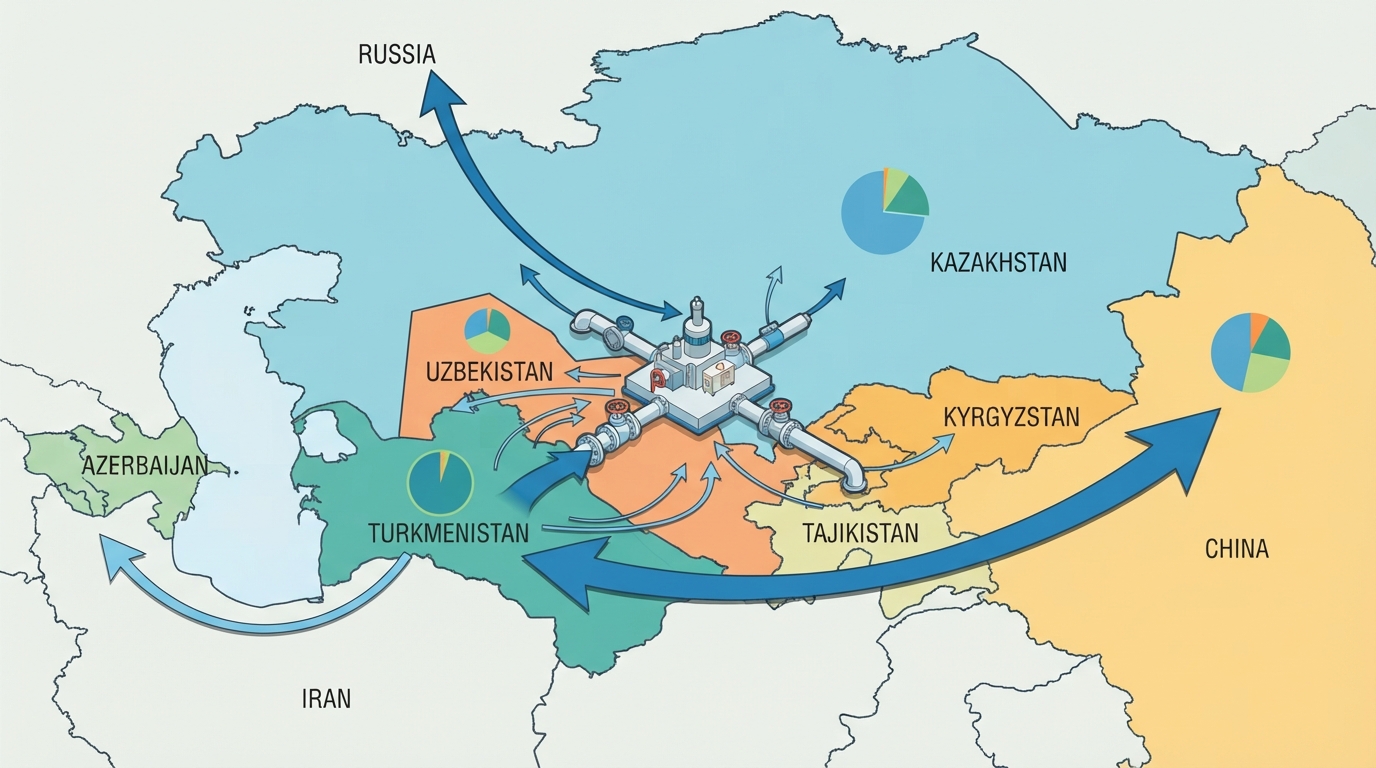
In 2022, Turkmenistan produced 78 billion cubic meters of gas. About 38 billion cubic meters was used domestically, and more than 40 billion cubic meters was exported. The main destination was China, taking 33 billion cubic meters. Another 5 billion cubic meters went to Russia, and 2 billion cubic meters to neighboring Central Asian states.
The country's additional export potential is linked, in particular, to the development of the second phase of the Galkynysh gas field, the largest in the country. At the same time, the prospects for the supply project via Route D, with a capacity of up to 30 billion cubic meters per year, still remain uncertain.
Since 2022, Turkmenistan has also been supplying small volumes of gas to Azerbaijan through the territory of Iran under a trilateral agreement. Turkmen gas enters Iran's eastern border, after which Tehran delivers an equivalent volume to Azerbaijan through the northwestern part of the country.
There is gas, but little trade within the region
The paradox of Central Asia is that despite significant gas reserves and production, intraregional trade remains extremely limited.
The bulk of export flows goes outside the region. China remains the key destination: in 2022, deliveries via three "Central Asia – China" gas pipelines reached 40 billion cubic meters.
In the same year, the region supplied about 6 billion cubic meters of gas in net terms to Russia. However, the structure of these flows has already begun to change.
Turkmenistan's five-year contract to supply up to 5.5 billion cubic meters of gas per year to Russia ended on June 30, 2024. Simultaneously, since 2023, Uzbekistan has started importing Russian gas — up to 2.8 billion cubic meters per year. Long-term supplies of up to 11 billion cubic meters annually are currently under discussion.
For comparison: in 2022, the volume of gas trade directly between the five Central Asian states amounted to less than 3 billion cubic meters — approximately 16 times less than the region's external gas flows.
Intraregional supplies included gas exports from Turkmenistan to Kazakhstan and Uzbekistan, as well as supplies from Uzbekistan to Tajikistan and Kyrgyzstan.
This results in a kind of "gas crossroads": the region possesses significant resources, but most of the gas goes outside its borders, while a demand for additional volumes persists within Central Asia.
It is against this background that the question arises about the possibility of forming Central Asia's own gas hub.
Turkmenistan is seen as one of the main sources of additional gas volumes to expand intraregional trade. However, its role will depend on how ready the country is to develop production not only for the Chinese direction but also for the regional market.
This may require the creation of additional exit points along the Route D gas transmission system, which would allow other Central Asian countries to access additional volumes of Turkmen gas.
At the same time, the expansion of gas flows between the countries of the region and a possible increase in Russian gas supplies create the prerequisites for the formation of a more connected regional market.
In the future, such a market could become a source of price signals for producers, including Turkmenistan. Given sufficient volumes of domestic production, storage capacity, and interstate gas transmission links, this, in turn, could create conditions for the development of more complex market instruments, including gas futures trading.
Thus, it is not only about building new pipelines. A potential gas hub implies the formation of an infrastructure that will allow the redistribution of gas between countries, balancing supply and demand, and gradually creating a more transparent regional market.
This is discussed, in particular, in the book "Central Asia — 2050", prepared by the Agency for Strategic Development and Reforms under the President of the Republic of Uzbekistan together with a wide range of experts and international specialists.
The publication is dedicated to the long-term prospects of the region and is intended to provide universities, the academic and expert community with analytical materials for further research.
The publication examines four key areas — water and climate change, energy, transport connectivity, and demographics. The book also presents a demographic forecast for the region's development up to 2050, essays on the population's views on the future, and economic reviews.