

Why we should not blindly trust a single scientific study?
The problem is that most media outlets and journalists treat each new study in isolation from the general body of knowledge,
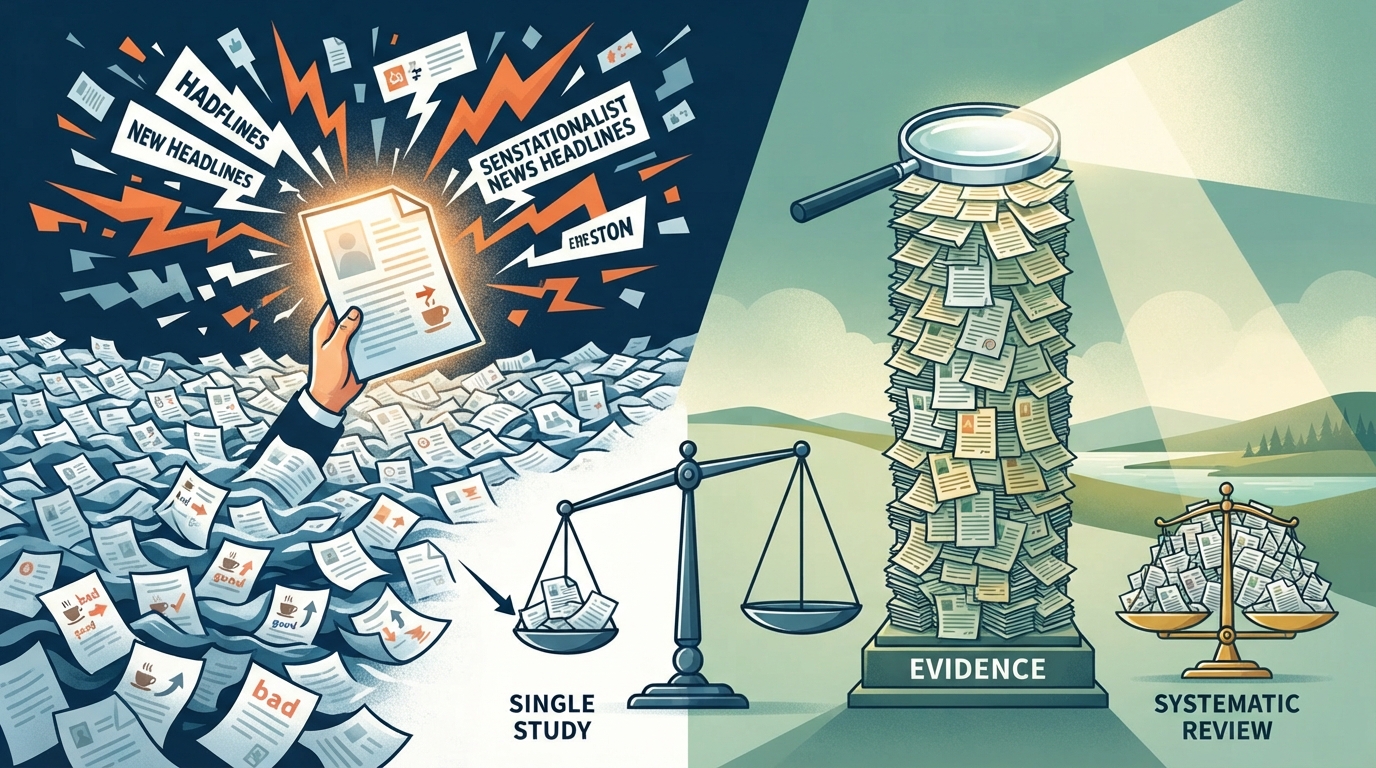
Why shouldn't we blindly trust a single scientific study?
As you follow your news feed, you may often be confused by reports about science and health: one week coffee is said to be beneficial, and the next week it is written to cause harm to the heart.
An analytical article published in Aeon notes that over time, the way new scientific studies seem to contradict each other leaves us in a state of not knowing which evidence to believe.
The main problem is that many media outlets and journalists isolate each new study from the general body of knowledge and present it as a standalone sensation...
Paracetamol and sensational headlines
Here is an example: in September 2025, US Food and Drug Administration officials called for warnings that taking paracetamol during pregnancy could increase the risk of autism in the child. Revolutionary headlines immediately spread across the world.
But when experts took a deeper look at the science, it turned out that officials had only cherry-picked certain studies, leaving aside hundreds of other reliable sources. A few months later, scientists gathered all available data and released a major review: there is no direct, clear link between paracetamol and autism. But in the meantime, thousands of pregnant women had already become needlessly anxious about the painkiller considered the safest, believing it would harm the fetus.
How many scientific articles and studies are published worldwide every year? In 2025 alone, more than 7 million scientific articles were published globally — which means more than 19,000 a day. In such a vast ocean of information, alongside studies with rigorous methodology, there are also rushed and unverified conclusions.
So, if relying on a study is risky, how can the truth be determined? Gene Glass, a data analyst, found the answer to this question in 1976. At that time, there were many conflicting opinions regarding the benefits of psychotherapy. Some scientists used a simple vote-counting method: comparing the number of studies saying psychotherapy helped with those saying it did not. But this method was unreliable because it did not take into account the strength of the effect.
Gene Glass and his spouse gathered more than 370 studies and developed a method to bring their results to a single standard measure and calculate the average value. This was like converting different currencies into dollars and then calculating the total sum. Glass called this method meta-analysis, meaning the analysis of analyses.
In this way, the concept of systematic review was established. This is not just relying on a single study, but gathering all published and unpublished sources on the subject worldwide, filtering their quality, and coming to a single, unbiased conclusion.
Unfounded advice and the tragedy of 50,000 babies
One of the most tragic mistakes in medical history clearly demonstrates how important systematic review is.
In 1957, the famous pediatrician Benjamin Spock, in his bestselling book, recommended that parents put babies to sleep on their stomachs rather than on their backs. For decades, millions of parents followed this advice. It was only in the 1980s and 1990s that this practice was found to be causing sudden infant death syndrome.
The saddest part of the tragedy is that if scientists had synthesized the existing evidence earlier, instead of waiting for individual articles, the dangerous link between stomach sleeping and infant death would have been known as early as 1970. Researchers estimate that if the evidence had been summarized in a timely manner, the lives of at least 50,000 babies could have been saved.
Following this, international systematic review networks like the Cochrane Collaboration were formed in medicine. Today, the diagnostic and treatment guidelines used by doctors rely on the foundation of precisely such clear evidence.
How is this experience working in other fields?
Evidence synthesis has not been limited to medicine: the UK's Education Endowment Foundation (EEF) combined thousands of pedagogical studies to identify the most effective methodologies for schools. For example, teaching students "metacognition" (understanding how to learn correctly) was proven to deliver an additional 8 months of progress in one academic year.
In the field of climate and ecology, the Intergovernmental Panel on Climate Change gathered thousands of environmental studies and proved the human factor's impact on global warming with unquestionable evidence.
The Future and Artificial Intelligence
The only major drawback of systematic reviews is the time they take. Preparing a single systematic review and re-checking all studies takes an average of 2-3 years.
Today, artificial intelligence is being tested to speed up this process. In the future, AI could sort through millions of articles and provide a reliable synthesis in a single second. But for now, the risk of hallucination — that is, fabricating fake information — remains high in existing AI tools.
When you read the next "sensation" or "revolutionary discovery" in your news feed, stop and ask yourself: "Is this just a single isolated study, or is it the synthesized conclusion of the entire scientific community?"
To make correct decisions regarding science and our health, we must learn to look at the full picture of existing knowledge, rather than chasing sensational headlines.