

Vaccination: myths and facts
The probability of experiencing complications from a vaccine is thousands of times lower than contracting the disease and facing its severe consequences. For example,
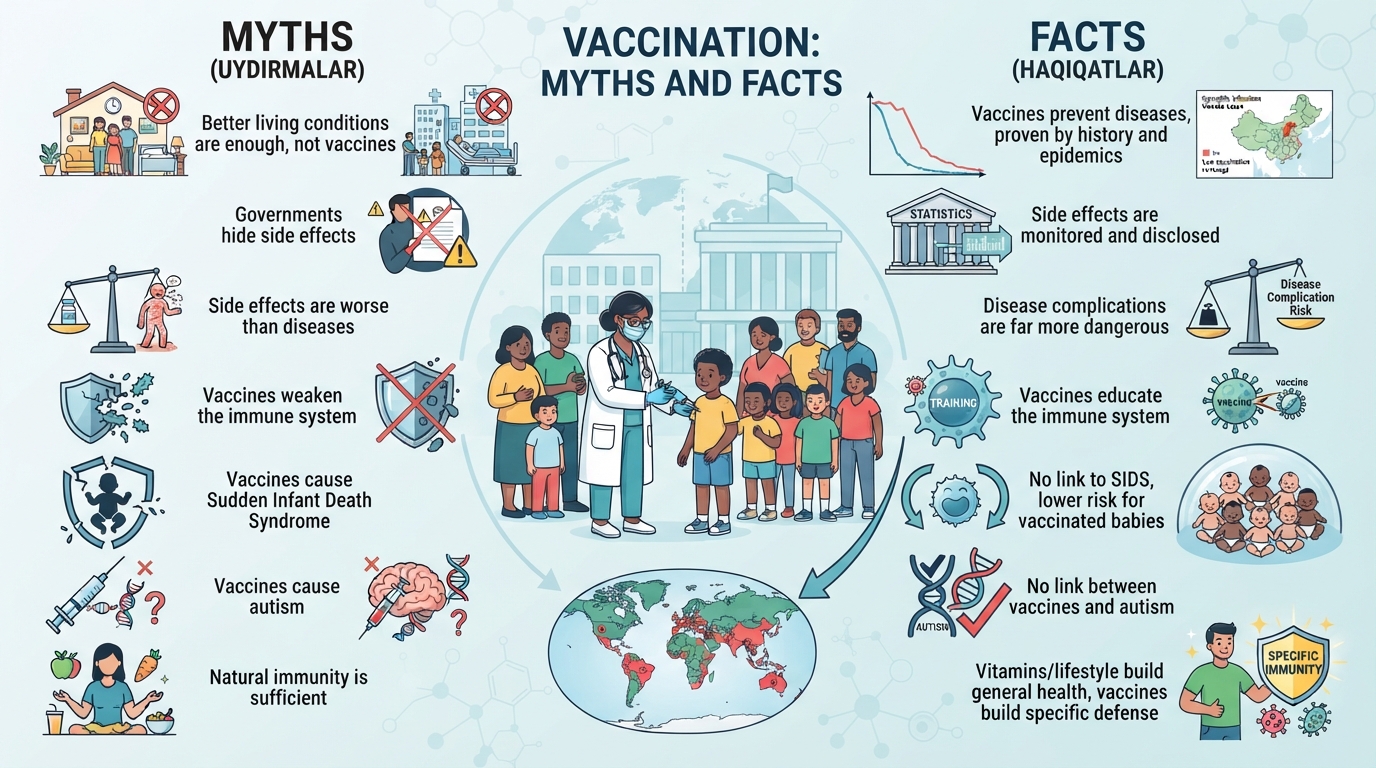
**Vaccination: Myths and Realities**
Preventing various diseases through vaccination is one of the most significant contributions of medical science to public health preservation. Thanks to this, a number of infectious diseases—diphtheria, measles, mumps, congenital rubella, Haemophilus influenzae type B—have sharply decreased in developed countries, while smallpox and polio have been completely eradicated.
Nevertheless, various myths and anti-vaccine views persist among the population regarding mass vaccination. Below are the scientific facts about vaccination.
**Myth 1: The decline in infections was caused by rising living standards, not vaccination.**
Good living conditions and sanitation alone cannot fully protect against infectious diseases. The resurgence of infections in areas where vaccine coverage has declined is clear evidence of this. In the Netherlands and the United Kingdom, major epidemics were observed during years when vaccination was refused or coverage decreased.
**The government hides the side effects of vaccines.**
For example, the system for registering post-vaccination complications has existed for decades. In accordance with legislation, all adverse reactions are recorded by state statistics and are openly indicated in the instructions for use of the preparations.
**The side effects of vaccination are more dangerous than the complications of the disease.**
The probability of experiencing complications from a vaccine is thousands of times lower than contracting the disease and facing its severe consequences. For example, measles can cause the death of one in five children, whereas the vaccine only causes a temporary mild reaction in very rare cases.
**Vaccination weakens and destroys the immune system.**
Vaccines do not disrupt the immune system; on the contrary, they "train" it to fight against specific diseases. The amount of antibodies in vaccines is extremely small compared to the number of antigens a child encounters in daily life.
**Vaccination causes sudden infant death syndrome.**
Large-scale scientific studies have proven that there is no link between vaccination and sudden infant death syndrome. On the contrary, it has been found that this risk is lower in vaccinated children.
**Mercury (thimerosal) in vaccines causes autism.**
The ethylmercury in thimerosal is rapidly eliminated from the body and does not cause harm. Numerous large-scale studies conducted worldwide have shown no link between thimerosal-containing vaccines and autism.
**Natural immunity is sufficient to protect against any infection.**
Although a healthy lifestyle strengthens general immunity, only a vaccine creates specific adaptive immunity against certain dangerous pathogens.
**The DTP vaccine causes many reactions and should be discontinued.**
It is true that the DTP vaccine causes more reactions than others (short-term fever or pain), but stopping its use immediately leads to a pertussis epidemic and child mortality, as observed in the case of Japan. Currently, safer acellular vaccines are also available.
**Vaccinating against several diseases at the same time overloads the immune system.**
A child's immune system can respond to thousands of antigens simultaneously. Combined vaccines have undergone rigorous scientific testing; they are safe and protect against several diseases at once.
**The Hepatitis B vaccine destroys the liver and causes many complications.**
The Hepatitis B vaccine does not damage liver cells and is not metabolized in it. It merely provides a safe amount of antigen to produce protective antibodies in the body.
**The BCG vaccine does not protect against tuberculosis, but rather causes it.**
In more than 150 countries around the world, BCG is still used as the primary means of protecting infants from severe forms of tuberculosis (tuberculous meningitis and others).
**Children with various illnesses cannot be vaccinated.**
On the contrary, if individuals with chronic diseases contract infections, the disease progresses very severely in them. For this reason, vaccinating people in such groups under medical supervision serves as a means of protection for them.
**Hygiene has improved, diseases have decreased, so vaccination is not necessary.**
Infectious agents are still circulating in other parts of the world. If herd immunity drops, dangerous diseases thought to have disappeared will quickly flare up again.
The only reliable way to protect yourself and those around you is to get vaccinated on time.