

Why do children get sick after the holidays and how can their immunity be strengthened?
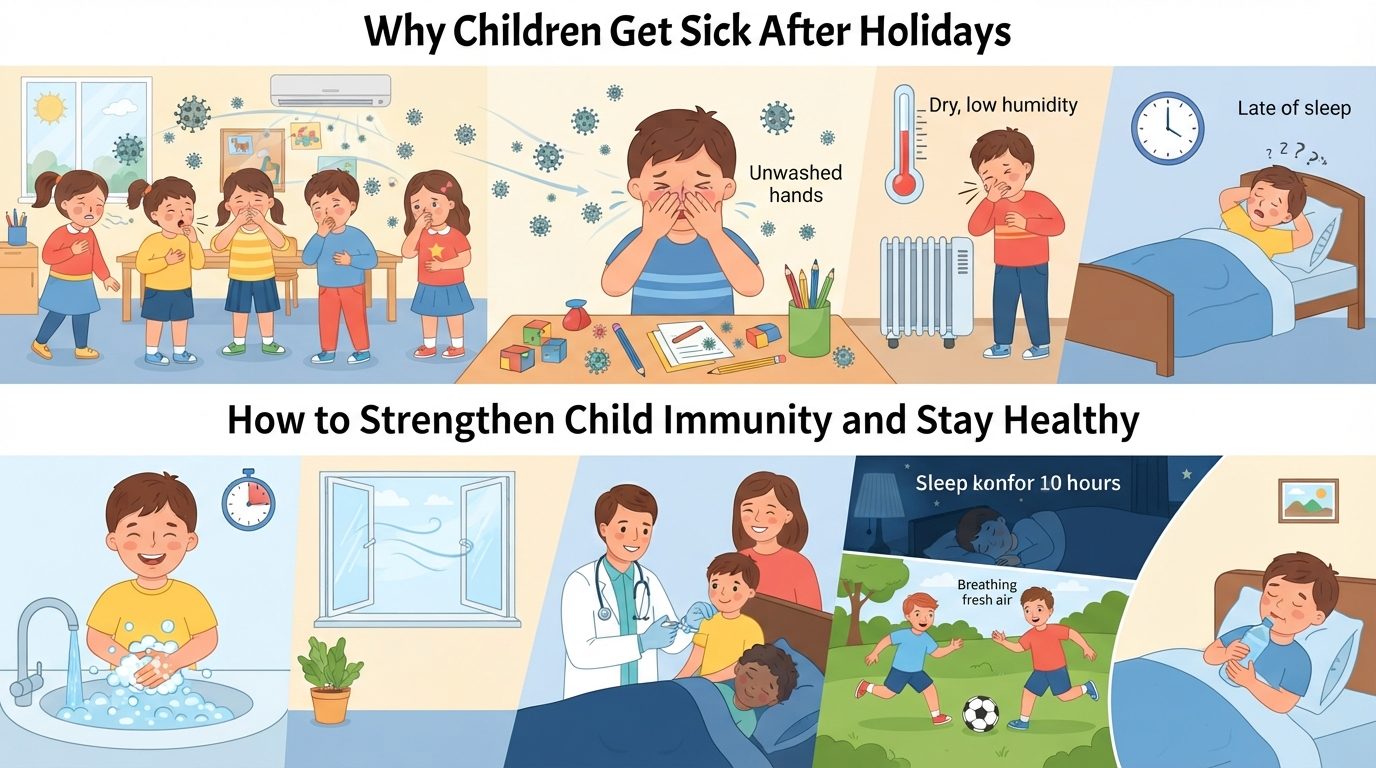
Why do children get sick after the holidays and how to strengthen their immunity?
The "cold" in children is most often an acute respiratory viral infection (ARVI), mainly caused by rhinoviruses. These viruses are transmitted by airborne droplets: viral particles are spread when an infected person coughs or sneezes. The disease can also be transmitted by shaking hands, touching contaminated surfaces, or inhaling virus particles through the air. That is why children are more likely to get sick after the holidays.
**Children return to the team**
With the start of the school year, children communicate more and more closely with each other. They often spend time in closed spaces, such as school classrooms and kindergarten groups. In such places, viruses accumulate more than in the open air, which increases the risk of infection.
**Not following hand hygiene**
Many children have a habit of putting dirty hands or various objects (pens, pens, toys) in their mouths. This also makes it easy to catch the disease. When their parents are not around, the child is more likely to forget to wash their hands at school and kindergarten.
**Room air becomes dry**
Batteries and other heating devices reduce the humidity in the room air. As a result, the nasal mucosa becomes dry and susceptible to viruses.
**Children's sleep is not normal**
Many children do not follow the daily routine during the holidays. When school starts, they are forced to get up early, which leads to sleep deprivation. Lack of sleep negatively affects the immune system and reduces the body's ability to fight infections, as a result of which children often get sick.
**How to strengthen a child's immunity?**
Simple methods of preventing flu and ARVI will help to reduce the risk of getting sick.
**Remind your child to wash his hands**
Explain to your child why it is impossible to touch his nose, mouth and eyes with dirty hands. Agree with him to wash his hands immediately after a walk and before eating. This should be done according to simple rules:
* Wet hands in clean, running water.
* Lather hands: the back of the palms, between the fingers and under the nails.
* Rinse thoroughly in clean, running water.
* Dry with a clean towel or in a dryer.
Make sure your child washes his hands for at least 20 seconds. To make it easier for the child and not to count the time, offer to sing the song "Happy Birthday" twice during this time. According to scientists, this process should last exactly this long.
**Regularly ventilate the rooms**
Ventilating the room increases the amount of fresh air compared to the air containing virus particles. All rooms at home should be ventilated, and in school or kindergarten, teachers can open the windows during breaks or when children go for a walk.
**Vaccination of the child and yourself**
Vaccination is the best prevention of infectious diseases, including seasonal flu. It is best to get vaccinated against it in September-October, before the incidence increases.
**Monitor your child's sleep**
Children aged 6 to 12 years old need 8–12 hours of sleep. From 13 to 18 years old, the daily sleep norm is 8–10 hours. Help your child develop the habit of going to bed at the same time every day. To do this, you need to follow the established routine even on weekends. When preparing for sleep, the room should be dimly lit, and an hour before bedtime, limit screen time: do not allow the phone to be taken away, watching TV or playing video games.
**Help your child be physically active**
Regular physical activity helps the immune system fight diseases better. It is not necessary to give the child to professional sports. A walk in the fresh air or active games on the street are enough.
**What does not help protect against disease?**
Almost all the means that pharmacies offer for the prevention of influenza and ARVI do not work.
**Vitamin C**
Taking vitamin C does not prevent viral infection. It also does not help to significantly shorten the duration of the disease. The difference in the duration of the disease between those who took the vitamin and those who did not is only 8–14 percent. Considering that a person is sick for an average of 7 days, vitamin C can only help him recover a day earlier.
**Antivirals**
There are several hundred types of rhinoviruses, so it is difficult to imagine a drug that would protect against each of them equally. Taking antivirals for the prevention of ARVI is not indicated as a preventive measure in any international clinical recommendations. They are mainly recommended in advertisements by the manufacturers of the drugs themselves. However, these pills have no proven effectiveness. It should also be remembered that immunity is an independent and aggressive system. It regulates the number of inflammatory and anti-inflammatory cells itself, so you should not interfere with its work.
**Oxolin ointment**
Its task is to create a barrier on the nasal mucosa so that virus particles cannot enter the body. Although this ointment has been used for 50 years, there is still not a single study confirming its effectiveness.
**Dressing too warm**
People get sick when they get a viral infection. Wearing a warm hat and several layers of clothing at a temperature of +15 °C does not protect against infection. Being cold does not cause illness. Therefore, dress your child according to the weather.
**What to do if your child gets sick?**
As soon as the first signs of illness appear, the child should be left at home to prevent infecting other children. Immunity will overcome the virus itself after a few days. At this time, you can help the child relieve unpleasant symptoms:
* Give antipyretics when the body temperature rises.
* Rinse the nose with saline solution to moisten the mucous membrane.
* Ventilate the room and humidify the air.
* Ensure that the child gets plenty of rest and drinks enough fluids.
**When should you see a doctor?**
If you experience any of the following symptoms, you should seek immediate medical attention:
* Difficulty or rapid breathing.
* Signs of dehydration.
* Fever lasting more than four days.
* Symptoms that do not improve for more than 10 days or disappear and then reappear.
* Worsening of chronic conditions.