

Why some Indian civil servants become heroes for doing their jobs
In a system often marked by red tape and exhausting delays, officers seen to be following the rules get adulation.
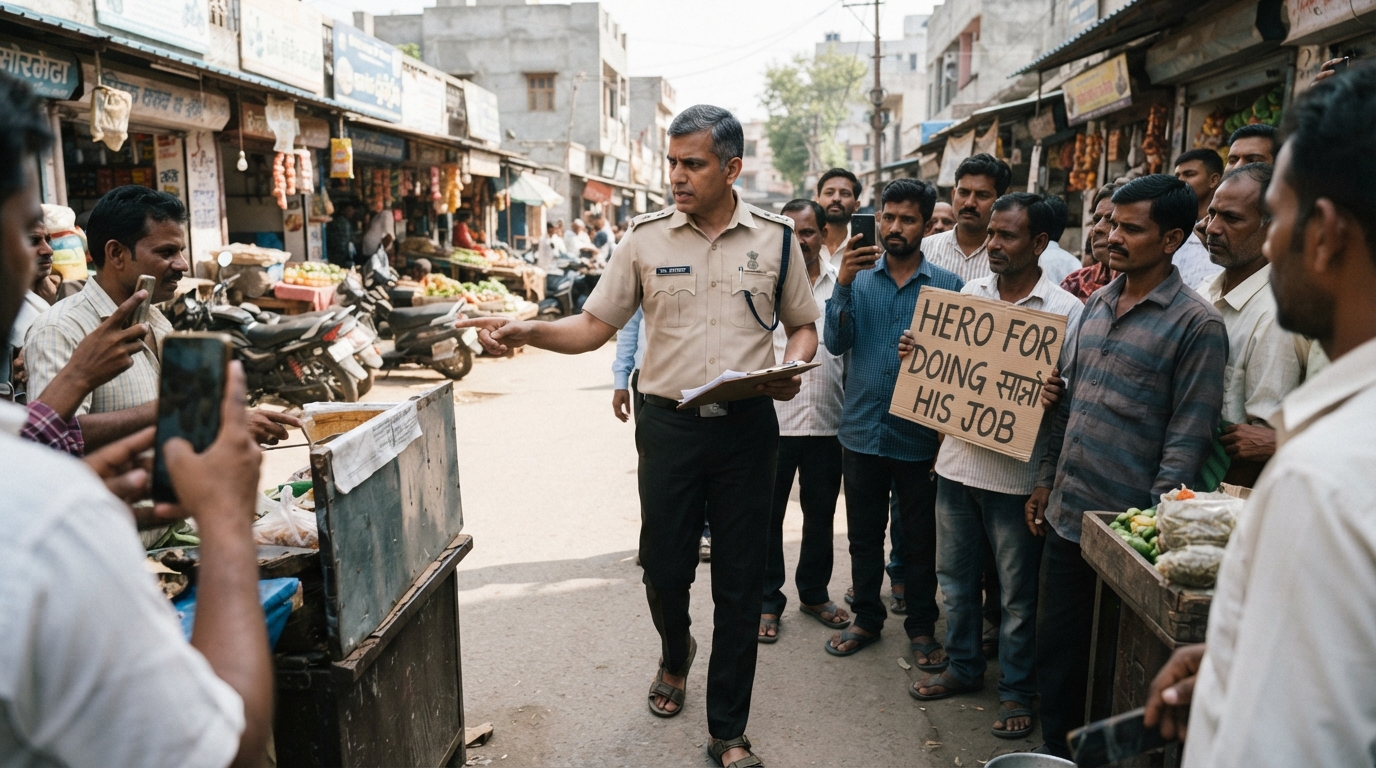
Why some Indian civil servants become heroes for doing their jobs
Among the thousands of civil servants who keep India’s huge government system functioning, only a few every few years emerge as unlikely public figures.
Tukaram Mundhe, 51, is one of them.
As commissioner of Maharashtra’s Food and Drug Administration, he has launched a series of enforcement drives since taking over in May. His teams have checked restaurants and other food businesses, finding pest infestations, poor hygiene and expired food.
He has also drawn attention to the wide difference between what hospitals pay for common medical supplies and what patients are billed.
Those steps have turned Mundhe into a social-media celebrity, with inspection videos and photos widely circulating online. Hundreds of people have said they wished officers like him could be sent to address food safety problems in their own state.
Mundhe is not the only one. In Gurugram, a suburb of Delhi, district town planner RS Batth has also been praised for taking action against illegal construction and encroachments.
But why are such officials hailed as heroes for simply doing their jobs?
In India, civil servants handle many services people depend on every day, from issuing documents to policing, food safety and healthcare. Yet many are also accused of delays, bribe-taking and making people run from pillar to post.
So when an official seems to cut through red tape, the reaction can be remarkably enthusiastic.
“What should have been normal has become exceptional,” says retired civil servant Kamal Kant Jaswal.
For many citizens, delays, bureaucratic obstacles and indifferent treatment have become so routine that efficient governance now stands out as unusual, he adds.
Many Indians link government offices with long procedures, repeated visits and an often unresponsive bureaucracy.
Mundhe is not the first official to be recognised for doing exactly that.
One of the best-known examples is TN Seshan, who became a household name as India’s chief election commissioner in the 1990s for strictly enforcing rules without fear.
Such stories have made the idea of the “honest” or “no-nonsense” bureaucrat both familiar and rare.
Jaswal, however, notes that thousands of officials in India do their work without drawing public attention.
“Their work may not involve much direct contact with citizens, or may simply be less visible.”
For ordinary people, though, a trip to a government office is often viewed as an exhausting ordeal.
Rajesh Singh, 43, who works at a finance company in Delhi, says he has faced long waits to get work done and even longer processes to resolve complaints.
“What is supposed to take 24 hours, I have personally experienced being stretched to six months with no guarantee of a positive outcome even then,” he says.
But an officer praised for enforcing rules can also be criticised for applying them too rigidly without considering ground realities.
Kiran Bedi, India’s first woman IPS officer, became known for her strict approach to law enforcement.
Mundhe has faced criticism from parts of the food and hospitality industry over his enforcement drives. He has denied allegations of selective or unlawful action, saying inspections are evidence-based and licences are suspended only in serious cases.
Batth has also come under fire for acting against illegal encroachments, with critics claiming his enforcement is selective and disproportionately harms vulnerable people. In several viral videos, he has said his actions are carried out strictly under town-planning rules.
Jaswal says a street vendor’s stall may be an illegal structure in the eyes of the law, but it could also be a family’s only source of income. And in a country where millions move to cities in search of work, unauthorised living spaces may be the only way to find shelter.
This tension between law and economics helps explain why the same enforcement action can be seen as both lawful and harsh.
Bureaucrats also face their own difficulties while carrying out their duties.
Pushpa Sundar, who briefly worked as a civil servant and has written extensively on development issues, says officers can face political pressure and transfers when they refuse to comply with demands.
“They too have families, careers and financial responsibilities and it needs extraordinary courage to risk those things in order to act independently,” she says.
She argues that officers need stronger institutional backing when they refuse to do something illegal or improper.
Jaswal recalls facing such pressure himself.
In 1974, when he was district magistrate of Uttarkashi in what was then undivided Uttar Pradesh, a senior minister was contesting the state legislature election.
He says he had to reject several demands from the minister because they violated the rules. The minister won the election, and Jaswal says he received his “marching orders soon after”.
But when he left for his next posting, people stood in the summer heat for several kilometres along his route to say goodbye.
The relationship between politicians and civil servants, he says, is rarely simple.
Many civil servants who want desirable postings or depend on political backing choose the path of least resistance, while resisting political pressure comes with costs, he says.
Social media has also changed how quickly an officer can become a public sensation.
What once stayed confined to a district can now be filmed, shared and watched by millions within hours.
“Social media can turn an official into a national talking point almost overnight,” Sundar says.
That is partly what happened with Mundhe, whose inspection videos have turned routine enforcement into a widely watched spectacle.
Mundhe, however, sees it differently.
Speaking to the BBC last month, he said his actions were driven by public-health concerns and that businesses following the rules had nothing to fear.
For Mundhe, the attention is not the point. The rules already exist, and his job is simply to enforce them.
But the public fascination is about more than one officer.
When basic government functions are carried out visibly and consistently, they can seem extraordinary — especially because so many people have come to expect the opposite.