

Why do companies need teambuilding and when does it actually work?
Why do companies need teambuilding and when does it actually work?
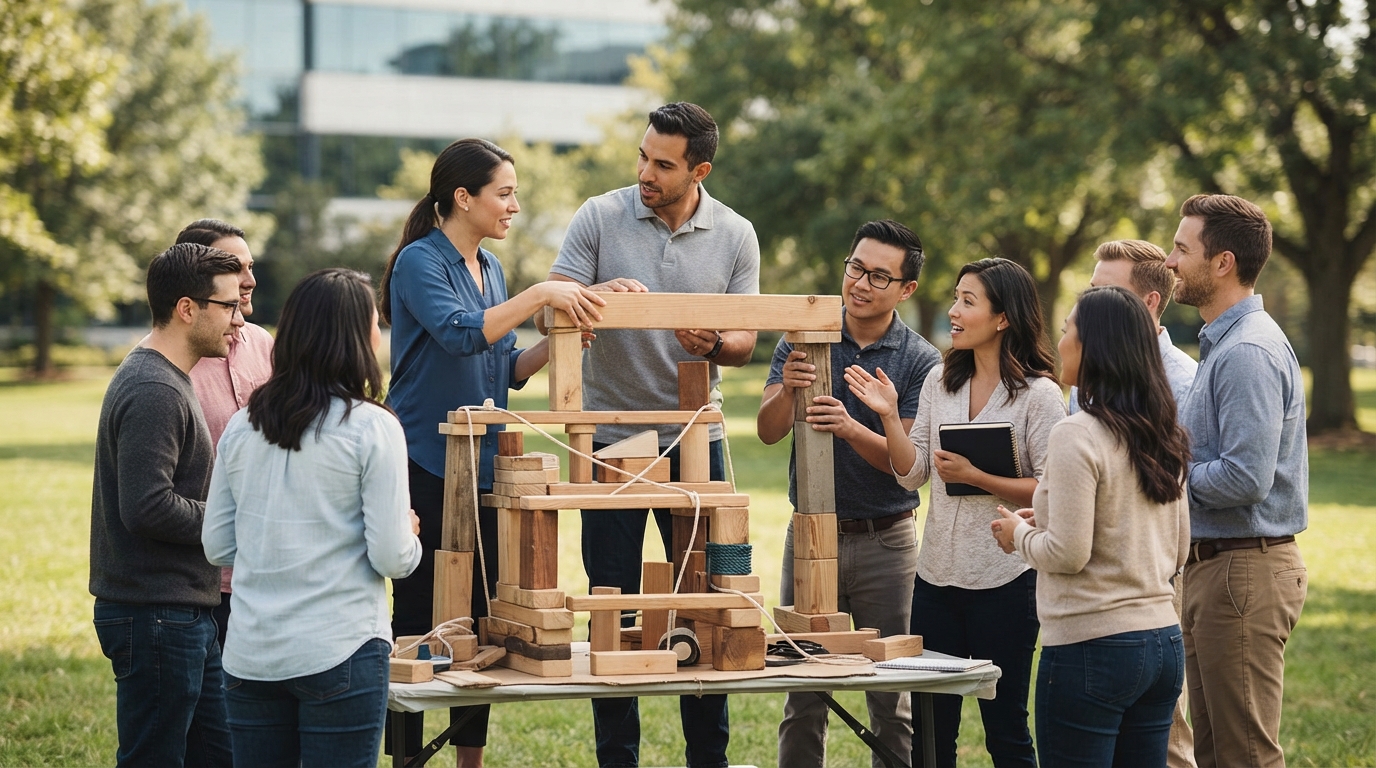
Employees build a tower of wooden blocks, act out a scene, or complete tasks outdoors. From the outside, this is easily mistaken for ordinary corporate entertainment, but teambuilding has a different goal — to help colleagues practice skills that, in a work environment, are often tested only under stressful circumstances: communication, role distribution, conflict resolution, and the willingness to ask for help. Together with teambuilding expert Temur Karimov, we look into where the corporate party ends and teamwork begins, why a single successful day cannot fix management problems, and how to understand if teambuilding has actually proven useful.
### Corporate party or teamwork
In everyday speech, teambuilding refers to almost any event where colleagues find themselves outside the office: a dinner, a trip out of town, a sports tournament, or a shared celebration. Such recreation can indeed bring people closer: in an informal setting, an employee is no longer perceived solely as a job title, and colleagues find common topics and connections that do not always have a place in work meetings.
But a pleasant evening in itself does not yet mean that the team has learned to make decisions, share information, or calmly discuss mistakes.
Temur Karimov does not draw a hard line between a corporate party and teambuilding. According to him, anything that strengthens informal connections can be beneficial. The difference arises where the meeting has a specific work goal, a facilitator monitors the process, and the participants, after the exercise, discuss how they acted and what can be transferred from this into daily work. A corporate party primarily provides relaxation and socialization. Teambuilding, in a stricter sense, becomes a training session.
"Clients often say: we want to raise team spirit, motivation, efficiency. But all of this is based on one factor — the level of trust. If there is no trust between colleagues, the manager, and subordinates, the corporate culture remains on paper," explains Temurbek Karimov.
Therefore, the task must sound more precise than a request to "unite the team." One team needs to learn to hear the quiet participants of a meeting, another — to coordinate actions between departments faster, a third — to discuss mistakes without looking for someone to blame. The format also depends on the answer: free communication is useful for getting to know each other, while a role-playing exercise or a joint task is useful for observing specific work habits.
### How the team became an object of science
The idea of purposefully working not only with an individual employee but also with relationships within a group arose long before modern outdoor programs. In 1924, productivity studies began at the Western Electric plant in Hawthorne. They continued until the early 1930s and drew managers' attention to the informal side of the organization: group norms, personal connections, and a sense of belonging could influence behavior just as much as instructions and pay. Later, the methodology and some of the findings of the Hawthorne experiments were criticized, but it was they that helped shift the conversation about management from the mechanics of the workplace to human relations.
In the 1940s, social psychologist Kurt Lewin established the concept of "group dynamics" and proposed viewing the group as a system in which the behavior of one person changes the conditions for the rest. After Lewin's death, the staff of the center he founded at the Massachusetts Institute of Technology moved to the University of Michigan. There, T-groups and sensitivity training were developed: participants learned to notice their own behavior, receive feedback, and analyze what was happening right during the interaction. This is already similar to the modern principle of "did it – discussed it – tried it differently."
In 1965, American researcher Bruce Tuckman described the now-famous sequence of group development: forming, storming, norming, and performing. The model is often turned into a convenient scheme for training, although initially it was a review of research on small groups, not a promise that four exercises would guide a team through four stages. Its value lies elsewhere: tension and disagreement in themselves do not mean that the team is broken. What matters is whether it can go through them and agree on the rules.
### What research actually confirms
The short answer from science is this: well-thought-out teambuilding programs help on average, but the size of the effect and its sustainability depend on the content. In a 2009 meta-analysis, researchers compared 60 statistical relationships and obtained a moderate positive effect across four groups of outcomes: knowledge about teamwork, participants' attitudes toward the team, work processes, and performance. Teambuilding was most strongly associated with emotional and process changes — how people perceive the team and how they interact.
The authors looked at four main areas: setting common goals, clarifying roles, solving problems, and working on interpersonal relationships. This is an important caveat. Under the word "teambuilding," research hides specially designed interventions, not just any quest, picnic, or competition. A high rating of an event in the evening shows that people liked it. It does not yet prove that a month later, departments began to coordinate their work better.
Another mechanism is connected with trust — psychological safety. This is the name for the general feeling that in a team, one can ask a question, admit a mistake, or express a doubt without humiliation or punishment. In Amy Edmondson's classic study of 51 work teams, psychological safety was associated with behavior necessary for learning. At the same time, the researcher herself pointed to the role of context, including support and the behavior of the leader. A game can provide a safe rehearsal, but it will not create such an environment if the boss punishes for uncomfortable questions again the next day.
Modern international practice has therefore long gone beyond ropes courses and fun contests. A review in the journal American Psychologist attributes four different tools to team development: team training, leadership development, teambuilding itself, and debriefing of joint work. In healthcare, for example, the American program TeamSTEPPS is built around communication, leadership, situation monitoring, and mutual support. It includes simulations, an implementation plan, and measurement tools — meaning that it is not the outing itself that is important, but the skill that the team then applies where an error has real consequences.
### Why play helps to speak up
In a normal work situation, people protect their professional reputation. An employee may remain silent if they did not understand the task, so as not to appear incompetent. They may not propose a raw idea or object to the manager. Karimov believes that the game form temporarily removes this armor. He describes it as returning adult professionals "to the level of childhood," where they can try, make mistakes, and negotiate without the official weight of each remark.
"A person is afraid to speak their mind even among colleagues: someone will think they are stupid or do not understand. There must be an atmosphere in the team in which people are not afraid to speak up and express themselves. One thought leads to another — this is how the skill of collective thinking appears," says Karimov.
This is precisely where the exercise becomes a diagnostic tool. While the group is building a structure or solving a task with limited time, it is quickly visible who claims leadership, who remains outside the conversation, how information is transmitted, and what happens after a mistake. But observation in itself changes little. The team needs a debriefing: what goal did it set, what worked, why did a failure occur, and what rule will it try to apply in real work.
The importance of such a debriefing is confirmed by a 2013 meta-analysis. Its authors concluded that properly conducted debriefings can improve individual and team performance by about 20–25%. These data refer to a structured discussion of experience in various conditions, and not to just any conversation after a game. The main principle is still clear: participants must not only live through a shared experience but also turn it into conclusions about their behavior.
### When teambuilding will not work
The most common mistake begins even before choosing a venue. A company orders "team spirit," although the real problem may be in overload, unclear authority, unfair pay, or conflicting indicators of two departments. These causes cannot be eliminated by a relay race. Teambuilding can make the problem visible and help discuss it, but the solution will require managerial changes.
The second risk is a manager who observes from the sidelines or is not ready to hear something unpleasant. In Karimov's experience, the format works better when the boss participates along with the employees and acts as a team leader, not as a judge over it. If at the training people are invited to speak openly and then punished for what was said, trust will become lower than it was before the meeting. The same happens when participation is formally voluntary, but refusal is perceived as disloyalty.
"Teambuilding is effective when the manager goes along with their team. It is important that employees can identify a problem and tell the manager about it directly, and he does not take it as personal criticism," notes Karimov.
A scenario that is too universal can also turn out to be unsuccessful. Fierce competition reinforces already existing rivalry, public confessions violate personal boundaries, and physical challenges exclude some of the employees. Finally, even a good conversation fades if the company cannot change processes. Karimov separately mentions bureaucratic organizations: ideas appear there, but, unfortunately, they go through too long a path to implementation.
### How to check the result
The result cannot be measured by the number of smiles in photographs. Before the event, the company should choose one or two observable signs: for example, the speed of task transfer between departments, the number of returns due to an unclear task, the participation of employees in discussions, or the willingness to report an error in a timely manner. It is useful to record the baseline state with a short anonymous survey and work data, and then repeat the measurement after a few weeks. If the manager, workload, or motivation system changed at the same time, these factors will also have to be taken into account.
Immediately after the meeting, it is more important to ask not "did you like it," but "what did we notice in our work" and "what will we do differently." The agreement must have an owner and a review deadline. This could be a new meeting rule, a procedure for transmitting information, or a short debriefing after a complex project. Then the event becomes the first cycle of practice, rather than a separate bright day.
Temurbek himself emphasizes that with some teams, work continues for years and is repeated monthly. In this, his experience coincides with the conclusion of research: a team changes through repetition, feedback, and the behavior of the leader. A one-day teambuilding can start a conversation, show habitual roles, and give people their first safe experience of cooperation. But if on Monday the team returns to the same prohibitions and silence, the event remained a corporate party, no matter what it was called in the budget.