

Do you feel guilty when calling in sick at work? This might be why...
As many as half of people report working when sick. The reasons for this are complex, experts say.
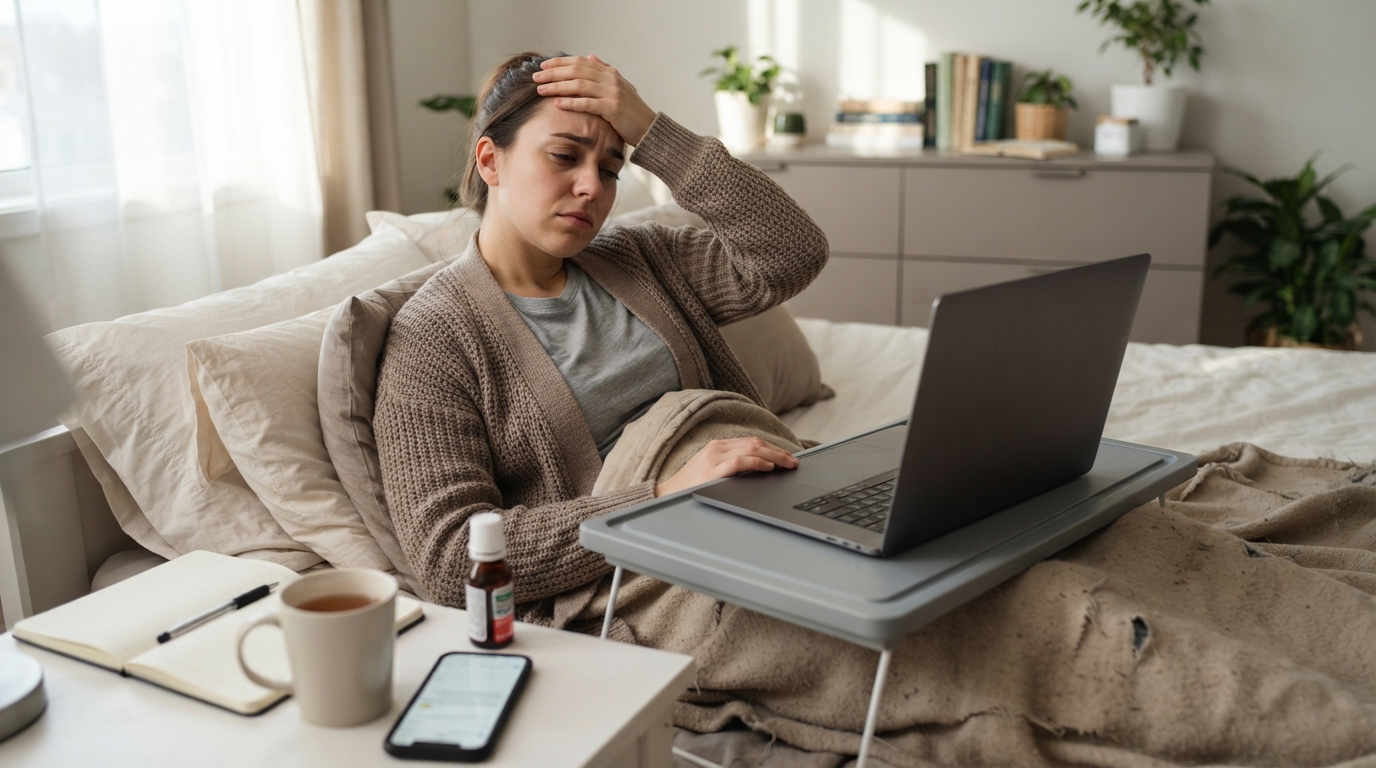
Do you ever feel bad about phoning in sick at work? That could be the reason...
You wake up feeling ill, but there’s a major day ahead at work. What should you do? If your answer is to go in, or log on, you’re far from alone.
Research suggests, external that between a third and a half of people in the UK work while sick — something experts describe as presenteeism.
And the way you handle sickness can reveal a great deal about you as a person and about your workplace.
“The younger generation get the snowflake tag thrown at them, but it’s not true,” says University of Manchester psychologist Prof Sir Cary Cooper, one of the world’s leading experts on workplace wellbeing.
Workers aged 16 to 24 took an average of 2.4 days off sick last year, compared with 6.2 days for those aged 50 to 64.
Sir Cary, who has advised the UK government on employment policies in this area, says there are a number of reasons for this.
Younger workers are more likely to be in jobs with little security, such as zero-hours contracts.
They are also less likely to have long-term health conditions and joint problems, which are major causes of sickness absence.
When was your last sick day?
But Sir Cary adds: “I think younger generations do have higher expectations about how employers should treat them and consider their wellbeing.
“Older generations have perhaps been more willing to put up with things, but that doesn’t necessarily make that approach healthy.
“When it comes to taking time off, younger workers seem more willing to view mental wellbeing as part of their overall health rather than something that should simply be pushed through.”
A range of factors shape how someone approaches sickness absence.
For some people, work is closely linked to identity. Occupational psychologists call this work centrality — and research connects it with greater engagement, commitment and a willingness to go the extra mile.
If work is central to who you are, being absent can feel like temporarily losing part of yourself.
“These people feel a strong desire to keep showing up,” says Dr Audrey Tang, a psychologist who writes about workplace wellbeing.
She says this is especially common among people in caring professions such as medicine, nursing and teaching.
“They often report they would rather have a physical accident to have a reason not to show up than just take the day off.”
Others worry about being seen as weak or lazy. Younger workers are especially vulnerable to this, says Tang.
“They’re more likely to be early in their profession and they don’t want to leave a negative impression.”
Workplace culture and behaviour can strongly affect whether people feel able to take sick leave, says psychologist Dr Tara Quinn-Cirillo.
When teams are stretched and there is little or no cover, employees know their absence will add to colleagues’ workload.
“The role of guilt and shame is significant in a toxic organisation that prioritises productivity over health and wellbeing,” says Quinn-Cirillo.
“There is a ‘carry-on’ culture in some workplaces that encourages people to keep going when they should be resting.”
Such cultures encourage presenteeism. Employees feel appreciated for turning up no matter how they feel, and staff quickly absorb the message when managers praise people for working through illness.
Workplace culture can have a significant influence on people’s willingness to take sick days
“In a healthy work environment, people should be able to have open and honest conversations about wellbeing and sick days,” says Quinn-Cirillo.
Trust is important too. If absence is regularly challenged or seen negatively, workers may become reluctant to take legitimate time off for fear of being judged.
That, says Quinn-Cirillo, is a “huge red flag”.
Deciding whether you are too sick to work is not always simple.
For physical illness, Tang says there are some well-established rules of thumb.
“If you’re vomiting and have diarrhoea or have a fever, you should stay at home for 48 hours and 24 hours respectively after the symptoms have passed. In those situations, you’re unlikely to be able to work effectively anyway.”
Beyond that, the choice becomes more complicated, according to Tang.
“Where there is more of a grey area is with coughs and colds. Since Covid, workplace etiquette has changed - generally it’s considered polite to work from home.”
But she says one absolute rule is that mental health should be treated no differently from physical health.
“If you’re sick and unable to work, you’re sick and unable to work.”
Quinn-Cirillo adds: “Ultimately it’s about capacity to do a job, whether it be physical or mental health.”
Another warning sign is when work begins to affect basic self-care, she says.
“Is your ability to look after yourself changing? Are you able to decompress from work? Is your sleep OK?”
If the answer is no, it may be a sign that rest is exactly what is needed.