

Why did the dollar drop below forecasts and what will happen to it by the end of the year?
Why the dollar turned out to be lower than forecasts and what will happen to it until the end of the year?
The Uzbek sum looks noticeably stronger than the June forecasts of the Eurasian Development Bank (EDB): as of October 8, the dollar exchange rate settled at 11,809.19 sums, whereas a figure of 12,200 sums was expected. EDB analysts told Podrobno.uz what is helping the national currency hold its ground and updated their estimate for the end of the year.
Artur Sharafutdinov, Head of the Country Analysis Center at the EDB, noted that the balance of risks has shifted in favor of a stronger sum. If current trends persist, the bank expects the average exchange rate to be around 12,000 sums per dollar in the remaining months of the year.
As a reminder, in June, EDB analysts predicted that after a historic decline, the dollar exchange rate in Uzbekistan could start rising again. They also expected a gradual weakening of the sum in 2027–2028. Under a conservative scenario, the average rate in 2027 was projected to be 12,900 sums per dollar, and to rise to 14,100 sums in 2028. Sharafutdinov attributed this to high domestic demand and faster import growth amid an investment cycle, equipment purchases, and economic modernization. For 2026, the bank had then forecast an average rate of 12,200 sums, lowering its estimate from 12,800.
Since the actual rate turned out to be lower than these benchmarks, Podrobno.uz asked the EDB to clarify whether the June forecast remains in place, whether adjustments are possible before the end of the year, and which factors are currently exerting the strongest influence on the sum's exchange rate.
According to Sharafutdinov, after the June revision, external and internal factors generally developed favorably for the national currency. As a result, the probability of the exchange rate being stronger than the June estimate has increased.
For the remaining months of 2026, the EDB forecasts an average rate of around 12,000 sums per dollar, provided current trends continue. At the same time, the bank did not specify the range of possible exchange rate fluctuations and did not estimate how much the actual value might deviate from the projected average.
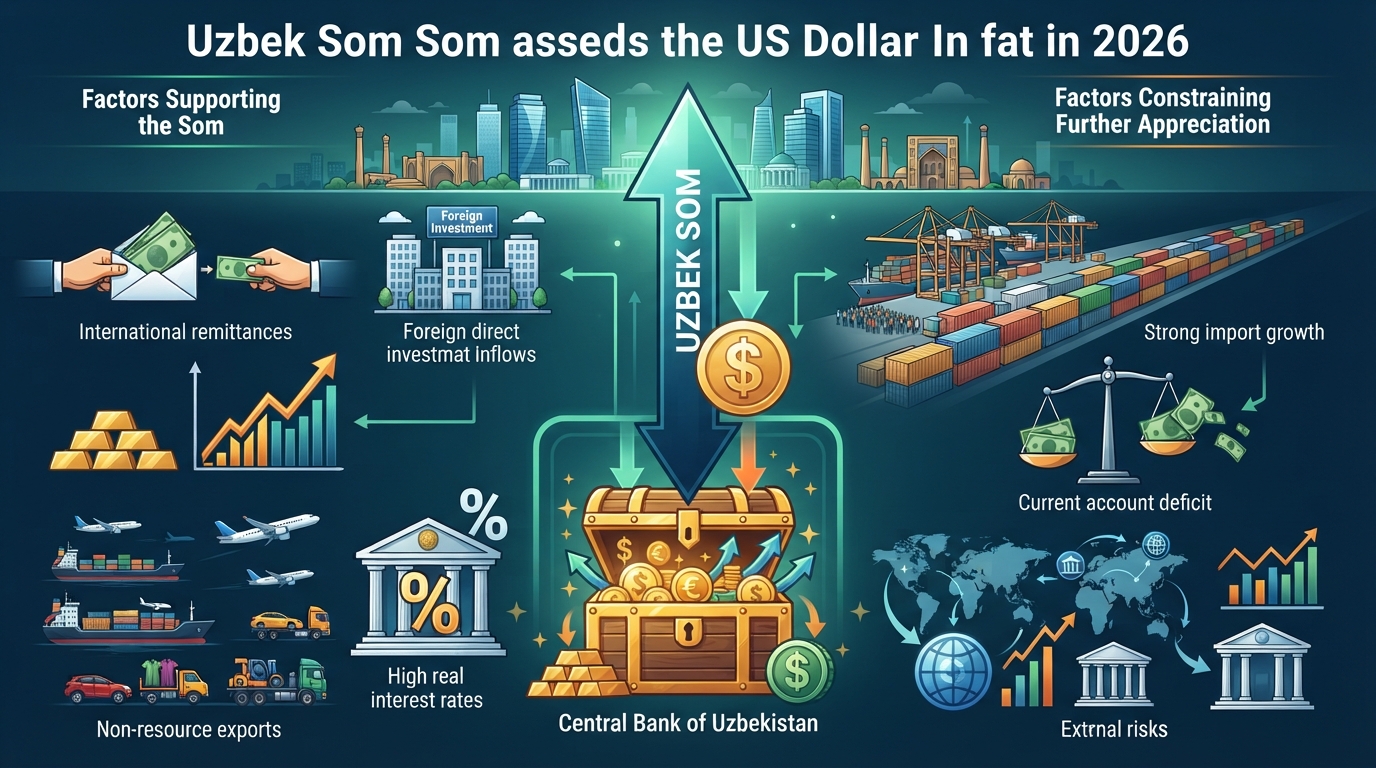
### What supports the sum
Among the key factors supporting the national currency, the EDB points to remittances. They increase the supply of foreign currency in the domestic market and partially offset demand from importers. In the first half of 2026, Uzbekistan received about 9.3 billion dollars in remittances — approximately 13% more than a year earlier.
Foreign investment remains another source of foreign currency. According to the Central Bank, the total net inflow in the main categories in the first half of the year amounted to about 5.8 billion dollars. Of this, 2.3 billion dollars came from direct investment, about 2 billion from portfolio investment, and around 1.5 billion from other investments.
Support for the sum is also provided by high gold prices. The EDB's June forecast already took into account the prevailing price level, but in August, the situation for gold remained favorable. According to the LBMA Gold Price, the precious metal rose by 14% over the month and ended August near 4,602 dollars per ounce. For Uzbekistan, this is particularly important due to the role of gold in exports and international reserves.
In parallel, non-commodity exports are also growing. This strengthens the stability of foreign currency inflows and partially offsets the decline in gold exports. In the first half of the year, exports of goods excluding gold grew by 29% in annual terms, while exports of services grew by 36%.
Another factor remains high real interest rates. They make savings in sums more attractive and, other things being equal, can limit the demand for foreign currency. On September 16, the Central Bank kept the policy rate at 14%. Inflation in August stood at 6.2% in annual terms, with core inflation at around 5.5%.
### What restrains strengthening
At the same time, the EDB emphasizes that the potential for further strengthening of the sum is not infinite. Strong consumer and investment demand supports rapid import growth. In the first half of the year, imports of goods and services increased by approximately 24% and exceeded 28.8 billion dollars.
Additional pressure is created by the current account deficit. According to the Central Bank's estimate, in the first half of the year it amounted to about 6.2 billion dollars. To cover it, it is necessary to maintain a sufficient inflow of capital and other external receipts.
### What the exchange rate will depend on next
According to EDB analysts, in the near term, the sum will continue to be supported by high volumes of remittances, export revenues, and investments. At the same time, further movement of the exchange rate will depend on how sustainable these flows turn out to be, as well as on import demand and external conditions.
Among the latter, the EDB highlights gold prices, the dollar exchange rate, global interest rates, and economic activity in the countries that are Uzbekistan's main trading partners.
At the same time, the strengthening of the sum is not a new trend. It also strengthened in 2025: by the end of the year, its average rate was stronger than a year earlier. Sharafutdinov previously explained this by a combination of factors, including an inflow of foreign direct investment amounting to 19 billion dollars, or 13% of GDP, high volumes of transfers, and attractive rates on sum-denominated assets.
In his opinion, a stronger national currency helps slow down inflation and move faster toward the Central Bank's target of 5%. In addition, cheaper imports benefit consumers.