

Who will protect the government from the government? | 5 minutes
Have you heard about the spirit of laws? Just as every human being has a body and a soul, laws also have a body and a spirit. We see the body of the law on paper, and its spirit in real life. A rule that seems fair on paper can in practice protect someone, while leaving another defenseless. Thinkers pondered this very issue three centuries ago.
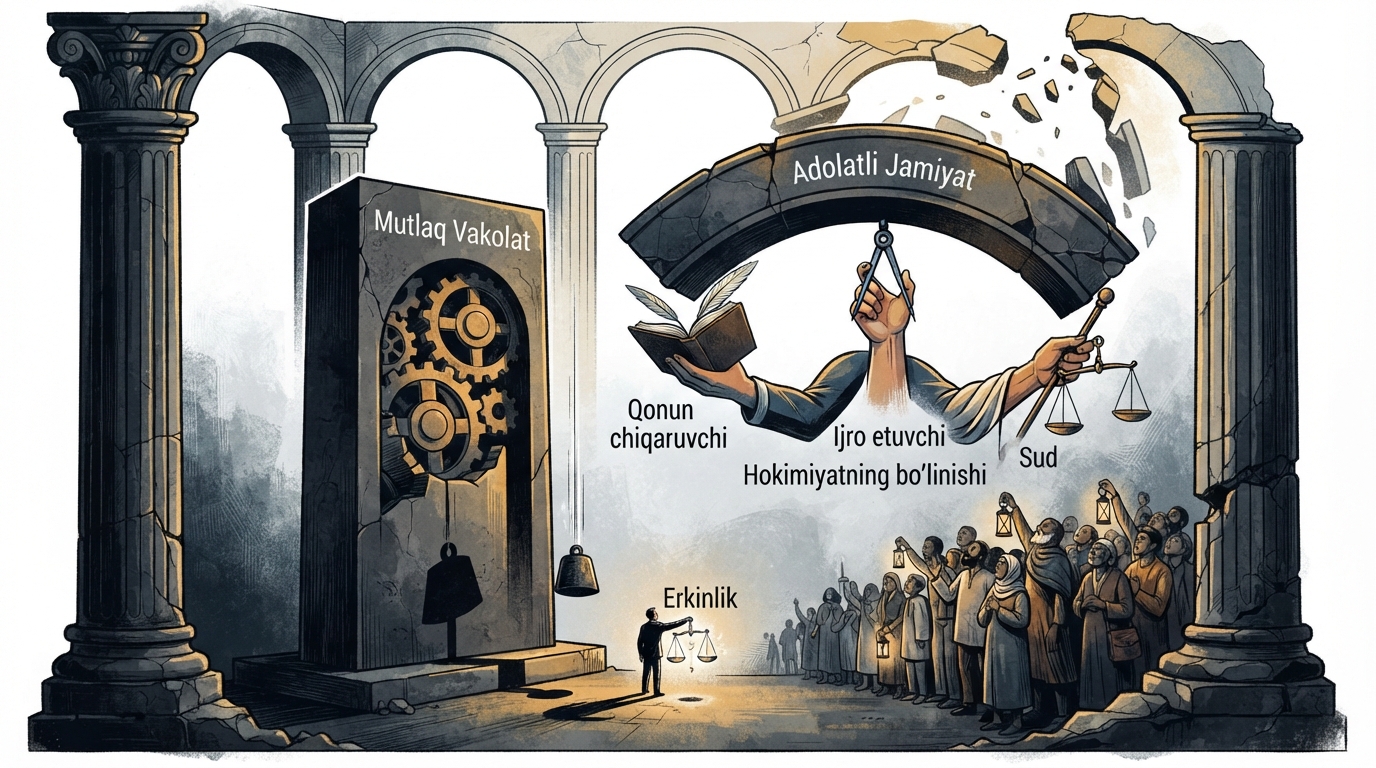
Who protects power from power? | 5 minutes
In this work, Montesquieu reflects on the state, society, law, and human freedom as a philosopher, jurist, and political thinker. This valuable book was translated into Uzbek by political scientist Hamid Sodiq.
Do not expect conventional characters, sharp plot twists, or mysterious events from the book. Here, the main character is power, and the central conflict takes place between freedom and absolute authority.
The work raises the issue of limiting power. As a thinker who understood human nature well, Montesquieu draws attention to one danger: if the authority in the hands of power is unlimited, the likelihood of its abuse also increases. Therefore, society's freedom should not depend solely on whether the leader is a good person. A system that controls power and limits its arbitrariness must also function.
According to Montesquieu, if the legislative, executive, and judicial powers are concentrated in one hand, true horror begins. Freedom is put at risk. Because in such a situation, the ability of power to control itself almost disappears. It is not always easy for a system or an individual to restrain themselves or view their actions critically.
To put it more simply, if the person who created the exam questions checked the answers themselves and graded themselves, how much would you trust the result? Of course, this is not the same as state governance, but it is a small example that helps to understand why the separation of powers is necessary.
The author emphasizes that a person should live trusting in their rights, be protected by law, and not fear the arbitrariness of power. While the law is a means of restricting the citizen, it must also provide a guarantee of protecting them.
However, do not rush to blame power for everything. Montesquieu does not only write about power. He also tries to understand why laws differ from one country to another. In his view, laws are linked to history, traditions, economic conditions, religion, lifestyle, and other factors. Thus, a rule that worked in one country may not give the exact same result in another. Law cannot be studied in isolation from society.
Today, laws are still being adopted. New decisions are issued. Various agencies exercise their powers. But the important questions for any society remain unchanged. That is, is everyone equal before the law? If a citizen's rights are violated, from whom do they seek protection? What conditions have been created for power to acknowledge its mistake and correct it? What is needed for the court to truly make decisions based on the law?