

Who gives more money to the UN?
According to 2025 data, seven of the top ten countries contributing the most funds to the UN system are located in Europe. Germany leads among European countries. China's contribution amounted to 2.7 billion dollars, while India's stood at 211 million dollars.
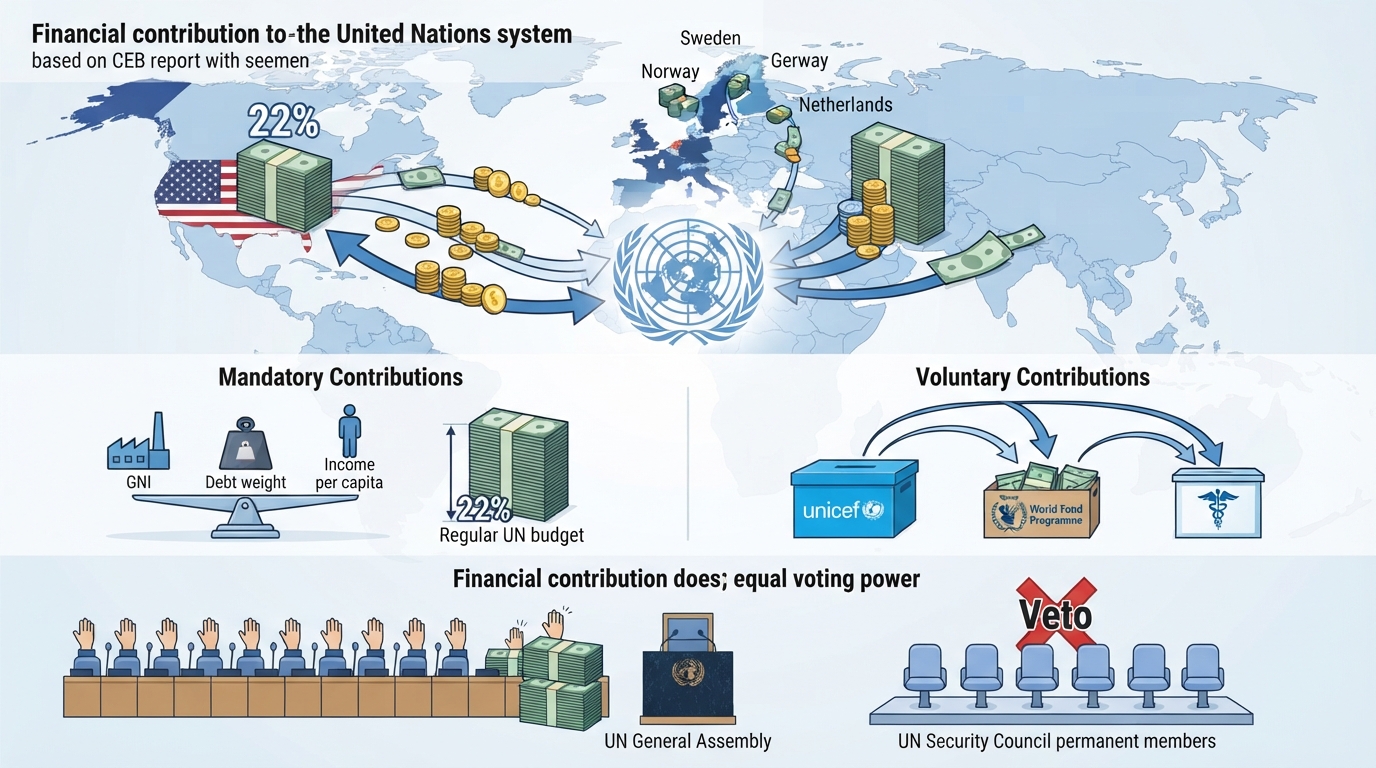
Who gives more money to the UN?
An infographic prepared by Visual Capitalist compares the funds allocated by countries to the UN system. The data is based on reports from the UN System Chief Executives Board for Coordination — CEB.
Along with Europe's participation among the leading donors, the contribution of some relatively small economies is also noteworthy. In particular, Sweden, Norway, and the Netherlands allocated more funds than some countries with significantly larger economies.
Assessed and voluntary contributions
The UN finances peacekeeping operations, humanitarian aid, and other programs through funds provided by countries. These funds are divided into two main types — assessed and voluntary contributions.
Assessed contributions are calculated based on a country's capacity to pay. In this regard, indicators such as gross national income, debt burden, and per capita income are taken into account.
An upper ceiling of 22 percent is set for a country's assessed contribution to the regular budget of the UN. The US share in this budget is equal to this maximum level. This figure does not mean 22 percent of all funds allocated to the UN system.
A separate formula is used in financing peacekeeping operations. It provides for higher rates for permanent members of the UN Security Council. US law, however, usually limits the country's share in the costs of such operations to 25 percent.
These restrictions do not apply to voluntary contributions. Through them, countries support specific initiatives of the United Nations Children's Fund — UNICEF, the World Food Programme, and other entities.
More money does not mean more votes
A country's financial contribution does not change the number of votes in the UN General Assembly. Each member country has one vote, regardless of how much money it allocates.
The five permanent members of the Security Council have the right of veto, which gives them a special mechanism to influence decision-making.
At the same time, countries can direct their voluntary funds to specific programs. This affects which humanitarian initiatives and development projects receive financial support.