

45.3 percent in Denmark, 1.4 percent in Kuwait: why do tax revenues differ?
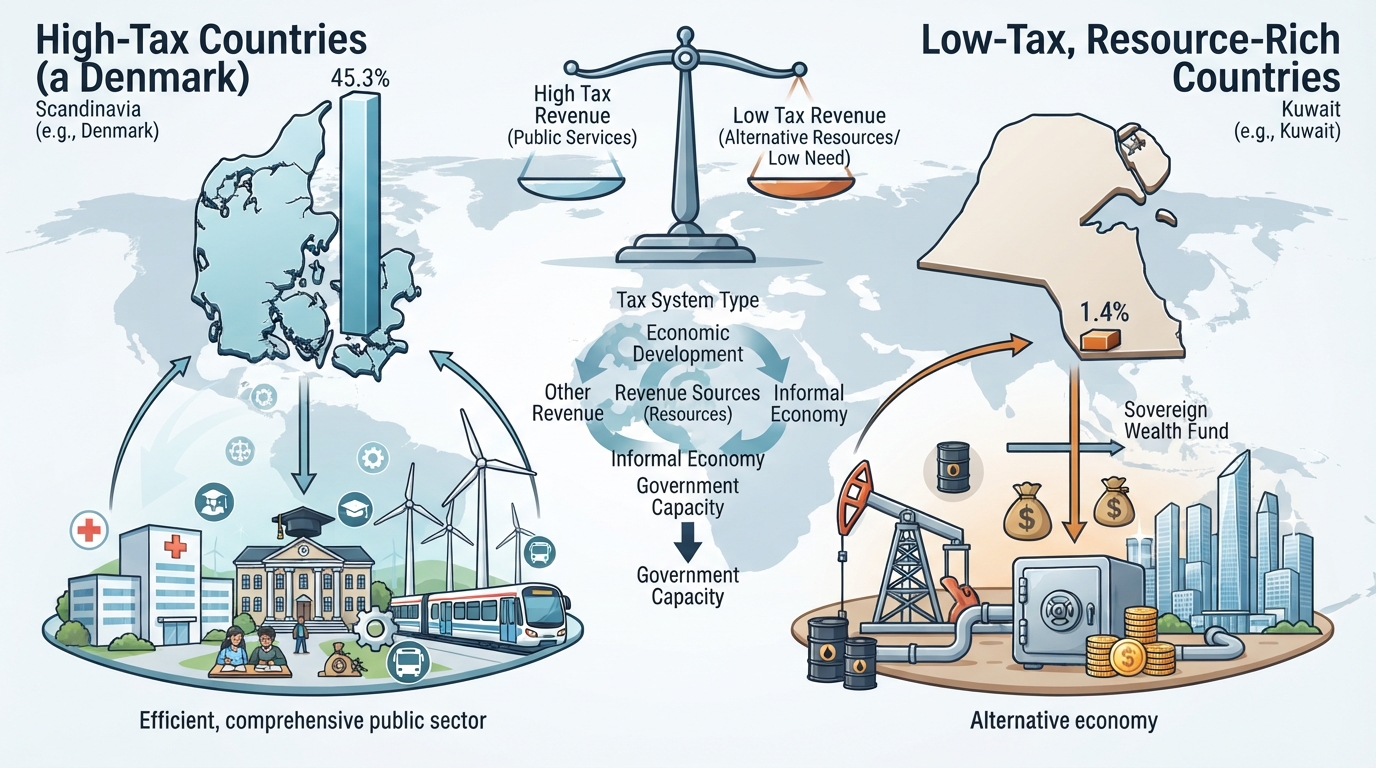
In 2024, Denmark's tax revenues accounted for 45.3 percent of its gross domestic product, while in Kuwait this figure was 1.4 percent. A Visual Capitalist infographic prepared based on International Monetary Fund data shows the large disparities between countries.
45.3 percent in Denmark, 1.4 percent in Kuwait: why do tax revenues differ?
In the comparison, countries' tax revenues are calculated relative to the size of their economy, i.e., the gross domestic product (GDP). These figures do not mean that a citizen or an enterprise pays exactly that portion of their income in taxes.
According to the presented data, the figures are as follows:
Such differences are related to tax systems, the level of economic development, and other sources of state revenue.
In Scandinavian countries, the tax base is generally broad, and revenues serve to finance major government programs. In the US, however, the share of private spending in areas such as healthcare and pensions is larger.
In countries like Kuwait, Qatar, Bahrain, and Oman, the share of tax revenues in GDP is relatively low.
For major oil producers, natural resources serve as an alternative source of government revenue. Therefore, low tax revenues do not mean that total budget revenue is also low.
In low-income countries, however, low tax revenues can be explained by other factors. In particular, the size of the informal economy and the government's limited capacity to collect taxes influence this.