

Which professions are in high demand in technical colleges?
Although there are more than 450 professions and specialties in Uzbekistan's technical schools, 49 percent of the total enrollment is concentrated in just seven directions. In the 2025-2026 academic year, 249,130 students were admitted to technical schools, but significant disparities remain in admission rates by specialty, region, and form of education.
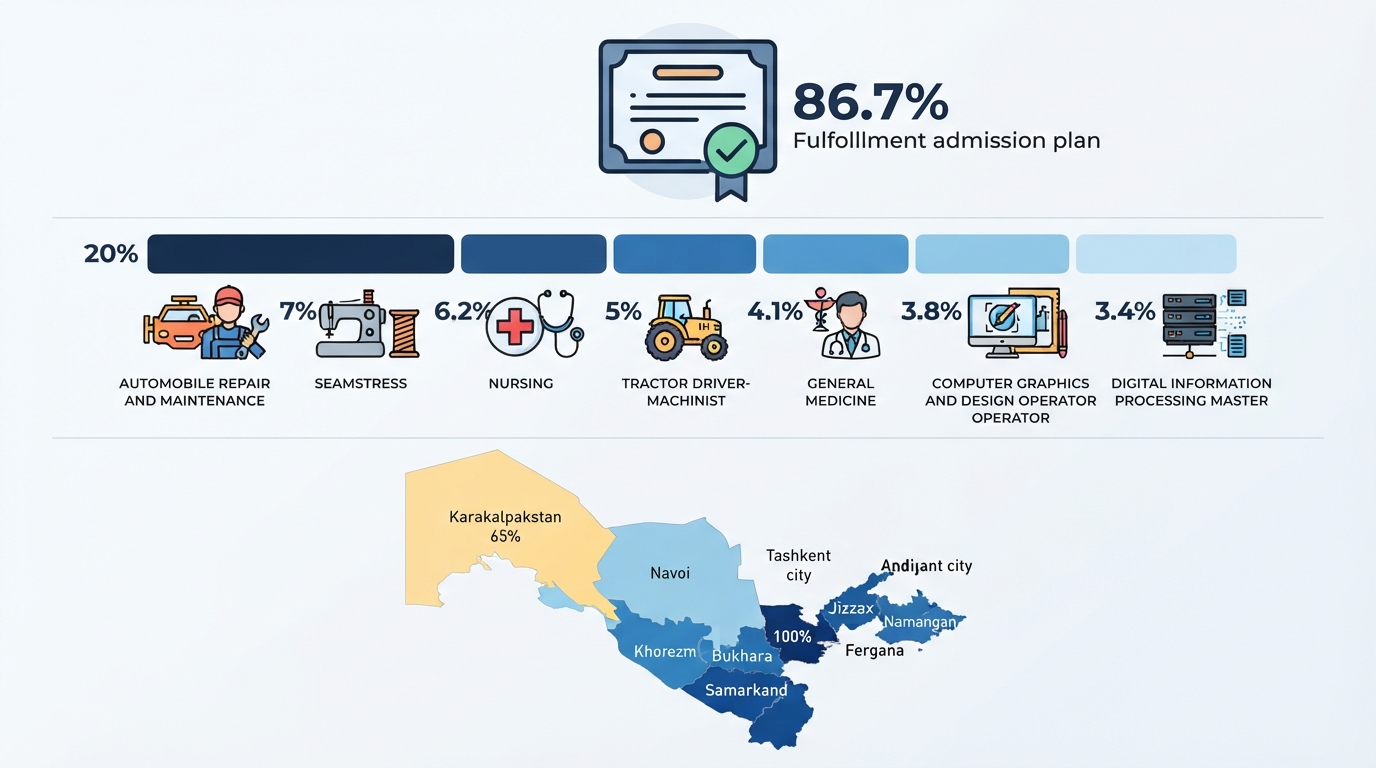
Which professions are in high demand in technical schools?
This issue is highlighted in the information-analytical report titled "Admission Parameters of Vocational Education Organizations and Their Effectiveness." The analysis was prepared based on official data provided by the Vocational Education Agency.
According to the document, 287,301 admission quotas were allocated to technical schools for the 2025-2026 academic year. In practice, 249,130 students were admitted. The report's table by forms of education notes that the overall admission plan was fulfilled by 86.7 percent.
The largest share of admissions — 20 percent — was accounted for by the profession of "Automobile Repair and Maintenance." While 27,660 places were allocated for this field, 50,116 students were actually admitted.
Additionally, the following professions and specialties accounted for a significant share of the total admissions:
- tailor — 7 percent;
- nursing — 6.2 percent;
- tractor driver-machinist — 5 percent;
- medical care — 4.1 percent;
- computer graphics and design operator — 3.8 percent;
- digital information processing master — 3.4 percent.
The analysis states that in some specialties, admissions were several times higher than the established quotas, while in others, the allocated places were not fully filled.
However, it is noted that zero or very low admission levels do not always mean there is no demand for a specific profession. In some cases, because not enough students were gathered to form a group, they were transferred to related fields with their consent.
The report indicates that the admission plan was fully completed in Fergana and Samarkand regions. This figure was 96 percent in Bukhara and Andijan, 93 percent in Jizzakh, and 92 percent in Namangan.
The fulfillment of the admission plan was 65 percent in Karakalpakstan, 70 percent in Khorezm region and the city of Tashkent, and 72 percent in Navoiy region. Thus, the gap between the regions reached 35 percentage points.