

"When a trolleybus stops running, people notice it immediately." Interview with the head of the Khorezm trolleybus enterprise
The only region in Uzbekistan where the trolleybus system remains is Khorezm. In the past 30 years, it has become an integral part of life. 'If a trolleybus stops running, you will immediately notice it,' says the head of the enterprise. With the arrival of new trolleybuses, the route will be extended, the interval will be shortened, and the number of passengers is expected to double.
“When a trolleybus stops, people immediately notice it.” Interview with the head of the Khorezm trolleybus enterprise
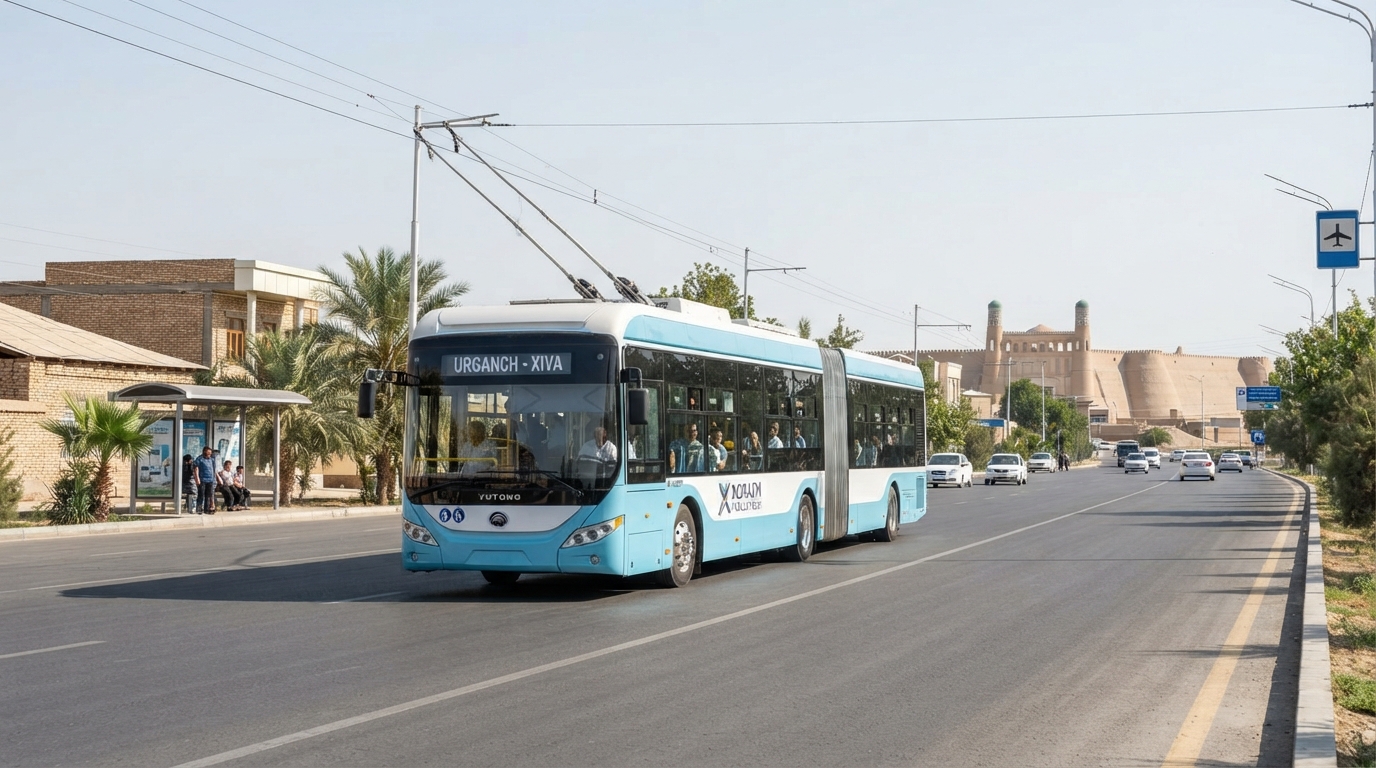
10 Yutong trolleybuses have been delivered from China to the Khorezm region, the only region in Uzbekistan where the trolleybus system has been preserved. They were presented to President Shavkat Mirziyoyev on August 17.
Once the new trolleybuses are put into operation, the route will cover the Urgench airport and train station, the travel interval is expected to be reduced from 25 to 12 minutes, and the number of passengers per day will double.
“Gazeta” correspondent Mirolim Isajonov spoke with Shukhrat Khayitbayev, head of the “Khorezm Trolleybus Palace” state institution, about the history and current state of the Urgench-Khiva trolleybus route, existing problems, and the changes expected with the launch of the new trolleybuses.
— The trolleybus line between Urgench and Khiva is one of the two intercity trolleybus systems operating in the world today. Its length is 35.6 kilometers in one direction. The longest line in the world is between Simferopol and Yalta, with a length of 84 kilometers.
The decision to introduce a trolleybus system in Urgench was made in 1997. This initiative was dedicated to the 2500th anniversary of the city of Khiva, which was celebrated in 1998. A year before the city's anniversary, the Urgench khokimiyat established the state enterprise "Khorezm Trolleybus Administration" and began work on establishing a communication network and building the necessary infrastructure. During this period, nine "Škoda 14Tr" trolleybuses were purchased from the Czech Republic. In 2013, new "Škoda 24Tr" trolleybuses were also imported from the Czech Republic. Trolleybuses, which were modern and comfortable for their time, have been serving the people in good condition for 13 years.
Today, we have nine trolleybuses in operation. In July, we purchased 10 new trolleybuses from China. They will start operating in the near future, that is, on the eve of Independence Day, and thus the total number of trolleybuses will reach 19.
Currently, trolleybuses operate on the Urgench-Khiva route on a 4+4 schedule. The interval is 25 minutes. After the 10 trolleybuses are put into operation, 16 of the 19 trolleybuses will be deployed in two directions, and three will be kept in reserve. This is planned to reduce the interval from 25 minutes to 12 minutes.
70 minutes are allocated for one round trip of one trolleybus, and it will make 9 flights a day. Due to the extension of the route on the new trolleybuses, the round trip time can be approximately 80-85 minutes.
— The cost of the new trolleybuses is $ 2.7 million. A 7-year loan agreement has been concluded for them, and we are obliged to pay this amount during the term.
Each trolleybus is designed for 87 passengers. They are equipped with amenities for people with disabilities, the elderly and passengers with children, USB and Type-C ports, internal and external surveillance cameras, air conditioning. There are also safety systems such as driver status monitoring, lane departure warning, and automatic fire extinguishing.
The main advantage of the new trolleybuses is contactless, that is, wireless movement. They can travel wirelessly for up to 100 kilometers. When the wireless part of the route is over, they reconnect to the contact line and recharge their batteries. For example, even if it goes off the line for 7-8 kilometers, it will reconnect to the line and continue its movement. It is possible to make 9 flights per day, and the energy consumed in each flight is replenished when it is connected to the line.
The current line does not directly connect the Urgench airport and the train station. The new trolleybuses will start their journey from the Urgench international airport, go to the railway station, and then join the Khiva route. The trolleybus will move wirelessly between the airport and the train station, then connect to the contact line and replenish the lost power. Therefore, there will be no need to lay a separate wire to the airport.
In fact, the airport route existed in 1996, but then the line was removed (trolleybuses start their journey from the central market of Urgench - ed.). Now we are restoring the airport route. The main goal is to create convenience for tourists and guests. For example, a tourist will be able to get on a trolleybus after getting off the plane and travel all the way to Khiva for 3,000 soums.
When the new route is launched, 11 more stops will be added, bringing the total number of stops to 100. In addition, while currently an average of 2,000-2,500 passengers are transported per day, this figure is planned to double, reaching 4,000-5,000, after the new trolleybuses are launched.
— A fare of 3,000 soums for a distance of almost 36 kilometers is convenient for our people. From July 1, payment of fares on some bus and trolleybus routes in our region has been transferred to electronic form, cash is not accepted.
Currently, the main line passes the regional main hospital and oncology center and runs through the Khiva and Kushkupir districts. The trolleybus is also a convenient means of transportation for those working in these areas, including medical workers and patients' relatives.
— One trolleybus consumes an average of 450 kilowatts of electricity per day. New trolleybuses are more economical, consuming around 300-350 kilowatts of electricity per day.
We still have a debt for electricity, but we have agreed on this issue with the power grid. There is an agreement to pay the debt monthly.
Since March 12 of this year, we have been working on a gross contract system. According to it, the organization is paid for each kilometer traveled. Currently, 11,392 soums are paid for 1 kilometer. One trolleybus travels about 300 kilometers per day and brings in about 3.4 million soums in income. Eight trolleybuses earn more than 27 million soums per day. We plan to pay off the organization's existing debts with this income.
— To drive a trolleybus, you need to undergo special training. The driver is required to have a category “T” license and at least 5 years of driving experience. We mainly select drivers with experience in public transport, category “D” or driving minibuses, and train them for category “T”.
Currently, the training lasts three months. Then the driver undergoes an internship with an experienced instructor for six months to a year. After passing all the tests, he is given an independent trolleybus. Drivers for new trolleybuses have also been trained and trained.
The driver must be over 22 years old. There are currently no women among the drivers, but women who meet the requirements can also work as trolleybus drivers.
Four to five foremen work in the trolleybus fleet. In technical maintenance, the repair time varies depending on the type of breakdown: some malfunctions can be eliminated within an hour, while others may take a day or two.
There is a slight problem with spare parts, since the trolleybuses came from the Czech Republic. Given their age, some parts are difficult to find today. Nevertheless, our locksmiths prepare and repair many parts themselves. Due to this, the trolleybuses that have been operating for 13 years are still in good condition.
It is planned to create a new trolleybus storage area of 2,000 square meters in Khiva. This will cost 833 million soums. The park will be located on Elabad Street in the Sangar neighborhood. 10 trolleybuses can be stored there. Since the new trolleybuses can move without contact, there is no need to lay a separate wire here.
The new storage area will be approximately 500 meters from the existing line. It is planned to be completed by January 1, 2027. It will be built in a lightweight structure and will serve mainly for new trolleybuses.
— The trolleybus is a very clean transport for the environment. At the same time, it has become an integral part of the people of Khorezm, especially the population of Khiva-Urgench, for 30 years.
When a trolleybus stops running, people immediately notice it. Sometimes we do not operate for a week or 10 days to repair the line. At such times, we receive a lot of requests, asking, “When will you start it up, what is happening?”
Usually, we carry out such repair work in the summer, when there are fewer students and pupils. We repair and replace substations, fans, and worn-out wires.
One of the main issues is the interval and air conditioning. When new trolleybuses are put into operation, the interval will be reduced and the number of air-conditioned transport will increase.
Another issue is the traffic jams that occur in the morning due to the large number of cars coming to Urgench from Khiva and Qoshkopyr. We hope that after the toll road is opened, the traffic jams on the Khiva-Urgench road will decrease significantly.
One of our biggest tasks is to build and put into operation a new trolleybus depot in Khiva. Then, we will put new trolleybuses on the line and create convenience for the people. For this, it is also planned to renovate the administrative buildings here. There are also plans to repair the park and reorganize the car wash.