

What's behind the cheap package tour: the conflict that comes from travel
The tour package was purchased through Kapital Travel LLC in Bukhara. The women said that before the contract was signed, the society
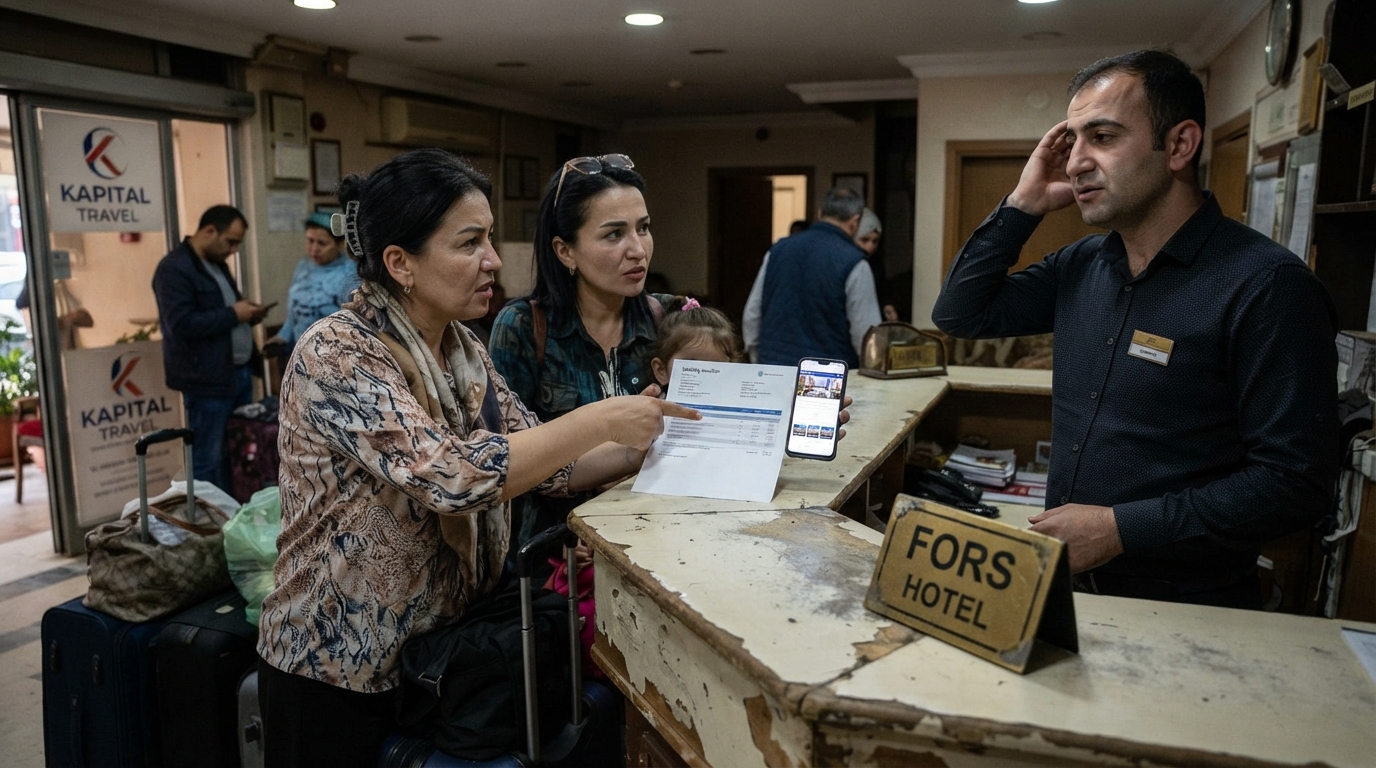
A simple vacation plan for two women from Bukhara, who were traveling to Turkey, turned into an unexpected conflict. The dispute, which began with the hotel address, quality of service, communication problems and additional charges, later escalated into a demand for compensation. The parties' views differ, but the contract and available evidence can clarify the exact picture of the incident.
Two women from Bukhara and Fergana regions - Sabina Sanoyeva and Nigina Makhsudova, who was traveling with her minor child, planned to go to Turkey. The goal was simple: to see Turkey, relax a little, and return with good memories with her child.
Since the funds for the trip were not enough, the women said that they decided to withdraw money from the bank and cover part of the travel expenses from this account.
The tour package was purchased through Kapital Travel LLC in Bukhara. The women said that before concluding the contract, the head of the society Azamat Tokhtayev sent them an Internet link about the hotel. The link belonged to the Fors Hotel, located in the Sultan Ahmet district of Istanbul. Information, photos and positive reviews about the hotel inspired confidence in them.
However, the women told Khabar.uz that when they arrived in Istanbul, they were greeted by a different scene. Instead of the hotel in Sultan Ahmet, they were placed in another branch of the Fors Hotel of the same name in the Aksaray district.
After that, the simple travel plan gradually turned into a conflict.
“We did not expect such a hotel..
The women said that the main requirement they put forward to the tour company was to provide the cheapest tour package possible. The tour company offered them a relatively cheap three-star hotel.
One thing should be noted here: choosing a cheap tour package does not mean that the tourist has agreed to poor-quality service. The client has limited funds, he can choose a cheaper option, not an expensive hotel. But does a low price exempt the service provider from the obligation to comply with the terms of the contract? Of course not!
The first serious question in this case begins with this: was the hotel shown to the female travelers the same as the one they were actually accommodated in?
The women said no: the room had electrical problems, plumbing problems, and unsuitable furniture. They were also not satisfied with the quality of the breakfast. More importantly, when they complained, there were problems contacting the tour company.
— For us, who were staying in a foreign country with a minor child, this was not a simple technical problem. True, we asked for a cheap package. But we did not expect such a poor hotel. Even the SIM card provided to us did not work. We could not even contact the head of the tour company, — says Sabina Sanoyeva.
Nigina Maksudova also said that it was difficult to establish full communication with the tour company for several days.
— The head of the society answered me in two or three days. Sabina did not answer at all. Their questions remained unanswered. It was completely impossible to establish contact with the transfer service employee for seven days. More precisely, through the SIM card number belonging to the Happytell company, which was registered by the tour operator in the document, we received only the answer “the specified number does not exist,” he says.
According to the women, they then expressed their dissatisfaction with the hotel representative. They also showed their reservation information and the hotel link that was sent to them earlier.
The hotel employee said that the hotel they were shown was not this branch, but another branch.
If this information is confirmed, the issue will go far beyond a simple complaint of “not liking the hotel.” After all, if a traveler is given information about one hotel and is actually placed at a different address, it is necessary to separately investigate how this situation corresponds to the terms of the contract and tour package.
A low price does not mean poor-quality service
However, the head of Kapital Travel, Azamat Tokhtayev, has a different assessment of the incident.
He said that the women themselves asked for a cheaper package, after which the travel agency offered them one of the cheapest three-star hotels in Istanbul. The hotel was chosen and approved by the women themselves.
— They turned to us to organize the trip. True, they asked us to offer a cheaper package, since the conditions were not suitable. We sold them an individual tour package to Istanbul, Turkey. Based on their request, we offered the cheapest three-star hotel. They chose and approved it themselves
, says Azamat Tokhtayev.
However, his explanation raises another question: even if the client chooses a hotel, is the travel agency obliged to clearly explain to the tourist which hotel, which address and what conditions are being offered? Of course! This information is even more important for the tourist if there are two branches with the same name.
The head of the tour company says that when the women went to Turkey, they stated that they would not be staying at the hotel permanently, that they had a friend there, and that they might have the option of staying somewhere else.
This is another important point in the dispute. Because if the hotel was included in the tour package, the fact that the tourist did not use it or wanted to stay somewhere else would have had to be assessed based on the documents.
It should be noted that the women themselves confirmed that they had read and signed the contract and were informed about the hotel. Therefore, in this case, questions should be asked not only to the tour company, but also to the tourists themselves: Did they fully familiarize themselves with the contract and did they know the exact address of the hotel? What services are included in the tour package? What is the procedure if the hotel is changed?
The answer to these questions can clarify an important part of the dispute.
What does the tourist do if the connection is lost?
One of the most serious issues in this case is the loss of the ability to contact the service provider during the tourist's stay abroad. The head of the travel agency admits that there was a technical problem with the Happytell SIM card. However, he says that communication with the women was not completely cut off.
— They were contacted. All their questions were answered via a video message and an SMS message. True, there was a problem with the SIM cards belonging to the Happytell company, which caused a temporary slowdown in communication. However, this problem was also eliminated by our company on the same day. There are correspondences, — says Azamat Tokhtayev.
So, the views of the two sides differ here too: if the women say that “we could not contact them for seven days,” the head of the travel agency says that “there was communication, only a temporary problem with the SIM card.”
Call history, correspondence, SMS and other electronic evidence are important in determining this issue. After all, for a tourist traveling abroad, especially with a minor child, the failure of a communication device is not a simple technical inconvenience. For a tourist, this is also related to the possibility of seeking help in an emergency.
What does the contract say
?
Clause 3.3.2 of the contract for the sale of tourist products and the provision of tourist services No. 450 dated April 10, 2026 between Kapital Travel and the client states that the client must carefully study the terms of the contract and comply with them in order to successfully carry out a tourist trip. Clause 3.4.1 states that in the event of non-fulfillment or improper fulfillment of the terms of the contract by the executor, compensation for damages may be required in accordance with the procedure established by the legislation of the Republic of Uzbekistan.
Thus, the document itself provides for the obligations of both parties. Therefore, it would not be correct to assess the dispute based on the statement of only one party. Here, the contract, booking information, payment documents and the service actually provided should be compared.
“We paid $120 to change the hotel”
One of the most controversial points of the incident is the $120 that was allegedly paid to change the hotel.
The women say that after they did not want to stay at the original hotel, they were forced to move to another branch of the “Fors” hotel. For this, the hotel employee asked them for an additional $120. At that time, they did not have enough money. So from the hotel maid? They say that they borrowed $120 and gave the money to the hotel employee.
— We paid the money required to move to the “Fors” hotel branch and just filmed it, — the women say.
At this point, we face important questions for the women:
- Was a check given for $120?
- No.
- Did the money go to the hotel cashier or was it given to the employee?
- To the employee.
The women reported that they had a video confirming that $120 was paid. However, the editorial office was not provided with an official check, receipt, or other document for this payment. Therefore, there is not enough evidence to draw a firm conclusion that “$120 was officially charged by the hotel.” However, if the video is confirmed and the money was indeed given to the hotel employee, this situation should also be investigated separately. However, if the tourist was charged an additional fee, the legal and financial basis for this payment should be determined.
The trip is over. But the dispute is not over
After returning to Uzbekistan, the women spoke with the editorial office employee several times. They stated that the hotel conditions were unsatisfactory and provided photo and video materials. However, here too, there is an important limitation for journalistic investigation. The photos provided mainly show a hanging wardrobe and a situation with an electrical outlet in an inconvenient part of the wall. There is no complete photo and video material confirming all the shortcomings in the hotel. Therefore, it would not be right to draw a sharp conclusion about the entire hotel based on some shortcomings in one room. For this, it is important to study the hotel itself, booking information, opinions of other travelers, hotel ratings and independent sources. The women said that they also contacted law enforcement agencies on this issue. Therefore, the veracity of some evidence and its relevance to the incident can also be assessed in a legal manner.
Why did the demands change?
Another interesting point in the dispute is the subsequent financial demands of the parties. The women say that upon returning to Uzbekistan, they initially raised the issue of returning the $120 they had paid extra for the hotel. They also informed the editorial office about this.
The head of the tour company says that their demands later changed.
— I also came to the conclusion that “okay, I’ll give you $120.” And I told the women this. And they changed their demands. In addition to $120, they demanded that I pay an additional $200 for each of them, — says Azamat Tokhtayev.
Here the question arises: on what basis was the additional $200 determined? Is it material damage? Moral damage? Travel expenses? Or other losses? If the amount demanded is indicated as damage, the issue of substantiating it with documents also arises.
Nigina Maksudova, however, gives a different explanation for the situation.
— We, two women, were stranded in a foreign country, with a minor, nursing child. We could not contact the tour company or the transfer service employee either by phone or by the Internet. After all, we signed the contract with good intentions. We believed. Our nerves were strained. We suffered both moral and material losses. Therefore, we asked for our money back, - he says.
The head of the tour company says that in subsequent negotiations the amount increased again.
- I said by phone that I would consider paying the 520 thousand US dollars they demanded. Within 2-3 days, I got tired of their complaints to various departments and organizations, and called again to deliver this amount. Since Sabina Sanoyeva was at work at that time, she told me to talk to her partner - Nigina Maksudova - about this "agreement". I contacted the woman from Fergana by phone. Unfortunately, this time she demanded not 520, but 1300 US dollars. How can this be explained? When the situation became tense, I had to “bargain” with them. And they “lowered” their demands to $1,000,” says Azamat Tokhtayev.
Nigina Maksudova explained this not as a demand, but as an amount stated in order to reach an agreement.
In the audio recording provided by Azamat Tokhtayev, the women mentioned $1,300. The women also raised the issue of repaying their loans. So, the dispute is no longer just about the conditions in the hotel. The issue of compensation and restitution between the parties has also become a separate dispute.
From $120 to $1,300 — how is the damage calculated?
There is no clear answer to this question yet. If the women were dissatisfied with the hotel service, the issue of refunding the payment for the service that was not properly provided to them can be assessed based on the contract and the current situation. However, if a specific amount is being claimed for moral damages, its legal basis must also be indicated. At this point, the question arises: on what criteria was the claimed amount calculated?
At the same time, the head of the tour company also has relevant questions. If the customers were dissatisfied with the hotel conditions on the first day of the trip, why did the tour company not take prompt enough measures to resolve the problem on the spot? If there was a problem with the SIM card, was there no alternative channel to contact the women? If the travelers were forced to move to another branch, was this process under the control of the tour company? Also, if an additional 120 US dollars was charged from the women, what did the tour company know about it?
Since these questions are not clearly answered, it is premature to conclude that “it is all the tourists’ fault” or “it is all the tour company’s fault.”
Appeal to the Tourism Committee
The dispute did not end there. The women appealed to the chairman of the Tourism Committee about the situation. After that, the responsible employees of the Bukhara Regional Tourism Department held a conversation with the head of Kapital Travel. During this conversation, Azamat Tokhtayev stated that he was not aware of the existing conditions in the hotel in advance. He was given recommendations to prevent such situations in the future, to control the quality of service provided to travelers, and to thoroughly study the activities of partner hotels in advance.
The interesting point here is that if the head of the tour company himself admitted that he was not aware of the conditions of the hotel in advance, how effective was the mechanism for checking the hotels offered to tourists? Does the task of the tour company end only with selling the tour package, or is it also his responsibility to have sufficient information about the quality and services of the partner hotel offered to the client?
The women, however, were not satisfied with the study conducted by the department and appealed to the committee again.
The offer to “drink coffee” and misunderstanding
The most sensitive part of the appeal is the allegation regarding the responsible employee of the Tourism Department. Sabina Sanoyeva stated that she had applied to the Bukhara Regional Tourism Department several times, but her appeals were not fully and impartially studied, and were limited to formal responses.
She said that the responsible employee who considered the appeal invited her to drink coffee in order to informally resolve the problem.
The responsible employee, in turn, interprets these correspondences as a misunderstanding on the part of the interlocutor. She noted that the purpose of the offer to chat over coffee was to calm the situation and call on the woman not to be nervous, and there was no malicious intent in it.
Who is right in this dispute?
It is a bit difficult to answer this question for now. The women have serious questions: how much did they check the exact address of the hotel? What can be used to justify the additional payment of 120 US dollars? How were the subsequent compensation amounts calculated?
There are also open questions in the position of the travel agency: was the hotel shown to the clients the same as the one actually placed in? Why was the problem not resolved on the spot after the travelers' dissatisfaction? If there was not enough information about the hotel in advance, why were the travelers placed in this particular facility?
Most importantly, choosing a cheap package does not relieve the travel agency of its responsibility for the quality of service and fulfillment of the terms of the contract. However, women who have returned from a trip must also be able to substantiate their claims with documents.
Therefore, this incident cannot be ended by declaring one party “victim” and the other “guilty.”
This is a situation that raises serious questions about the quality of service in the tourism industry, the rights of the traveler, the responsibility of the travel agency, and the obligations of both parties to the contract. And the most accurate answer is given not by emotions, but by documents. Contract. Reservation information. Payment documents. Receipts. History of calls and correspondence. Proof of payment of $120. Basis for the $1,300 claim. Hotel information. Original photos and videos. Only when everything is put together will the true picture of the incident become clear.