

What will the weather be like in Uzbekistan on October 19–25? Gazeta review
No precipitation, significantly cool, and dry weather is expected to be observed in Uzbekistan this week. In the middle of the week, temperatures will drop to +17…+22, and at night down to +5 degrees. Due to the weakening of the wind, there is a risk of air pollution with fine dust particles in Tashkent and the valley. Gazeta forecast.
What will the weather be like in Uzbekistan on October 19–25? Gazeta review
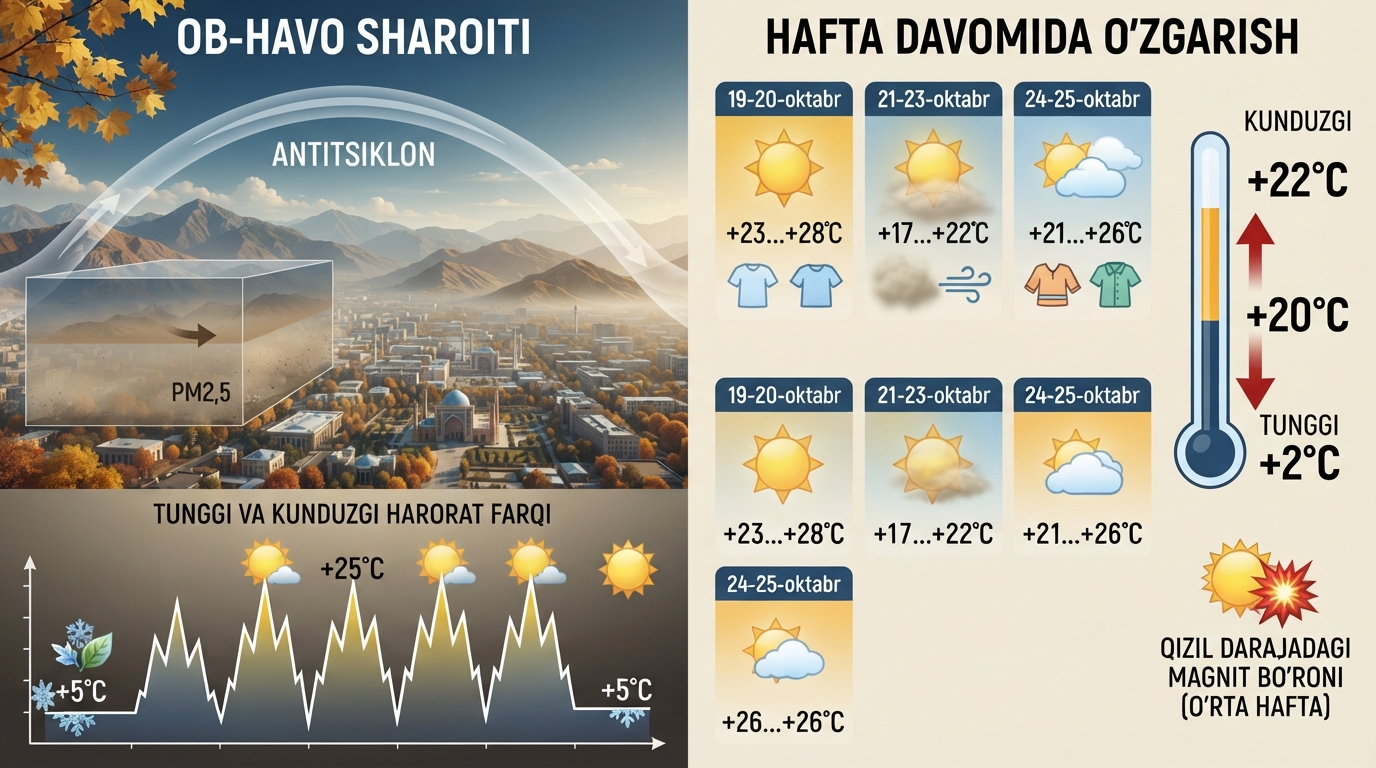
The weather in Uzbekistan during the weekdays will be determined by the southeastern, and later southern, edge of a cold anticyclone, the center of which will see atmospheric pressure rise up to 1045 hPa. Especially in the middle of the week, the southern edge of this anticyclone will keep night temperatures down to +5 degrees and daytime temperatures at +17…+22 degrees across a large part of the republic.
It is noted that due to the impact of the cool air mass in the middle of the week, average temperatures across a very large part of Uzbekistan will be around the multi-year climatic norm and 1–2 degrees above it, that is, warm.
According to the weekday forecasts prepared by Uzhydromet, it is becoming clear that the current week will be very dry, with no precipitation expected even in the mountains. This situation is clearly reflected in the general precipitation forecast map for the period up to October 25, which shows that no precipitation at all is expected across the republic over the coming 7 days.
On weekdays, air temperatures are expected to drop to zero degrees in the Ustyurt Desert of Karakalpakstan and the Kyzylkum Desert of Navoiy, while temperatures in the northern regions and mountains of the republic are also expected to drop to +1…+3 degrees.
In other parts of the republic, warm weather of +5…+8 degrees is expected at the beginning of the week, but by the middle of the week, due to a deeper influence of the anticyclone, temperatures will drop slightly compared to the beginning of the week. By the weekend, nighttime temperatures will rise noticeably in places. Daytime temperatures follow the same trend as nighttime temperatures. While maximum temperatures across most of the republic are expected to be between +23…+28 degrees at the beginning of the week, they will shift to +17…+22 degrees on October 22–23.
According to another report from Uzhydromet and forecasts from the European Centre for Medium-Range Weather Forecasts (ECMWF), average weekly temperatures across most of the republic will be close to the multi-year norm and 1–2 degrees below it, while warmer in the mountains. In terms of precipitation, the week is noted to be extremely dry, and due to a complete lack of precipitation in the mountains throughout the week, it could be significantly drier compared to the third ten-day periods of October in the past.
Thus, this week is expected to be significantly cooler than last week, with very dry, stable weather prevailing throughout the week. Weakening winds in the air of large cities will increase air pollution for the current season.
In autumn, under the influence of an anticyclone, wind weakening, atmospheric stagnation, and an increasing diurnal temperature variation could become significant factors for public health. Particularly in Tashkent and the Fergana Valley regions, when air exchange is limited, the risk of PM2.5 fine particles accumulating in the surface layer increases.
On weekdays of the current week, the difference between nighttime and daytime temperatures is expected to widen. Even the difference between the night minimum and day maximum could reach 20 degrees in some regions. International epidemiological studies show that an increased daily temperature amplitude can elevate the risk of adverse outcomes associated with respiratory and cardiovascular diseases.
Children, the elderly, and people with asthma and cardiovascular diseases should take extra precautions.
In the middle of the weekdays, weather conditions will require wearing warmer clothing even during the day. Daytime temperatures of +15 or +17 degrees will be deceptive, as under the influence of the anticyclone, the perceived temperature will be lower. Morning temperatures in particular are expected to be quite low in places. Due to wind and humidity in the air, temperatures will feel colder than usual. By the weekend, the impact of piercing cold in the morning hours will diminish. The population will also feel the arrival of a warm air mass from morning temperature values. At the beginning of the week and on the weekend, people may even wear light clothing.
For those who enjoy autumn walks and trips, this week is ideal — trees in large cities will gradually turn golden, providing aesthetic pleasure to many along with sunny scenery.
According to current forecasts regarding solar activity, magnetic storm disturbances at the red level are estimated to occur in the middle of this week.
At the start of the workweek, magnetic storm disturbances are expected to remain at a green, safe level. There are still no clear scientific conclusions regarding the impact of magnetic storms on human health. Therefore, it is incorrect to claim that such cosmic influences have a definitive impact on human health.
The Uzhydromet Agency does not expect very strong winds during the week. On weekdays, under the influence of the edge of the anticyclone, wind weakening and atmospheric stagnation may create conditions for a temporary deterioration of air quality in certain areas, especially in Tashkent and the Valley. No strong meteorological factors are currently visible that would cause a sharp increase in dust particles in the air.
If air pollution increases or pollution related to fine particles occurs, it would not hurt to review the recommendations prepared by the Sanitary-Epidemiological Committee for different age groups of the population and patients on how to act.
Thus, stable weather conditions will be observed in Uzbekistan between October 19 and 25. In large populated areas, an increase in atmospheric inversion phenomena may possibly lead to an increase in fine dust particles in the air.