

What will the weather be like in Uzbekistan on November 2−8? Gazeta review
This week in Uzbekistan, temperatures are expected to be 3–6 degrees above the long-term normal, with the air warming up to +28 degrees. Short-term rain is possible in some areas on November 4–5, and snow may fall in the mountains. Due to light winds, dust particles are likely to remain in the air in the capital and major cities.
What will the weather be like in Uzbekistan on November 2−8? Gazeta review
Climatologist Erkin Abdulahatov shared the next weekly weather review with Gazeta. According to him, at the beginning of the week, certain regions of Karakalpakstan in Uzbekistan will be under the influence of the south-eastern edge of a cold anticyclone, and temperatures at night may drop to -5 degrees. Although this synoptic process will not deeply affect the republic, it will ensure slightly cool weather on November 2. Moist air streams expected to enter from the south on November 4−5 will bring light precipitation to some places. Starting Friday, the temperature will rise sharply, and this situation will persist over the weekend as well.
According to data from foreign weather bureaus, on November 2−6, in a very large part of Uzbekistan, apart from the slightly cool day on Monday, average temperatures during weekdays will be 4 degrees or more above the long-term climatic norm, meaning it will be warm.
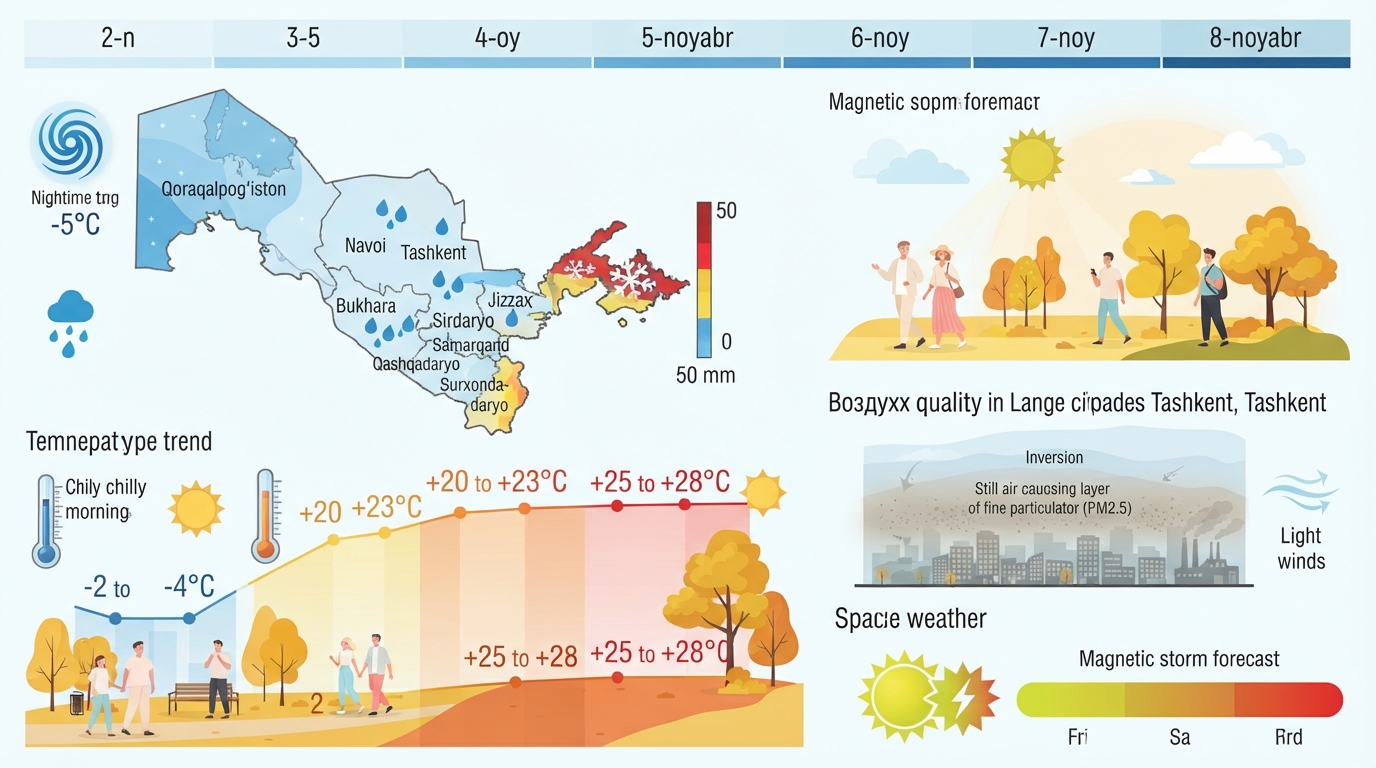
According to the weekday forecast prepared by Uzhydromet, light precipitation may occur in certain areas of Bukhara and Navoiy regions on October 4, in Tashkent, Jizzakh, Syrdarya, Samarkand, Kashkadarya, and Surkhandarya regions on November 4−5, and in Fergana Valley regions on November 5; precipitation may also be observed in the mountains on November 3−5. No precipitation is expected in other regions on remaining days.
The above situation is clearly reflected in the general precipitation forecast map expected across locations for the week from November 2 to November 8, where possible precipitation in certain regions of the republic is indicated in blue, green, and yellow. Red images in mountainous areas mean that a total of up to 50 mm of precipitation will fall in those areas this week. In the mountains, precipitation will fall mainly in crystalline form, that is, as snow.
On the morning of November 2, air temperatures in certain areas of the Republic of Karakalpakstan are expected to drop to −2…−4 degrees of frost. Such a cold wave is mainly characteristic of these very areas, and on weekdays of the week, air temperature minimums in other regions will range between +5…+10 degrees in southern regions and +2…+7 degrees in other areas. In the mountains, cold down to zero degrees at night, and at times down to -3 degrees, is expected.
Starting Friday, night temperatures will rise. Daytime temperatures are expected to be slightly lower at the beginning of the week, and from mid-week they will gradually warm up, reaching +20…+23 degrees of heat, and +25…+28 degrees in desert and southern areas. In the mountains, daytime temperatures of +10…+15 degrees of warmth are expected. Fog may fall in some areas at the beginning of the week.
According to another report by Uzhydromet and forecasts from the European Centre for Medium-Range Weather Forecasts (ECMWF), average weekly temperatures in most of the republic will be 3−6 degrees above the long-term norm, meaning it will be warm. Regarding precipitation, it is stated that a wet week is possible in the north and the Kyzylkum desert areas, while other regions except the valley may experience precipitation typical for early November.
Thus, it is becoming clear that this week will see noticeable warmth, rain clearing the dust in the middle of the week, and snowfall in high mountains. The weakening of the wind in major cities will intensify air pollution during this season.
The weather this week is not at a level that directly affects human health. Air pollution with fine PM2.5 particles in major cities may affect the health of certain categories of people. Changes in atmospheric air pressure are projected to remain at normal levels for the season.
Moist and warm air waves expected to enter from the south this week will lead to higher night air temperatures. Residents in major cities, except for the beginning of the week, will not face piercing cold in the morning and night hours. A weather atmosphere similar to early spring warmth is expected.
The rise in air temperature up to +28 degrees in desert and southern regions starting from the middle of the week will encourage people to wear light clothes. The population may feel the breath of winter in high mountains. It is becoming clear that expected precipitation in the middle of the week will cause snowfall events in these areas.
For those who enjoy autumn walks and travel, this week is ideal — trees in major cities will gradually turn golden, offering aesthetic pleasure to many along with sunny scenery.
According to existing forecasts on solar activity, magnetic storm disturbances at yellow and green risk levels are estimated to occur on weekdays this week.
Only by Friday, magnetic storms at the red risk level are projected. There are still no clear conclusions in science regarding the impact of magnetic storms on human health. For this reason, it is incorrect to say that such space influences definitely affect people's health.
The Uzhydromet Agency did not focus on very strong winds during the week. However, the agency shared a warning message with the public about light winds in the capital until November 8 and the persistent content of fine dispersed particles in the air due to the inversion phenomenon.
For now, strong meteorological factors are not visible for a sharp increase in dust particles in the air or large-scale dust storms to occur.
If air pollution increases or pollution related to fine particles occurs, it would not hurt to review the recommendations prepared by the Sanitary-Epidemiological Committee for various age groups of the population and patients on how to act.
Thus, between November 2 and November 8, weather suitable for a warm autumn with a gradual rise in temperatures is expected in Uzbekistan. The intensification of atmospheric inversion phenomena in major populated areas may lead to an increase in fine dust particles in the air.