

What will change in Uzbekistan from September 1?
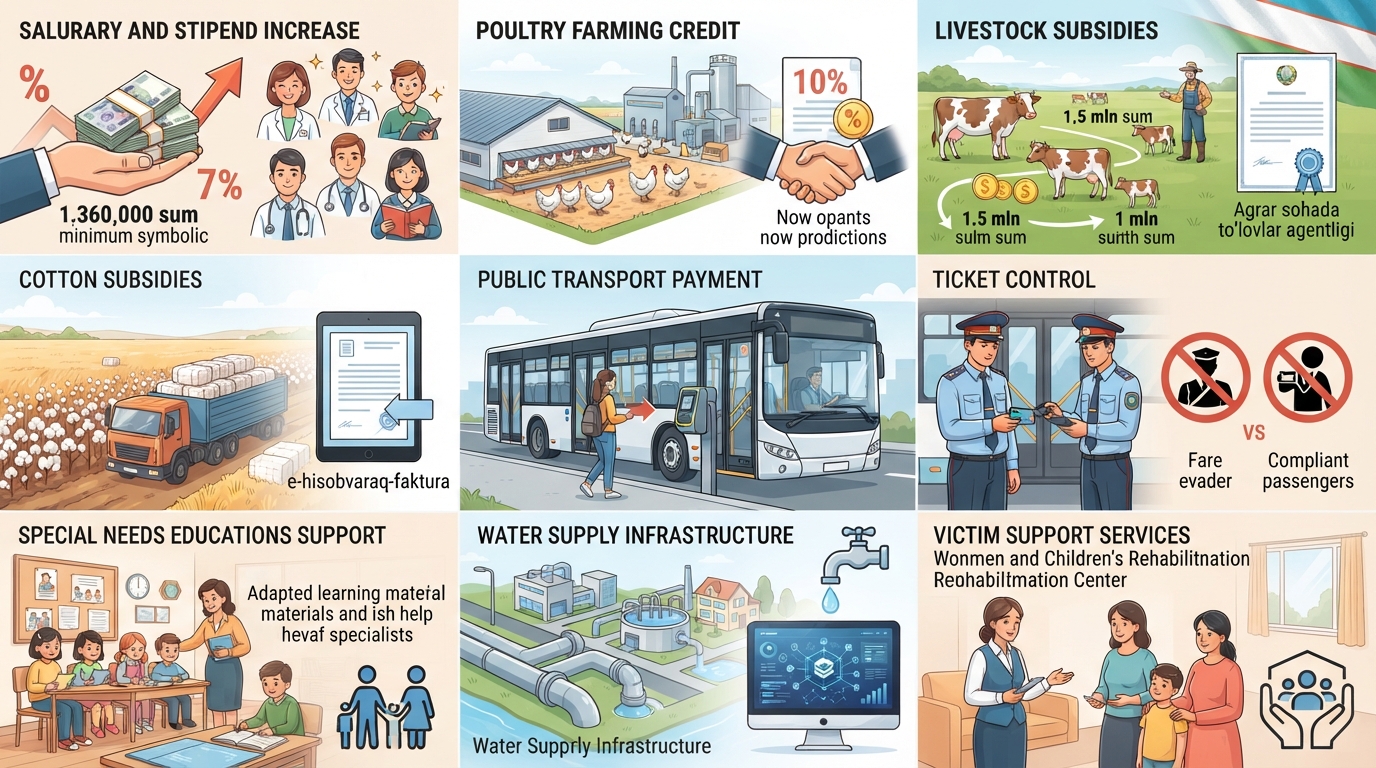
A number of important changes will come into force in Uzbekistan from September 1, 2026. In particular, the amount of wages and scholarships will be increased, new subsidies will be allocated to certain sectors, the procedure for paying bus fares and controlling passengers without tickets will change. In addition, new mechanisms will be introduced to support children with special educational needs and develop livestock farming.
**Salaries and scholarships for employees of budgetary organizations will be increased by 7%**
From September 1, 2026, the amount of wages and scholarships for employees of budgetary organizations will be increased by 7%. From this date, the minimum amount of remuneration for labor will be set at 1 million 360 thousand soums per month. Also, the base calculation amount will be 440 thousand soums. The costs associated with increasing salaries and scholarships will be covered by the state budget.
**10% loans will be provided for poultry projects**
From September 1, loans will be provided at an annual rate of 10% to finance poultry farms, poultry feed producers, and "ready-made business" projects. This procedure applies only to newly issued loan agreements. Loans will be financed from funds allocated from the Fund for Reconstruction and Development to "Microcreditbank". This includes the commissioning of new poultry facilities and the implementation of relevant projects.
**Subsidies will be provided for breeding cattle in livestock farming**
From September 1, 2026 to January 1, 2030, subsidies will be provided to breeding farms to cover part of the costs of maintaining identified female breeding cattle left for breeding. The funds will be provided by the Agency for Payments in the Agricultural Sector from the state budget. A subsidy of 1.5 million soums will be allocated for the purchase of the first female calf, 2 million soums for the purchase of the second calf, 1 million soums for keeping the calf up to 12 months of age, and another 1 million soums for keeping it from 12 months to 18 months of age.
**The authority to allocate certain subsidies related to agriculture will be transferred to the agency**
From September 1, the authority of the State Support Fund for Agriculture to allocate certain subsidies will be transferred to the Agency for Payments in the Agrarian Sector. This mechanism will also cover the reimbursement of part of the cost of electronic invoices for cotton raw materials sold by farms on the exchange. Also, the allocation of subsidies to cotton-textile clusters and textile enterprises with a yarn production chain to cover part of the cost of cotton raw materials purchased at their own expense will be transferred to the agency.
**Bus fares are paid upon boarding**
From September 1, passengers on city buses operating on a gross-rate contract will have to pay their fare upon boarding the bus. To do this, they can touch their transport card to the validator, use a bank card, smartphone or other contactless electronic payment methods. Passengers with preferential or free travel rights must also validate the relevant transport or social card with the validator when boarding the bus. If the fare is not paid in the prescribed manner or the privilege is not confirmed, the passenger is considered to have traveled without a ticket.
**Control over ticketless passengers on buses will be strengthened**
From September 1, employees of the Transport Control Inspectorate and the State Institution for Monitoring and Control of Urban Passenger Transport will also conduct control measures to identify ticketless passengers directly in bus salons. Currently, a fine of one tenth of the MHM, i.e. 41,200 soums, is set for traveling on a bus without a ticket. Proposals to increase the fine for driving without a ticket have been submitted to the Legislative Chamber. Therefore, there is no basis yet to indicate the new fine amounts as the procedure that came into force on September 1.
**A "family-based" system of work will be introduced for children with special educational needs**
From September 1, a "family-based" system of work will be introduced to involve children with special educational needs in education, social assistance and services. The identification of the educational needs of children aged 3 to 18 and their referral to state educational institutions will be carried out by the Child Comprehensive Assessment Groups under the "Inson" social service centers. Also, a subsidy will be allocated for each student to non-governmental educational organizations providing general secondary education services by organizing a correctional class. Its amount is 4 million 840 thousand soums in Tashkent, 4 million 180 thousand soums in regional centers and Nukus, and 3 million 740 thousand soums in other districts and cities.
**Drinking water projects will be maintained on a special electronic platform**
From September 1, all drinking water and wastewater infrastructure development projects that will be transferred to the use of Uzsuvtaminot JSC will be maintained on a special electronic platform. Also, some contractual relations between the company and its system enterprises will be established directly. It is also envisaged to attract more loans and grants from international financial institutions and foreign government financial organizations for new projects. The authority to approve tariffs for drinking water and wastewater services will be transferred to the Interdepartmental Tariff Commission under the Cabinet of Ministers from January 1, 2027.
**A system of providing services to victims of human trafficking at the mahalla and district levels will be established**
From September 1, a system of assessing the condition of victims of human trafficking at the mahalla and district levels and referring them to appropriate services will be introduced through the “Inson” social service centers. Also, the Republican Center for the Rehabilitation of Women and Children and its regional centers will be established to receive and provide services to women victims of human trafficking and their minor children. An additional 40 places will be created in regional centers in Karakalpakstan, Kashkadarya, Samarkand and Fergana regions.