

What weather is expected in November? Uzhydromet overview
In November, the weather in Uzbekistan can be highly variable — over the years, both heat and severe frosts have been observed. Over the past 50 years, a slight but steady rise in temperature has been recorded. This year, temperatures are expected to be near normal, locally 1–1.5 degrees above normal. Precipitation is expected on certain days.
What weather is expected in November? Uzhydromet overview
Uzhydromet has presented an overview of what the weather might be like in November.
During the last autumn month, a gradual decrease in air temperature usually continues, which is associated with the transition to the winter period.
According to climate data, the average air temperature in November is 6–7 degrees Celsius lower than in October, and in the north and the desert zone — 8–9 degrees lower.
During the month, the impact of cold air masses coming from the northern and northwestern directions intensifies, which significantly increases the likelihood of sharp cold spells.
November's climatic conditions differ noticeably across the country's territory: a milder temperature regime persists in the south, while in northern regions the cold spell usually arrives earlier and is more pronounced. Temperature contrasts between plain and mountainous areas intensify.
The temperature regime in November is characterized by high variability: periods of relatively warm weather can be replaced by cold air intrusions accompanied by a significant drop in temperature.
The absolute minimum air temperature across most of Uzbekistan was recorded in the last century. During the coldest Novembers, temperatures dropped to −19…−24 degrees, in the north of Karakalpakstan — to −28…−31, and in the extreme south — to −12…−15.
In this century, the minimum air temperature across most of Uzbekistan was −10…−15 degrees. Such values were recorded in November 2020 and 2016. Only in Karakalpakstan and the Khorezm region were very low air temperatures observed in this century, close to record values for the entire historical observational series. In 2006 and 2016, the air temperature in November dropped to −18…−21 degrees, and on the Ustyurt Plateau — to −26…−28 degrees.
The absolute maximum temperature for the entire series of meteorological observations is +30…+33 degrees, and in Karakalpakstan and the Fergana Valley — +26…+28. Across most of the republic's territory, these records were set in this century.
The warmest November in all years of meteorological observations in Uzbekistan was in 2023, when the average monthly temperature exceeded the climatic norm by 3–6 degrees. Across most of the republic's territory, except for northern regions and the desert zone, the air temperature in November 2023 never dropped below freezing.
The average November temperature in Tashkent over the last 50 years has a positive but relatively weak upward trend. The linear trend of increasing average monthly air temperature in November is about 0.14 degrees per decade.
Precipitation (rain, at times turning to snow) falls more frequently in November than in October, and is more prolonged and intense.
The monthly precipitation norm for most of the territory ranges from 30 to 55 mm, and in foothill and mountainous areas — from 60 mm to 110 mm.
On average over a long-term period, the lowest precipitation falls in the northwestern regions and the desert zone of the republic — from 8 mm to 17 mm, and in places in the Fergana Valley and isolated southern regions of the republic — from 20 mm to 30 mm.
Precipitation falls mainly in the form of rain, and during cold spells — turning to snow.
In mountainous areas, the first snow cover is already forming.
In lower zones it is unstable, while at altitudes above 2000–2200 m its height reaches 25–40 cm by the end of the month.
The wettest November in all years of observation for most of the republic's territory was in 2011. That November, up to 3–3.5 times the monthly precipitation norms fell, and in the extreme south — up to 4–7 monthly norms.
In Tashkent, for example, 167 mm of precipitation fell in November 2011 against a norm of 51 mm, and there were 19 days with precipitation against a norm of 11 days.
Precipitation fell both as rain and as snow. An unstable snow cover formed several times during the month, and at the end of the month the snow cover height reached 20 cm, although it lasted in that form for only 2 days.
In Termez, 148 mm of precipitation fell in November 2011 against a norm of 20 mm.
However, in the history of meteorological observations, there have also been abnormally dry Novembers, when precipitation ranged from 1% to 30% of the norm.
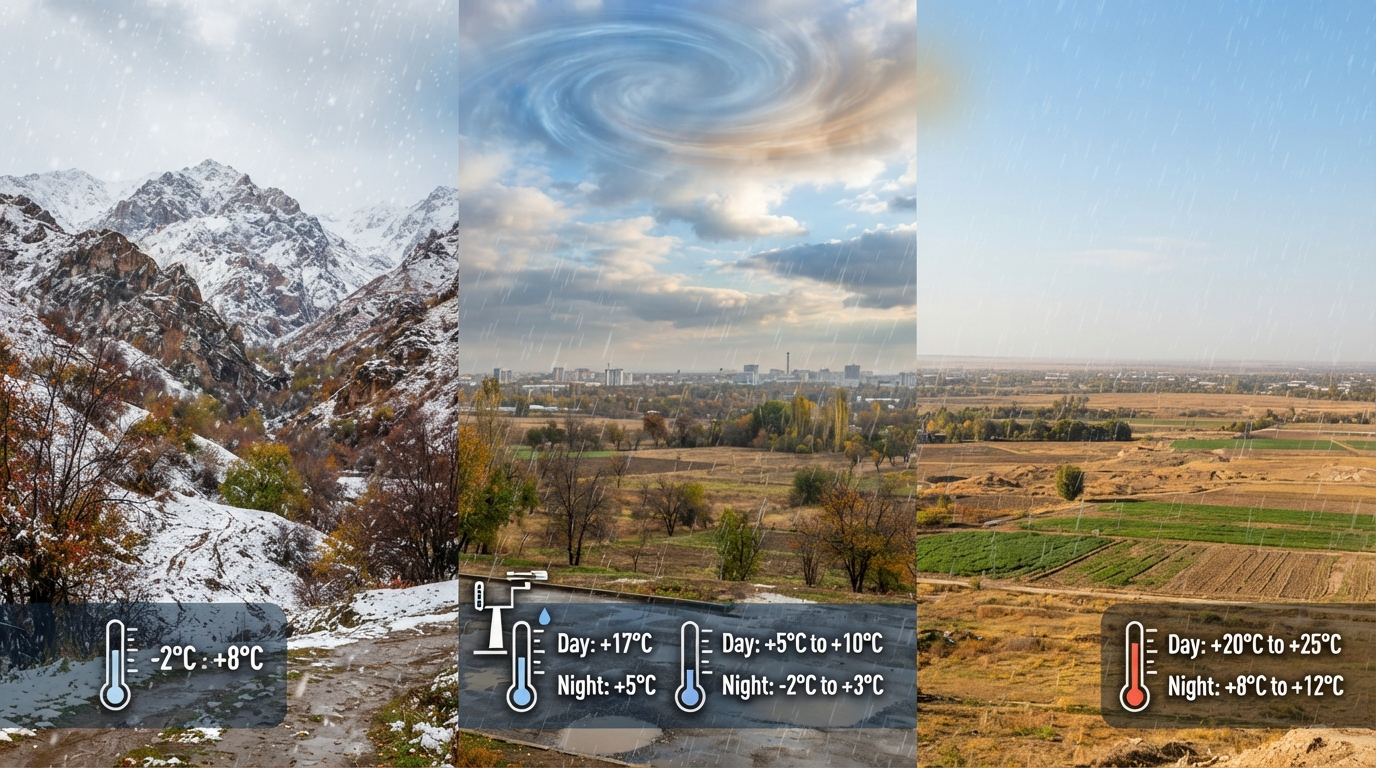
The average monthly air temperature in November is expected to be near normal, locally 1–1.5 degrees above normal.
The first ten-day period of the month will be relatively warm, with prevailing temperatures at night of +5…+10 degrees, and +17…+22 during the day.
In the second and third ten-day periods of the month, the temperature background will decrease, with expected temperature fluctuations at night from +3…+8 to −2…+3, and during the day from +15…+20 to +5…10 degrees.
Precipitation, predominantly in the form of rain, is expected on individual days of the month. As temperatures drop, a brief transition from rain to snow cannot be ruled out.
Monthly precipitation is predicted to be near normal, locally below normal.