

What the heads of state discussed at the first "Central Asia – Republic of Korea" summit
An industrial-technological park, a route from South Korea to Europe via Central Asia, joint ventures for processing critical materials, and AI specialist training programs — Gazeta has examined the speeches of the six presidents at the "Central Asia — Republic of Korea" summit.
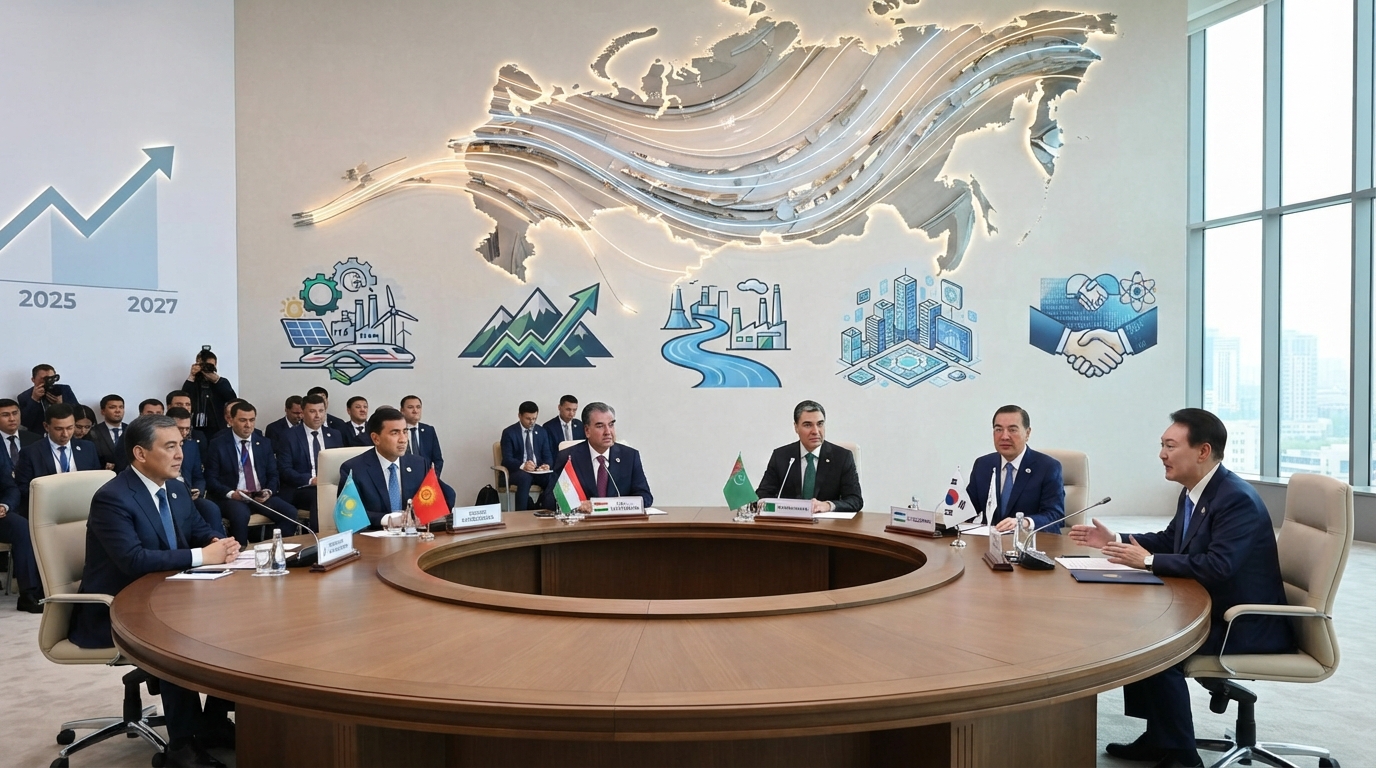
What the Heads of State Discussed at the First "Central Asia – Republic of Korea" Summit
On September 16, the first summit of the heads of state of "Central Asia – Republic of Korea" took place. This format has been active since 2007, but the meeting at the presidential level was held for the first time.
Following the summit, the Seoul Declaration was adopted: the parties agreed to hold such meetings once every two years and to develop cooperation in supply chains, processing of critical minerals, energy, transport, and digital technologies. The second summit in 2028 is planned to be held in Kazakhstan.
"Gazeta" has compiled the proposals put forward by each of the six leaders.
President of Uzbekistan Shavkat Mirziyoyev presented initiatives in five strategic areas of cooperation. The first of these is related to long-term partnership planning.
Shavkat Mirziyoyev proposed developing a concept of advanced development. It should determine in advance what competencies, production facilities, infrastructure, and personnel the countries will need in the future, as well as a portfolio of potential projects.
The second area concerns trade and investment.
Uzbekistan is ready to host the "Central Asia – Korea" Industrial and Technological Park. It is proposed to direct joint efforts towards the production of automotive components, electrical engineering, machinery products, and the pharmaceutical and chemical industries. Shavkat Mirziyoyev also noted the important role of cooperation between the regions of the countries and invited representatives of regional authorities and businesses to the Third Interregional Forum of Central Asia and Korea, which will be held in Samarkand in 2027.
The third area is dedicated to critical materials.
The President proposed forming a Regional Investment Alliance on Critical Minerals and creating processing clusters in the region. They should cover all stages of production: from geological exploration and extraction to deep processing of raw materials and the manufacture of high-value-added products.
The fourth area is related to "green" development and adaptation to climate change.
Shavkat Mirziyoyev proposed launching a Climate and Carbon Partnership format between Central Asia and Korea. The fifth area aims to unlock the potential of youth.
The President proposed forming a long-term partnership in the field of human capital development.
President of Kazakhstan Kassym-Jomart Tokayev outlined several priority areas of multilateral cooperation.
As the first, he named trade, economic, and investment cooperation and proposed launching the "Central Asia – Korea" industrial and technological development partnership.
The initiative is aimed at forming a portfolio of flagship joint projects with an emphasis on localizing production, technology transfer, regional cooperation, and exporting finished products to third-country markets.
The President of Kazakhstan named transport and logistics as another priority. Kazakhstan plans to increase transit through its territory to 100 million tons, and the capacity of the Middle Corridor to 20 million tons. Kassym-Jomart Tokayev believes it is possible to integrate the Middle Corridor with the "Trump Route" (TRIPP) through Armenia and form an end-to-end transport and logistics chain from Korea through Central Asia to Europe.
In energy, Kazakhstan is ready to resume energy supplies to South Korea and expand cooperation with Korean companies in the field of nuclear technology.
The President called for moving to pilot projects for the production and use of clean hydrogen, and invited Korean businesses to modernize coal-fired generation.
Kassym-Jomart Tokayev also proposed launching, together with Korea, a regional AI Talent program to train artificial intelligence specialists for Central Asian countries.
In the field of critical materials, the President proposed creating a joint Kazakh-Korean company. It should help build a full production cycle: from research and extraction of raw materials to deep processing and the manufacture of high-value-added products.
The Head of State spoke in favor of launching a joint program to attract Korean water-saving and digital water metering technologies.
To expand youth contacts, educational, and cultural exchanges, he called for launching the Central Asia – Korea Future Generation program.
President of Kyrgyzstan Sadyr Japarov named turning high political trust into a long-term economic and technological partnership as the key task at the current stage.
He proposed strengthening the coordinating role of the meetings of foreign ministers of the "Central Asia – Republic of Korea" format and endowing this mechanism with the functions of political support and monitoring the implementation of agreements.
In the economic sphere, Sadyr Japarov spoke in favor of creating a Council of State Investment Institutions within the framework of the existing Consultative Mechanism of Ministers of Industry, forming a single portfolio of important projects, and creating a joint investment fund.
As part of the climate agenda, Bishkek initiated the creation of a partnership on climate resilience of mountain regions and invited participants to the Global Mountain Summit "Bishkek+25" in 2027.
The President called for making human capital development a central area of cooperation by expanding educational programs, academic exchanges, and joint research.
President of Tajikistan Emomali Rahmon spoke at the summit in favor of deepening economic cooperation and creating stable supply chains between Central Asia and Korea. According to him, climate change, freshwater shortages, and melting glaciers require closer cooperation among countries.
He proposed eight areas of cooperation at the business summit held on the same day. The President named "green" energy as the first area.
The country's hydropower potential is estimated at about 530 billion kWh per year, of which about 6% has been developed. The second area was the extraction and processing of strategic raw materials: Tajikistan has reserves of 10 types of critical minerals and rare earth metals, as well as deposits of lithium, niobium, and tantalum.
Emomali Rahmon also proposed cooperating in the agro-industrial complex, textile industry, tourism, banking and finance, and artificial intelligence. Tajikistan, in particular, is interested in processing enterprises and export logistics centers, full-cycle textile complexes, and microfinance to support the private sector.
President of Turkmenistan Serdar Berdimuhamedov named urban development and infrastructure, and the creation of a modern urban environment, among the priorities of joint work.
In this context, he referred to the "Smart Cities Diplomacy" initiative recently put forward by Turkmenistan. It involves combining efforts, exchanging experience and information, and jointly implementing scientific and technological achievements.
In the field of education, Turkmenistan proposed developing new forms of interaction between educational institutions of Central Asia and Korea, including dual-degree programs. The country also considers it important to expand the digital knowledge of youth and hold joint Olympiads, competitions, and conferences. In science, Serdar Berdimuhamedov proposed intensifying joint research and development and design-and-survey work of young scientists and creating an Institute to Support the Development and Implementation of Innovative Ideas of Youth.
In culture, the President proposed a Roadmap for Intercultural Exchanges of Youth of Central Asian Countries and Korea and the "Young Talents" program. According to him, it is necessary to continue holding festivals, concerts, and creative contests that bring young people together.
President of the Republic of Korea Lee Jae-myung proposed five pillars of cooperation: partnership, peace, mutually beneficial practical interaction, cooperation in future spheres, and people-to-people ties.
Since the economy and technology are changing faster and faster, relations, according to the President, must become strategic. To this end, he proposed holding the summit regularly and expressed hope to meet in two years in Kazakhstan. Lee Jae-myung also called for parallel development of the C5+1 format, which brings together the five countries of the region and Korea.
The President noted the contribution of Central Asian countries to regional peace, including the 2006 treaty on a nuclear-weapon-free zone. He asked them to continue supporting Seoul's course towards resolving the DPRK nuclear issue, restoring inter-Korean dialogue, and resuming negotiations, including the US-DPRK dialogue. Korea is ready to share its experience in combating terrorism, transnational crime, and cyber threats.
In the economy, Lee Jae-myung called for moving from individual projects and infrastructure construction to jointly building industrial capacity and production chains.
He proposed expanding local processing and production in areas where the countries of the region are strong, such as critical materials, energy, and agriculture, relying on Korean technology and training. According to him, the region will receive added value and jobs, while Korea will expand its choice of suppliers and markets.
To create new sources of growth, the President proposed implementing artificial intelligence in industry and public services and expanding climate cooperation in water management, forest restoration, and the energy transition.
Lee Jae-myung emphasized the role of the Koryo-saram (ethnic Korean) community in the development of the region ahead of the 90th anniversary of its settlement in Central Asia in 2027. He proposed jointly training technical specialists and expanding exchanges of students, researchers, and entrepreneurs.