

What most strongly connects Uzbekistan and its partners in Europe? This and other questions are in Gazeta's blitz for foreign ambassadors.
For Independence Day, Gazeta invited diplomats to depart from the traditional format of congratulations and discuss the relationship with Uzbekistan itself—its historical foundations, current ties, and future. In the first of two parts of the blitz, ambassadors from the EU, UK, Germany, and France share their views.
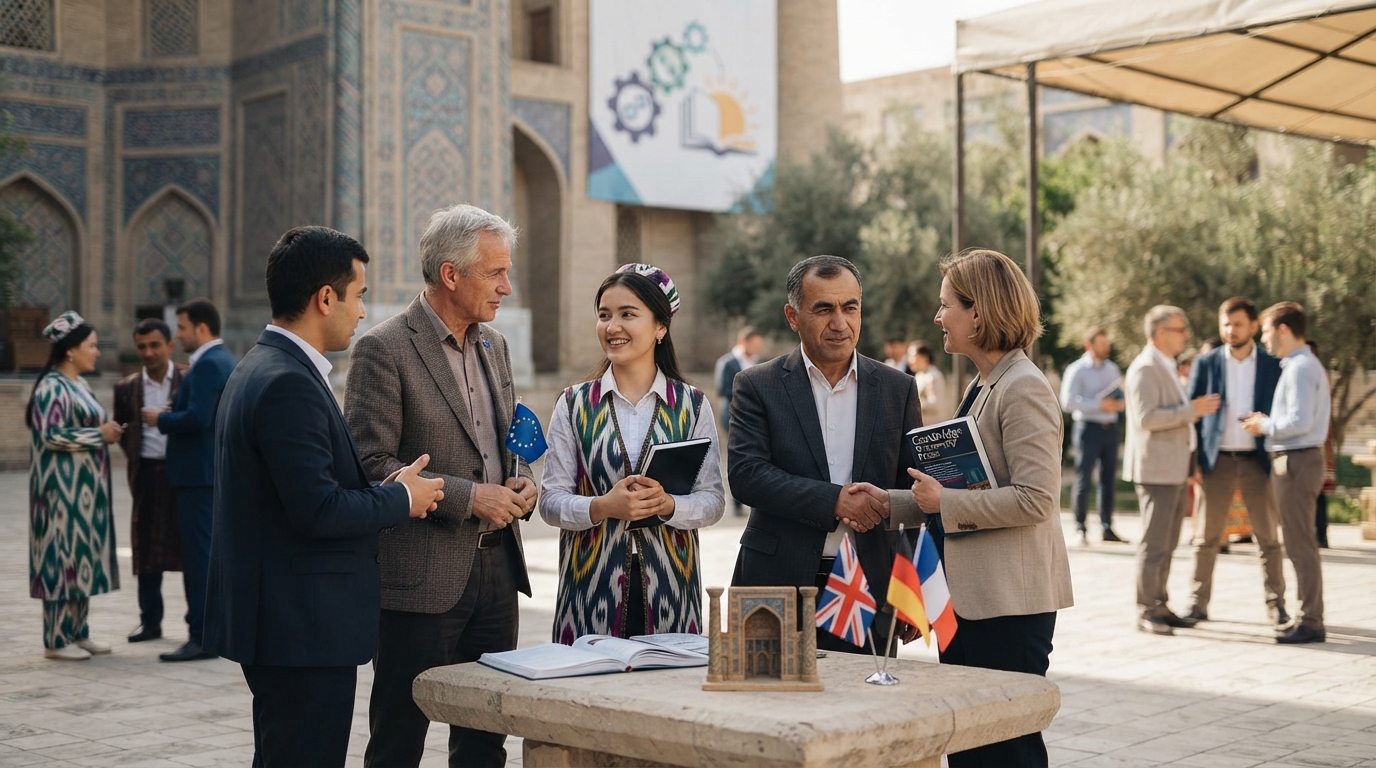
What is the strongest link between Uzbekistan and its European partners? This and other questions were posed to foreign ambassadors in a quick poll conducted by Gazeta.
While observing contemporary political processes in Central Asia, I am constantly reminded of events in Europe in the second half of the last century. President Shavkat Mirziyoyev actively promotes regional cooperation and integration, something we constantly see in Europe—both as a whole and between individual countries and EU regions. This makes the EU and Uzbekistan, and the EU and Central Asia, natural allies and partners, with Uzbekistan playing a key role here.
If I were to draw a parallel between Uzbekistan and the United Kingdom, I would note our shared belief in the transformative power of education, knowledge, and innovation. Both our countries have rich intellectual traditions, a deep respect for learning, and a long-standing commitment to science, research, and the pursuit of discovery.
Uzbekistan's history is inextricably linked to its role as a hub of knowledge, trade, and cultural exchange along the Great Silk Road. The ideas, discoveries, and connections that emerged in this region shaped not only Central Asia but the world as a whole. In the United Kingdom, education, science, and innovation have also played a defining role in the country's development, from our oldest universities to our contributions to research, technology, and global education.
Today, this shared commitment is one of the strongest foundations of the relationship between the UK and Uzbekistan. The ambitious education reform program implemented by Uzbekistan in recent years has achieved significant progress in expanding access to education, improving its quality, and creating new opportunities for young people. It has also opened up greater space for UK-Uzbek cooperation in education, skills, and innovation.
Today, more than 8.9 million schoolchildren across Uzbekistan learn from textbooks published by Cambridge University Press. Around 20 British-Uzbek transnational education partnerships are helping make world-class higher education more accessible here at home. This academic year, 104 El-Yurt Umidi scholarship recipients, nearly half of its international intake, will travel to the United Kingdom to study, acquire new skills, and build long-term relationships.
The British Council also works with partners across Uzbekistan to develop English language teaching and teacher training. This year, the British Council celebrates 30 years of work in Uzbekistan, and this milestone reminds us of the long and deep educational partnership between our countries and the many people and institutions who have built it over the past three decades.
Together, these efforts help equip young people with the skills, knowledge, and international perspective needed to diversify and transform Uzbekistan's economy. For me, such investments in people and human capital are one of the most compelling examples of what our partnership can achieve. They reflect not only what binds our countries today, but also the future we are building together.
On November 9, 1989, the Berlin Wall fell. Residents of West and East Germany embraced each other and celebrated their newfound freedom. A year later, thanks to the success of the peaceful revolution in the GDR, both parts of Germany were reunited into a single state. The fall of the Berlin Wall symbolically marked the end of the Cold War and the era of political breakthroughs in the previous century. Many peoples regained their freedom.
In the context of this historical process, Uzbekistan also declared its independence on August 31, 1991. The Federal Republic of Germany sincerely congratulates Uzbekistan and the Uzbek people on the 35th anniversary of this momentous event.
I believe that France and Uzbekistan are united by pivotal periods—the Age of Enlightenment and Jadidism, respectively—during which women and men advocated for reason and science to occupy a central place in society.
Today, as in the past, the strengthening of dialogue between our governments and joint work in the fields of economics, education, and science continue the commitment to knowledge that characterized those eras and testify to the unwavering desire to share our knowledge for the prosperity of our societies.
The EU and Uzbekistan share a common interest in global and regional stability and security, and in strengthening our economic ties.
But no less important—and this strikes me—is the ever-growing flow of people moving in both directions.
At tourist destinations in Uzbekistan, you can always hear the speech of many European languages. We are becoming closer every day.
People.
More than ever, the relationship between the United Kingdom and Uzbekistan is defined by the connections between people: students studying in the UK, British and Uzbek companies investing in each other, university collaboration, cultural exchanges, tourism, and the thousands of conversations that take place between our societies every day.
Education is one of the most visible manifestations of this connection. Every student, teacher, researcher, and graduate who builds a bridge between our countries becomes part of a greater partnership. Reforms in Uzbekistan are opening up new opportunities for young people, and the UK is proud to support these aspirations through education, English language, skills development, and institutional collaboration.
Governments can create opportunities, but it is people who bring the true depth, warmth, and strength to a partnership. It is the growing ties between our citizens, institutions, and communities that make the UK-Uzbekistan relationship so vibrant today and so promising for the future.
Economic cooperation is becoming increasingly significant, trade is growing, and German companies are actively involved in Uzbekistan's rapidly developing market, for example in mechanical engineering and the automotive industry.
Uzbekistan's population is relatively young and growing. Germany and Uzbekistan cooperate in vocational education, and many Uzbeks are learning German. The migration agreement concluded between Germany and Uzbekistan allows Uzbeks to work in Germany as qualified specialists. Student exchange and scientific cooperation are also expanding, bringing the societies of the two countries closer together.
Germany supports Uzbekistan in implementing its ambitious national reform program, in its efforts to strengthen regional cooperation, and in pursuing a peaceful foreign policy. We are seeing many common ground between our shared interests and values.
I continue to believe that faith in progress binds our two countries more strongly than ever. Let me share with you the message I convey to all my interlocutors: "You can always count on France—a country committed to progress, freedom, and sovereignty." And I am proud of the projects we are implementing together with our Uzbek partners—from medicine to education.
In July, I awarded diplomas to five surgeons who completed breast oncology training in France as part of a program initiated by the French National Academy of Surgery and the Republican Center for Oncology and Radiology of Uzbekistan, funded by the El-Yurt Umidi Foundation. This training, which will improve oncology care in Uzbekistan, is one of many examples of the progress achieved through French-Uzbek cooperation in science and education.
Traveling throughout Uzbekistan, I have also been able to observe how your country is developing while prioritizing the preservation of the cultural and linguistic heritage that underpins its development. This time, it is my turn to invite you to join us on this journey during French Culture Month in Bukhara this October. Since 2020, the number of students choosing to enroll in French universities has increased by almost 20%.
Do’stlik. Hamkorlik. Farovonlik (Friendship. Cooperation. Prosperity).
Education for opportunity. Partnership for prosperity. Friendship for the long haul.
These three phrases capture the spirit of where I see our relationship heading: practical cooperation that opens up new opportunities, a shared commitment to sustainable economic growth, and a friendship between our peoples that will only grow stronger in the years to come.
A close partnership for peace and stability. Steadily growing economic exchange. Developing renewable energy, protecting nature, and climate change.
Ambition. Success. Solidarity.