

Uzbekistan and Azerbaijan: How to Transform Political Rapprochement into Economic Growth
In recent years, Uzbekistan and Azerbaijan have evolved from a strategic partnership to a fully fledged alliance. Today, two dimensions are clearly visible in their interaction. On the one hand, the institutional foundation for cooperation has been fully established, while on the other, the economic dynamics of interaction are only just beginning to gain momentum. The relationship between the development of political and diplomatic mechanisms and the practical content of economic cooperation, in our opinion, will determine the content of the next […]
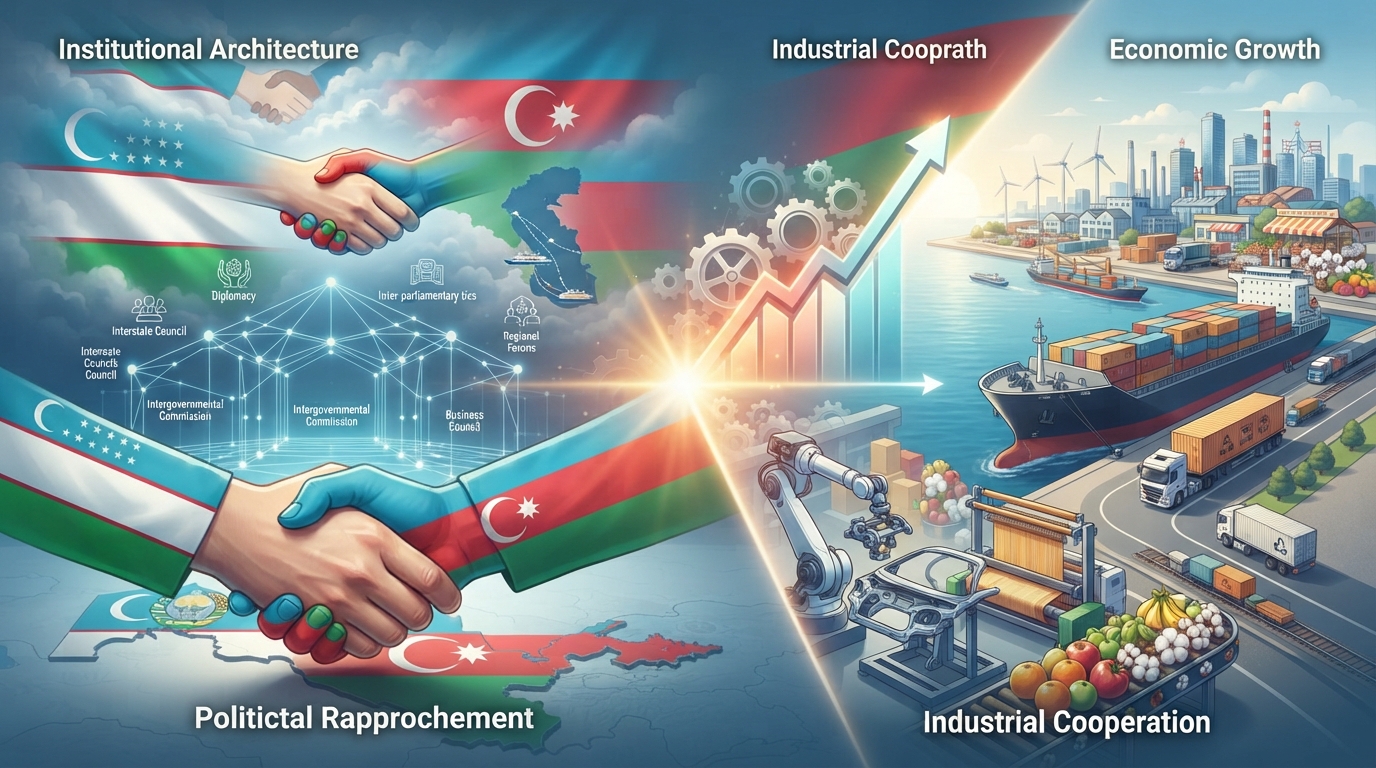
Uzbekistan and Azerbaijan: From Political Rapprochement to Economic Growth
In recent years, relations between Uzbekistan and Azerbaijan have transformed from a strategic partnership into a full-fledged alliance. Two key aspects are evident in their interaction today: on the one hand, a solid institutional foundation for cooperation has been created, and on the other, economic momentum is only just beginning to gain momentum.
In our opinion, it is the balance between the development of political and diplomatic mechanisms and the practical implementation of economic cooperation that will determine the content of the next stage of Uzbek-Azerbaijani relations.
**Institutional Architecture**
The architecture of bilateral relations built by Tashkent and Baku is largely based on the principle of top-down coordination. The agenda is set at the level of heads of state, and its implementation is ensured by intergovernmental, departmental, and business mechanisms. The presidents of Uzbekistan, Shavkat Mirziyoyev, and Azerbaijan, Ilham Aliyev, set the main vectors and pace of cooperation, significantly accelerating the decision-making process.
As a result, a comprehensive system of interaction mechanisms has gradually emerged. In 2023, the Supreme Interstate Council was established, with its first meeting held in 2024. A Treaty on Alliance Relations was also signed at that time. In July 2026, the 15th meeting of the Intergovernmental Commission was held in Tashkent. Since 2020, the Uzbek-Azerbaijani Business Council has been functioning, three Forums of Regions have been held, and sister city relations have been established between eleven cities. Over the past three years alone, more than twenty high-level interparliamentary contacts have taken place, and in 2025, the first interparliamentary forum was held in Khiva.
Such intensity of bilateral contacts is typically characteristic of neighboring countries or states with significantly higher levels of mutual trade. For Uzbekistan and Azerbaijan, separated by the Caspian Sea and with a relatively small trade turnover, the achieved level of institutionalization appears particularly significant.
The practical effect consists of reducing political and administrative barriers, reducing the time required to approve decisions, and simplifying the conditions for businesses to enter each other's markets. However, the institutional framework alone does not generate trade flows and investment demand. It creates favorable conditions for business activity, but does not replace the economic incentives on which the further dynamics of cooperation depend.
Therefore, the next stage will likely be determined not so much by the further expansion of existing formats, but by their ability to transform the achieved level of political ties into concrete economic results.
**Economic Dimension: Scale in Comparison**
Political dialogue between the countries is currently significantly outpacing actual economic indicators, which is clearly confirmed by statistics. By the end of 2025, mutual trade amounted to $307 million, an increase of approximately 15%. Uzbek exports increased by 8% to $227 million, while imports from Azerbaijan increased by 39% to $80 million. The range of Uzbek exports expanded by 116 items.
However, these figures take on a different meaning when compared to Uzbekistan's total foreign trade turnover, which exceeded $81 billion in 2025. Azerbaijan's share of this turnover was less than 0.4%.
This indicator should not be interpreted as an assessment of the quality of bilateral relations. Rather, it demonstrates the difficulty of translating political rapprochement into large-scale economic ties. This is explained by a number of objective structural constraints.
These include the lack of a common border and the need for multimodal transport across the Caspian Sea, the overlapping export goods (textiles, fruits and vegetables, and certain chemical products), and a similar model of diversifying economic ties, in which the parties compete more often in third markets than complement each other.
This leads to a very practical conclusion. Simply increasing traditional trade is highly unlikely to achieve the $1 billion target set by the two leaders. Growth will have to be sought through investment and industrial cooperation, where trade flows are generated through joint production chains.
Both countries understand the importance of establishing such systemic cooperation. Therefore, in recent years, the focus of the agenda has shifted significantly from trade to investment. The Azerbaijan-Uzbekistan Investment Company (AUIC), established in 2023 with a charter capital of $500 million, is already involved in 15 projects worth approximately $360 million, according to the Ministry of Investment, Industry, and Trade of Uzbekistan. The overall portfolio is significantly broader, including over 20 projects worth approximately $6 billion, with another 25 projects worth nearly $1.5 billion in preparation.
The extent to which investment cooperation extends beyond stated intentions is best demonstrated by the practices of specific production sites. The most notable example is the joint automobile assembly plant of Uzavtosanoat and Azermash in the Hajigabul Industrial Park, where over 11,000 Chevrolet vehicles and Isuzu buses have already been produced. The project is currently moving to the next stage – the creation of a full-cycle enterprise with an investment volume of over $84 million. Textile and silkworm farming clusters, as well as agro-industrial and logistics projects, are also being developed.
The significance of such initiatives is determined not only by production volume. Their main advantage lies in the formation of sustainable production ties between the two countries.
Joint production creates stable demand for mutual supplies of components, raw materials, and equipment, effectively integrating bilateral trade into a single production chain.
Such ties are generally less sensitive to market fluctuations, as they are based not on one-off transactions but on long-term production needs. Another important factor is that localizing production in Azerbaijan, while adhering to the relevant rules of origin, potentially allows access to third-country markets with which Baku enjoys preferential trade regimes.
In this sense, joint ventures can be viewed not only as a tool for developing national markets but also as a potential platform for jointly promoting products beyond the borders of Uzbekistan and Azerbaijan. However, this effect does not arise automatically and requires the separate development of trade, customs, and legal mechanisms.
**What influences further growth?**
The established institutional architecture and the results of economic interaction create significant potential for further expansion of cooperation. However, its realization will depend on the ability of the parties to overcome a number of structural constraints.
First and foremost, this concerns the aforementioned competition for similar products in third markets, the volatility of Caspian logistics due to the condition of the ferry fleet and the seasonality of shipping. Additional constraints include difficulties with direct payments between banks in the two countries and cargo insurance, which increases the cost and timeframe of foreign trade transactions.
Against this backdrop, the natural question arises: what could accelerate the dynamics of cooperation?
One of the most practical steps could be the mutual recognition of certificates and laboratory test results, particularly for agricultural products, which would reduce the time and cost of introducing goods to the partner market.
In the financial sector, it makes sense to expand correspondent banking relationships and settlements in national currencies through direct payments between them and convenient currency conversion mechanisms. This will reduce dependence on intermediaries and make trade and investment transactions more predictable.
The transportation component deserves special attention. Expanding the capacity of Caspian routes, synchronizing tariffs and shipping schedules, and developing digital cargo tracking will help reduce business costs.
Thus, Uzbek-Azerbaijani relations have reached a point where the political capital accumulated in recent years is gradually gaining economic and practical substance. In this sense, it can be confidently said that the countries have succeeded in laying a solid foundation for moving toward new directions and deeper forms of developing their allied relations.
Miraziz Mirumarov, Leading Researcher, Institute for Strategic and Interregional Studies under the President of the Republic of Uzbekistan
Iroda Imamova, Leading Researcher, Institute for Strategic and Interregional Studies under the President of the Republic of Uzbekistan