

What is supporting Uzbekistan's national currency
Over the week since our previous review, the situation on the foreign exchange market of Uzbekistan has become more stable.
What is supporting the national currency of Uzbekistan
In the week since our last review, the situation on Uzbekistan's foreign exchange market has become more stable.
As of November 5, 2026, the dollar is trading at approximately 11,975 soums compared to 11,980 a week earlier, and is not yet able to gain a foothold above the psychologically important level of 12,000.
This is especially noticeable after the sharp movement in the second half of October, when the exchange rate rose from about 11,780 to 12,000 soums. Now the momentum of the soum's weakening is almost exhausted, and the market is looking for a new point of equilibrium.
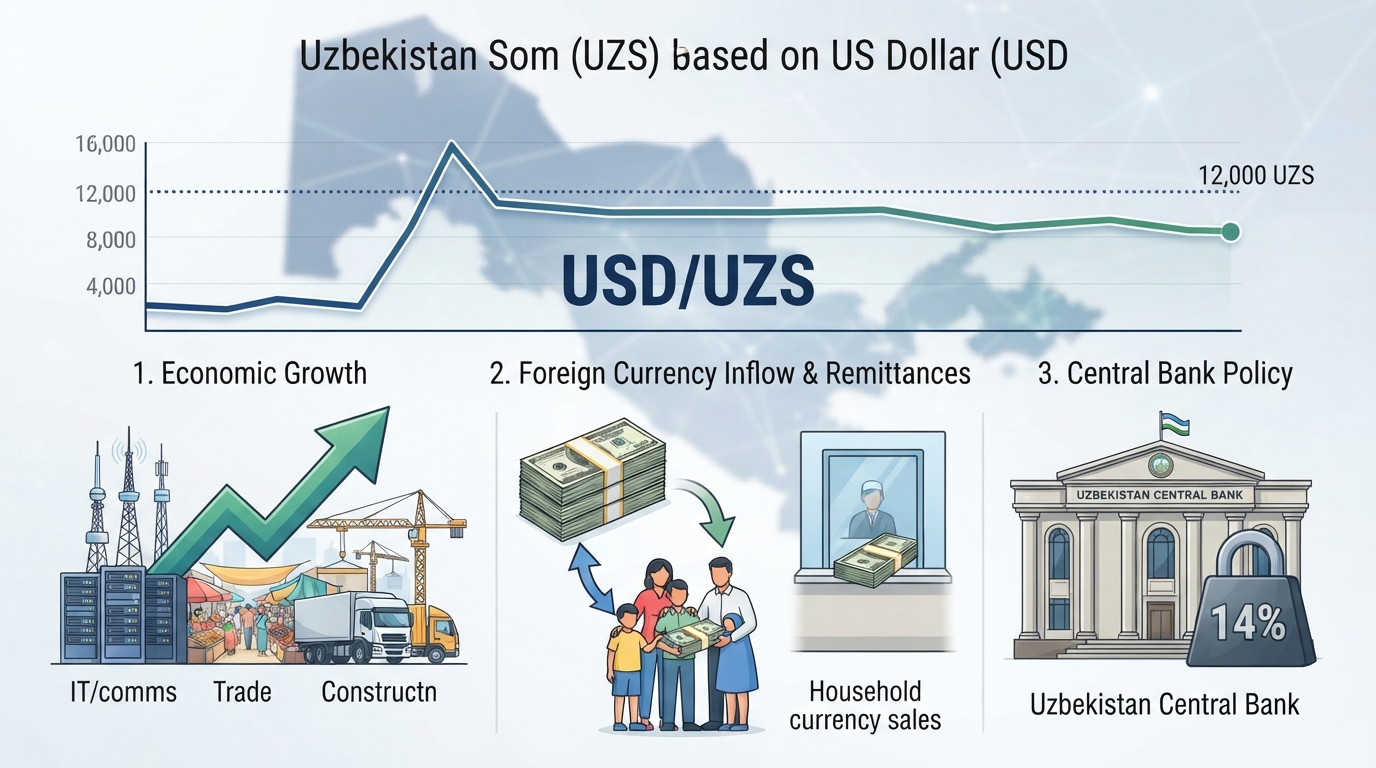
New data show that the fundamental background remains strong. Uzbekistan's economy grew by 8.3% over the nine months — the highest rate since at least 2022. Communications and IT, trade, transport, and construction look particularly good.
In other words, high business and consumer activity persists within the country. For the soum, this is a mixed factor: a strong economy increases income and the sustainability of foreign exchange earnings, but at the same time, businesses and the population require more imported goods, equipment, and raw materials, which means more foreign currency is needed.
Another side of the foreign exchange balance is particularly important here. Over the nine months, remittances to Uzbekistan exceeded $15 billion, and the population sold $18.9 billion in foreign currency to banks.
That is, households remain a significant source of dollars and other foreign currency for the domestic market. This helps smooth the impact of growing demand from importers and explains why the dollar's movement stopped after its rapid growth toward 12,000.
The inflation situation also looks relatively comfortable: in September, annual price growth stood at 6.4%. With the Central Bank's main rate at 14%, monetary conditions remain tight, which supports the attractiveness of savings in soums and limits excessive growth in domestic demand.
At the same time, the high economic activity itself remains a risk: the faster incomes, consumption, and investments grow, the higher the potential demand for imports and foreign currency.
Next week, 12,000 soums per dollar remains the key level. For now, a consolidation scenario in the range of 11,850–12,100 appears to be the baseline.
A sustained movement of the dollar above the upper boundary will require a noticeable increase in domestic demand for foreign currency.
For now, large foreign exchange inflows and tight monetary conditions provide fairly solid support for the soum.