

What is happening with propane prices and why the Ministry of Energy is betting on imports
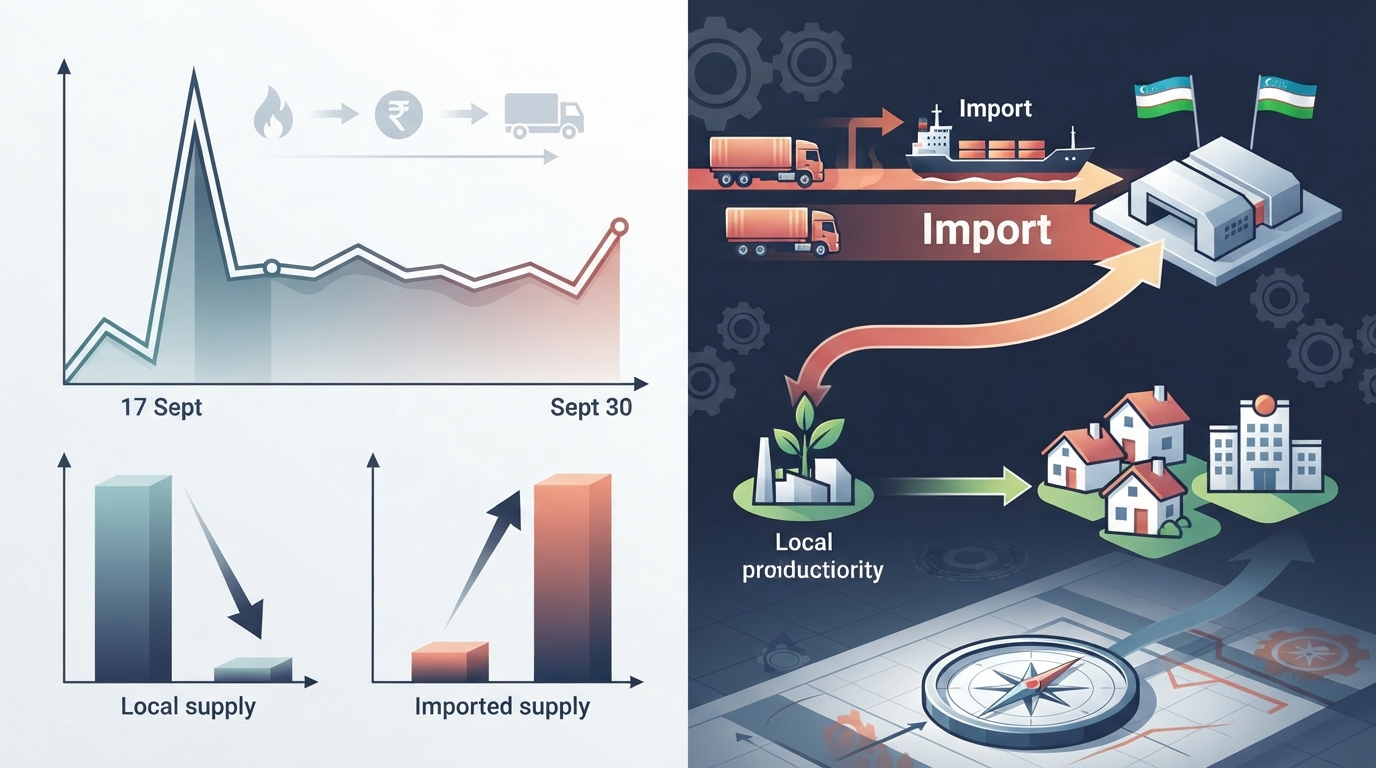
After the removal of the limit on exchange price growth on September 17, propane became more expensive by more than 60%, reaching 11.9 million soums per ton. The price subsequently declined, but supply decreased by the end of the month. The Ministry of Energy is counting on an increase in imports while preserving the domestic fuel resource for the population.
What is happening with propane prices and why the Ministry of Energy is betting on imports
In September, the liquefied gas market in Uzbekistan sharply changed its price dynamics after the removal of the limit on price growth on the commodity exchange.
From November 2024 until mid-September, the growth of the cost of liquefied gas on the exchange was restrained by a maximum spread — the sale price could not deviate from the seller's starting price by more than 20%.
On September 12, the President signed a decree on the gradual introduction of market mechanisms into the liquefied gas supply system. The document provides that liquefied gas produced in Uzbekistan and imported, with the exception of volumes sold by producers and importers through their own filling stations, must be sold through the exchange.
At the same time, the establishment of a growth limit — the spread — of the exchange price relative to the listing price of the goods was canceled. A separate deadline for this specific norm to enter into force is not specified in the decree. The document itself entered into force on September 15.
On September 17, the exchange price of propane rose by more than 60% — from 7.412 million to 11.904 million soums per ton.
After this jump, fears arose that liquefied gas would rise in price just as sharply at automobile gas filling stations.
However, a source of "Gazeta" familiar with the liquefied gas sales market noted that by the end of September, such growth had not occurred in most regions. According to his data, in some districts of the southern regions, propane was sold at about 11,000 soums per liter, in some regions — at 9,000–10,000 soums. In the central and eastern regions, the price mostly remained within approximately 8,000–9,000 soums.
The source attributes this to the fact that before the cancellation of the spread, part of the actual costs of buyers might not have been directly reflected in the exchange price. According to him, some market participants additionally paid sellers outside the exchange a so-called "shapka" (premium/kickback), and then factored these expenses into the retail price.
After the removal of the restriction, according to his assessment, this part of the cost began to be reflected directly in the exchange price, rather than being formed through additional payments outside of trading.
It was assumed that more market-based pricing would simultaneously increase the attractiveness of imports for entrepreneurs: with a sufficient difference between the domestic and import prices, it becomes more profitable for suppliers to bring in more liquefied gas. The growth of import supply, in turn, should strengthen competition and restrain prices.
After the sharp jump on September 17, the cost of propane gradually decreased. By the end of the month, the decline continued for seven consecutive trading days.
However, on September 30, the trend changed. Economist Otabek Bakirov pointed out that the average cost of propane rose by 371.4 thousand soums and reached 11.364 million soums per ton.
At the same time, the sales volume decreased to 1,018 tons. This is almost 25% less than the volumes of previous days and about 70% less than in the trading on September 23.
Bakirov also drew attention to the reduction in supply. In particular, on September 30, the divisions of the largest producer — "Uzbekneftegaz" — did not put liquefied gas on the exchange. Lukoil's offer amounted to about 50 tons.
At the same time, the absence of "Uzbekneftegaz" liquefied gas in the trading in the last days of the month corresponded to the schedule previously published by the company.
On September 3, "Uzbekneftegaz" posted the approved schedule for listing liquefied gas for September on the exchange's website. The company planned to sell a total of 4,500 tons during the month.
According to the document, the last volumes in September were to be listed on September 25. No deliveries were planned in the schedule for September 28, 29, and 30.
Of the total monthly volume, the Mubarek Gas Processing Plant accounted for 1,500 tons, the Shurtan Oil and Gas Production Department — 1,200 tons, and the Gazli OGPD — 940 tons. Another 560 tons were planned to be listed by the Shurtan OGPD under a commission agreement with Uz-Gas Energy, and 300 tons — by the Mubarek GPP under an agreement with Sanoat energetika guruhi.
According to Lukoil's schedule, approved by a letter dated August 28, in September the company planned to put 1,050 tons of liquefied gas up for sale (50 tons per day).
In response to a request from "Gazeta", the Ministry of Energy reported that the liberalization of exchange trading does not provide for an increase in the volumes of domestically produced liquefied gas entering the market.
"The main goal of removing the existing restrictions on exchange trading of liquefied gas is not to increase the volumes of domestic resources put up for auction, but to expand the opportunities for entrepreneurs to import and thereby increase import volumes," the Ministry of Energy reported.
The Ministry emphasized that for domestically produced liquefied gas, the priority of supplying the population at reduced prices remains.
"For the guaranteed and uninterrupted supply of this resource to the population, increasing the volumes of domestic resources put up for open exchange trading is not considered expedient," the department indicated.
The presidential decree also directly establishes the priority of liquefied gas supplies to the population. From November 1, a new system should start working: the LPG-Trade company, created under "Hududgaztaminot", will purchase gas through the exchange and supply it to the population, while private entrepreneurs will be able to supply the population with liquefied gas, including through imports.
The government was also instructed to conduct negotiations within a month with Lukoil Overseas Supply and Trading Ltd on the sale of the entire volume of liquefied gas produced at the company's facilities through a special platform of the commodity exchange (gas will be sold there at preferential subsidized prices for the population).
According to data from the National Statistics Committee, propane rose in price by 5.8% in August and by 41.4% over the year.
[The text is missing a transition here in the source] that 31 importing companies violated legal requirements when trading propane, including by restricting supply, inflating starting prices, and selling bypassing the exchange. Collusive actions aimed at restricting competition were established in respect of 12 companies. The violators were fined 28.9 billion soums, and another 34.1 billion soums of unreasonably received funds were to be transferred to the budget.
The Committee linked the situation to a change in the market structure. The share of imported propane in exchange trading at that time rose sharply from 20% to 90%, while local products are increasingly directed to the needs of the population and the social sphere. As a result, as the department claims, it was imported gas that began to determine the average price on the exchange.