

What does a Martian morning look like? Curiosity photographed unusual rocks
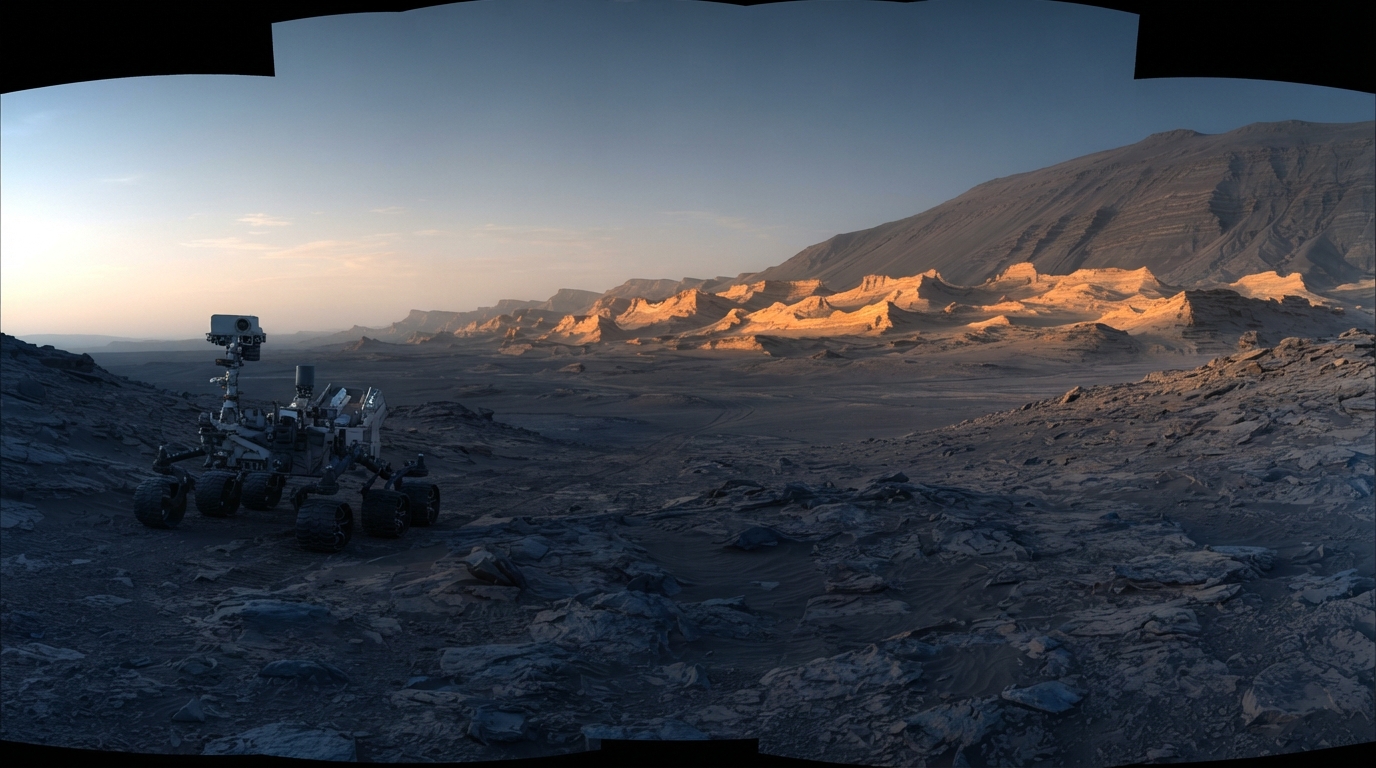
NASA's Curiosity rover captured images of unusual wind-eroded rocks on Mars in the morning light. Since the normal color correction was not applied to the panorama assembled from six frames, the morning view of the Red Planet retained its natural appearance.
What does a Martian morning look like? Curiosity photographed unusual rocks
Bluish tones are clearly visible in the foreground of the image. The yardangs on the horizon — rocks shaped by wind erosion — shine brightly under the early morning light.
Unlike many images taken by Curiosity’s Mastcam camera, the white balance of this panorama was not adjusted. Because of this, the natural early morning colors of the Martian landscape have been preserved.
The layer of yardangs stretches for approximately 16 kilometers in the northwestern part of Mount Sharp. Curiosity has been climbing the slopes of this mountain, which is nearly five kilometers high, since 2014.
Recently, the rover achieved another important milestone: its total elevation gain along the route reached one kilometer. This is recorded as the highest figure among all rovers that have operated on Mars.
Scientists hope to obtain even more detailed images as Curiosity gets closer to the yardangs. One of their main goals is to determine how these unusual rocks were formed.
Mount Sharp consists of many layers, each of which provides information about a specific period in Mars's history. By studying them, scientists have gained a better understanding of how lakes and streams existed in this area billions of years ago.
Over time, the water dried up, leaving behind salt minerals. After new deposits stopped accumulating on the mountain, wind may have gradually eroded part of the material. It is assumed that the yardangs were formed as a result of this process.
Currently, Curiosity is working in the second year of its fifth extended mission. This stage began with the study of ridges that form a grid-like structure resembling a spiderweb.
Over the next year or so, the rover will mainly move through layers rich in sulfate and carbonate minerals. These layers are expected to provide additional information about the ancient environment and the drying up of water on Mars.
Scientists hope that Curiosity will reach the base of the yardangs during 2027. Then, using its robotic arm, the rover will be able to directly study these rocks and gather new data.