

What do we still need to know about the Tyne nurdle spill?
The spill of 18 tonnes of plastic pellets happened in July but there is still a lot we do not know.
What else do we still need to learn about the Tyne nurdle spill?
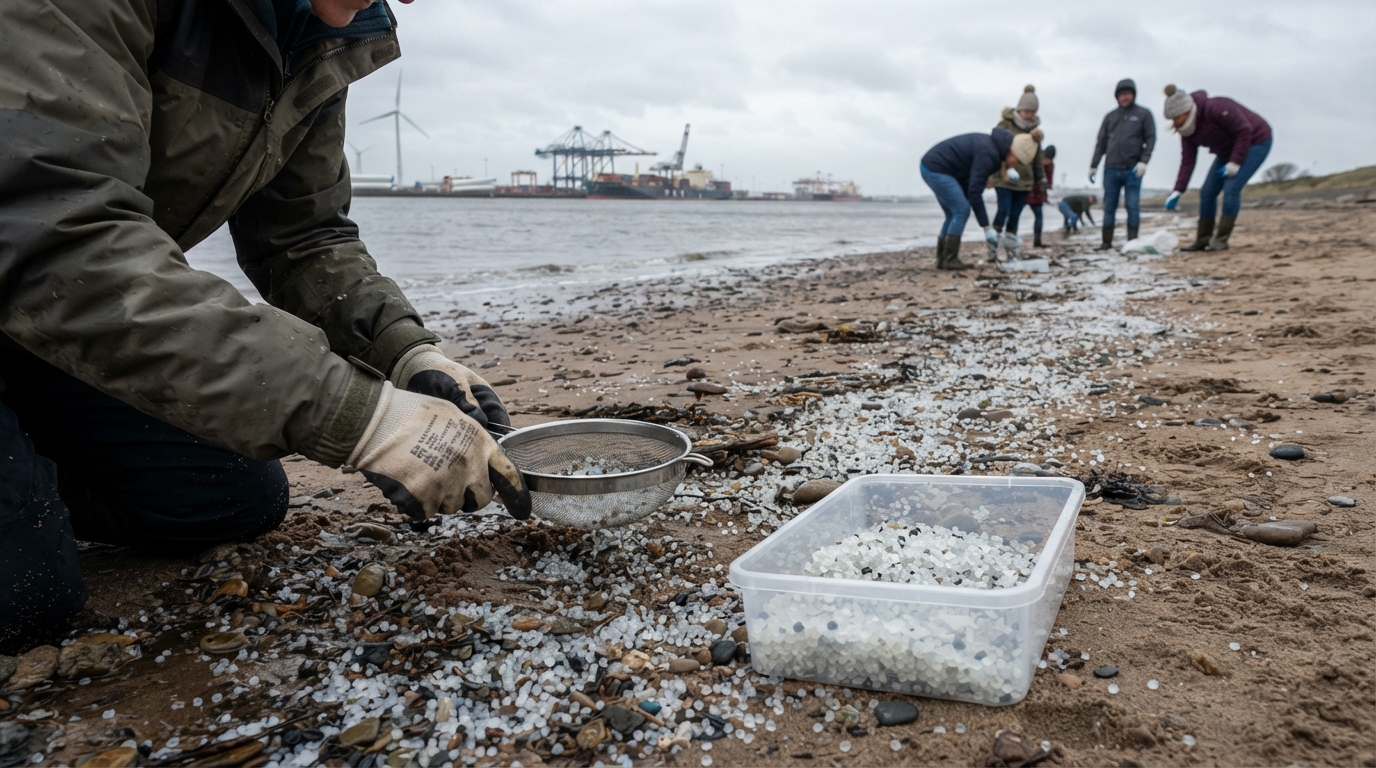
The pellets have turned up on a number of North East beaches.
On 19 July, around 18 tonnes of plastic nurdles — roughly one billion tiny balls — entered the River Tyne after a collision between ships at the Port of Tyne.
It is thought to be the worst recorded incident of its kind in Europe.
Since then, volunteer teams have helped gather the microplastics that keep washing ashore on the north-east England coast.
But many questions are still unanswered. So what do we know now about the spill, and what are we still waiting to discover?
What is a nurdle and why do they matter?
A wind turbine installation vessel named the Wind Orca struck a container ship moored at the Port of Tyne.
A gantry crane on the quayside collapsed and came to rest across the ship.
Two containers on the BG Orange were filled with nurdles. These are pre-production plastic pellets, about the size of a lentil, used as the raw material for making almost all everyday plastic products.
About 18 tonnes of these pellets spilled into the water as a result of the crash.
That is still under investigation.
Northumbria Police said it was investigating the collision and, so far, no-one has been arrested. The Marine Accident Investigation Branch is also investigating.
The Port of Tyne had previously said it, along with others, had asked the International Maritime Organisation (IMO) to consider enforcing safer transport methods for nurdles.
By the end of September, about 28% of the nurdles had been recovered, according to scientists.
But the Port of Tyne, the Environment Agency and the North East Mayoral Strategic Authority (MSA) said the number of nurdles washing up on shore had already "reduced significantly" by then and was still falling.
They said they believed recovering all 18 tonnes would not be possible. When asked what recovery percentage would count as success, the bodies said they would judge success using several measures, including shoreline surveys.
Pellets from the spill have been found along the English coast from Northumberland to North Yorkshire.
On Friday, the Danish Environment Protection Agency confirmed that pellets found on the country's western coast had also likely come from the Tyne spill.
Dr Matthew Perks at Newcastle University and his colleagues are tracking the movement of the nurdles and studying how the pellets may break down in water.
So far, the team's modelling suggests that about one in eight of the billion nurdles remain in the Tyne estuary, and high river flows could carry these microplastics downstream in the autumn.
Perks said this was a vital chance to collect the pellets.
The Danish Environment Protection Agency said the pellets on the Wadden Sea coast looked similar to those from the Tyne spill.
Even so, he said it was still unclear how far some of the nurdles could actually travel.
"As time goes by, it becomes more difficult to pinpoint the areas where these nodules are likely to be," he said.
It is also not clear when the nurdles will begin breaking down into nanoplastics. "That will change the way they behave," he said.
Long story short – we do not know yet.
Professor Bhavani Narayanaswamy at the Scottish Association for Marine Science said it could be months or years before the full impact of the spill is understood.
She said the nurdles could affect wildlife in several ways, including becoming lodged in animals' digestive tracts and adsorbing chemicals that may then be toxic to wildlife when ingested.
Prof Narayanaswamy said there had been little research into the long-term effects of plastic pollution on animals compared with its immediate effects.
Dan Turner, who coordinates the North East England Beached Bird Survey, said the group had collected several dead birds along the coast and would test them for nurdles next month.
"It is quite possible that the seabirds have mistaken the plastic for fish eggs," he previously told the
Birds have been seen appearing to eat nurdles on a beach in Tynemouth.
Recovery is being paid for largely by insurers representing BG Orange, which was carrying the pellets, as well as local councils and the Port of Tyne.
Thousands of volunteers have also taken part in the clean-up.
Councils have been told to log their costs so they can claim compensation from the insurers of those ultimately found responsible.
The multi-agency group, made up of the North East MSA, Port of Tyne and the EA, said the nurdle recovery programme was still continuing but had increasingly shifted away from "large-scale clean-up activity" and towards "targeted recovery and monitoring".
Environmental charity Fidra said it was unclear how long the clean-up would need to go on, given that nurdles could remain in water for years.
It said a long-term plan was needed to deal with the pollution and that the plans should be "adequately resourced" with responsibility clearly set out.
Volunteer Lou Shackleton said there was still a core group of people giving up their spare time to monitor and recover nurdles on local beaches.
She said the group needed all the help they could get.
"If you're happy to wrap up against the rain and the wind... come and join us," she said.