

What cooled the Earth 12,800 years ago: a comet or volcanoes?
New research has joined the debate over the causes of the sharp cooling that began approximately 12,800 years ago. Scientists who studied sediments in Florida report that they have identified traces of volcanic eruptions. Meanwhile, another group that analyzed Greenland ice attributes the findings to an impact from a cosmic body. For now, none of these hypotheses has provided a definitive answer to the issue.
What cooled the Earth 12,800 years ago: a comet or volcanoes?
The cold period known as the Younger Dryas began at the end of the last glaciation. According to one of the hypotheses aimed at explaining its causes, a comet or its fragments may have struck the Earth at that time. Two studies published in 2026 offer different explanations for this event.
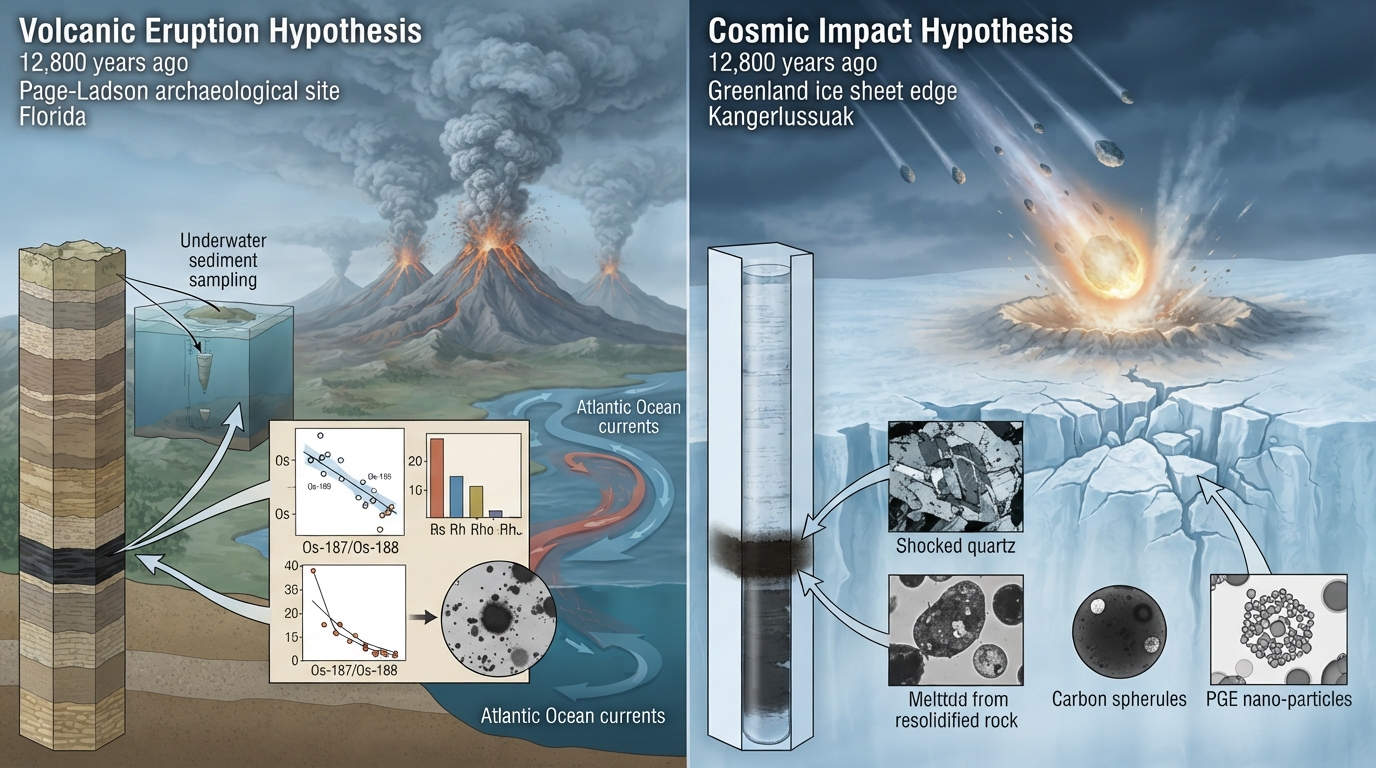
A team led by Lucien Nana Yobo analyzed sediments from the Page-Ladson underwater archaeological site in Florida.
This site preserves well-dated, continuous sediment layers covering the onset of the Younger Dryas. Scientists examined the ratios of osmium isotopes in them, as well as the levels of rhenium and other elements that help distinguish the origin of materials.
It was found that in the layers corresponding to the onset of cooling, the isotopic composition of osmium changed, while the amounts of osmium and rhenium increased. However, the ratio of elements was more consistent with volcanic aerosols—fine particles dispersed into the atmosphere during an eruption—than with meteoritic material.
According to the authors, it is more logical to explain the discovered chemical traces by volcanic eruption products rather than by matter coming from space.
Researchers interpret that several large eruptions occurring in a short period of time could have disrupted water circulation in the Atlantic Ocean, triggering climate changes.
"Our study provides reliable geochemical evidence that volcanic activity, not a cosmic impact, played the primary role," said lead author Lucien Nana Yobo.
Proponents of the cosmic impact hypothesis, meanwhile, are relying on samples obtained from Greenland.
They studied ice layers on the edge of the ice sheet in the Kangerlussuaq region. In the dust-rich dark layer, they described quartz with impact-characteristic microstructures, remelted glass, tiny spherical particles, carbonaceous particles, and nanoparticles enriched with certain metals, including platinum group elements.