

"We were born in a cotton field": false courage, maternal and child health
8-10 demands Was it a sign of strength and health to give birth to a child in the middle of a field or at home? In fact
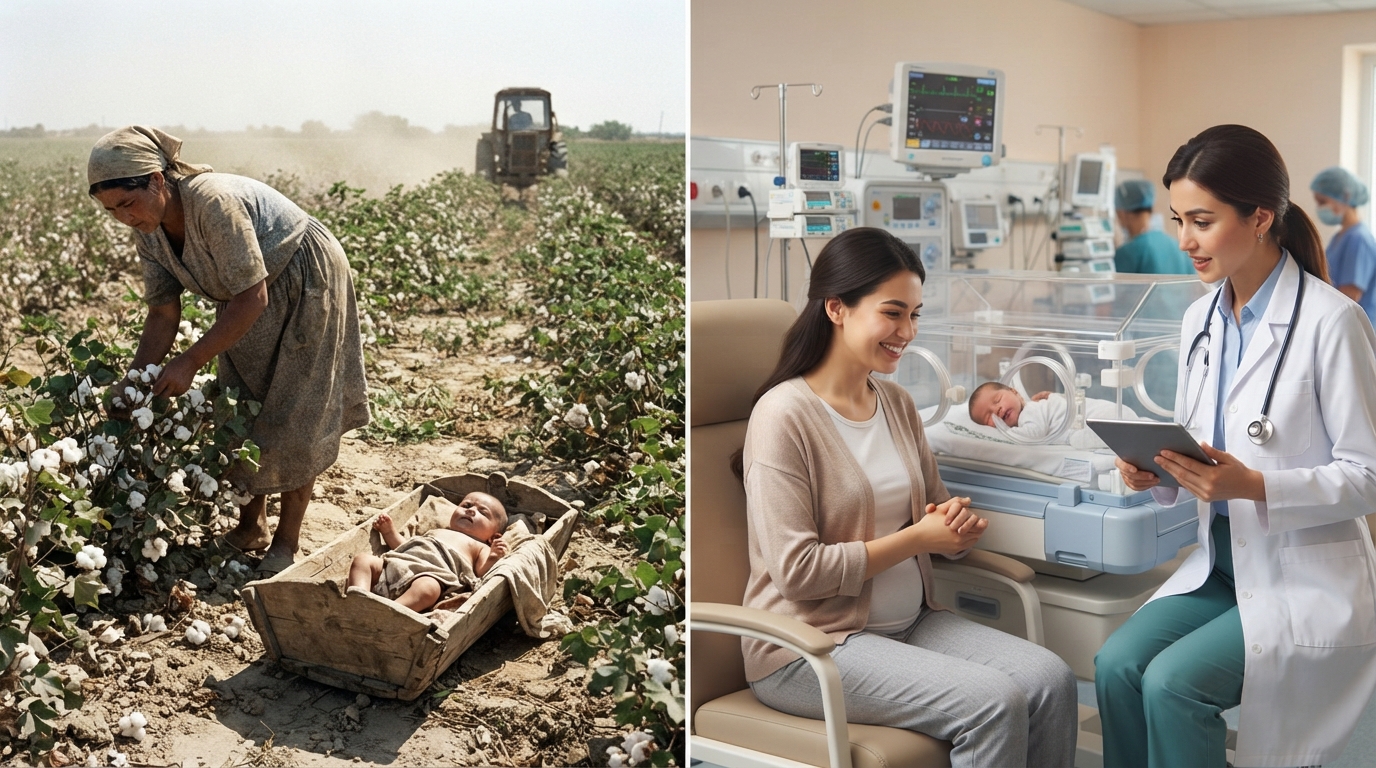
"Born in a Cotton Field": False Heroism, Maternal and Child Health
When we talk about the hard work of Uzbek women, we remember how our grandmothers in the recent past proudly spoke of being born in a cotton field. Or we imagine mothers swinging their children in a swing and playing in the sun. In the scorching summer heat, in a dusty cotton field, and a child who was bothered by a mosquito that landed on his face on a swing, hardly anyone worried at that time...
Pesticides, Health and False Myths
As soon as you imagine a woman who has recently given birth with her baby in a cotton field, a smile appears on your face. Can you imagine the health of a mother and child next to the phrases of a woman and a baby walking in a pesticide field?
The idea that ecology and people's health were good at that time is actually nothing more than a false myth. Isn't it illogical to talk about clean ecology at a time when women and children were constantly sprayed with toxic fertilizers? When we were walking around with the illusion that there were no problems with childbirth because mothers were strong and healthy, dozens of scientific studies were written about rickets in babies, severe anemia in mothers, and brittle bones.
Although we don't have time to delve into the studies, it is not difficult to learn from agricultural data that extremely toxic defoliants such as DDD (dichlorodiphenyltrichloroethane) and butifos were ruthlessly sprayed from airplanes in the 1970s and 1980s. Pregnant women worked in this toxic dust. This poison was absorbed directly into the mother's milk and fetus. Due to chronic malnutrition of women, babies were doomed to hypotrophy and rickets. In the late 1980s, 80 percent of pregnant and multiparous women in rural Uzbekistan suffered from severe, chronic anemia.
Now tell me, was it fortitude and health to give birth to 8-10 children, sometimes in the middle of the field or at home? In fact, this difficult fate, disguised as "fortitude", came at the expense of the health of thousands of women, and was the greatest moral and medical tragedy of society.
Lack of modern diagnostics and early control
Once upon a time, there was no such thing as screening or modern ultrasound machines in perinatal centers or family clinics. For the expectant mother, the 9-month pregnancy period was accompanied by joy, but also constant anxiety and terrible uncertainty.
It was completely unknown what was happening in the mother's body, the development of the fetus, its heartbeat, whether there were any hereditary or congenital defects. There was no choice but to simply "blink your eyes" and risk whether the baby would be born healthy or not.
Due to the lack of medical awareness and early diagnosis, how many women have experienced complicated births, how many families have been helpless in the face of the tragedy of babies born with congenital diseases.
A new system of maternity protection
The only place in the world that makes a person's heart beat faster and more excitedly, and at the same time gives the greatest peace of mind, is the maternity ward.
The good news, calmly conveyed to the relatives of a woman who was gasping for breath with anxiety and hope, by a doctor in a white coat, "Everything is fine, both mother and child are healthy!", cannot be described in words.
Today, the establishment of the Republican Perinatal Center, Screening Centers and their regional and district branches in our country has made it possible to monitor the health of mothers and children. Thanks to the chain system, the health of mothers and children is strictly monitored from the first weeks of pregnancy, and a mechanism for early detection and treatment of congenital and hereditary diseases has been formed. About 9,000 midwives have been established to regularly monitor the condition of pregnant women, and medical services for mothers and children are provided in each region by family clinics, family medical centers and a multidisciplinary central polyclinic.
A network of modern maternity complexes has been created in cities and districts, and to coordinate processes in the children's treatment and prevention multidisciplinary medical center, the Republican Specialized Scientific and Practical Medical Center for Maternal and Child Health, the Republican Specialized Pediatric Center and 9 other republican institutions have been merged into a single structure. Also, the 4th-level Children's National Medical Center received an international JCI certificate, and a medical clinic for diseases of the Aral Sea region was established under it.
Fight against anemia and positive indicators
Also, a systematic fight has begun against the problem of anemia, which previously affected almost 60-70 percent of our women and expectant mothers. Thanks to the provision of free multivitamins, iron and folic acid preparations to the population, especially women of childbearing age and pregnant women, as part of state programs, as well as a system of food fortification (especially flour), the anemia rate among women and children has decreased by 1.5-2 times.
Let's face the facts: in 1991, there were 65.3 maternal deaths per 100,000 live births, but by 2025 this figure had decreased to 14.8, a decrease of almost 4.4 times. At the same time, infant mortality under 1 year of age decreased from 35.5 per thousand in 1991 to 9.0, and child mortality under 5 years of age from 48.2 to 12.5, a positive dynamics of 3.9 times was recorded in both directions. Compared to 1990, the mortality rate of children and infants under 5 years of age has decreased by 5 times, and neonatal mortality by 4 times.
Vaccination and prevention culture
Modern screening and high-tech surgical procedures play a special role in protecting children's health. Children are regularly vaccinated against 13 types of infectious diseases within the framework of the National Preventive Vaccination Calendar.
I remember once hearing a heroic mother say that three of her children died of measles, and one of her legs did not work because she did not vaccinate him on time. I remember wondering if vaccination was so important.
Today it is becoming clear that in those days, children who were deprived of walking simply because of untimely or poor-quality polio vaccination also constitute a generation. Infectious diseases that are actually preventable, such as measles, diphtheria, whooping cough or tetanus, caused the death of infants in every second family. The lack of vaccination culture and the weakness of medical prevention have ruined the future of countless orphans and the hopes and dreams of parents.
High-tech medicine and screening practice
Let's turn to the facts again. In order to detect hearing loss early, audio screening of babies has been established in 209 maternity hospitals, and about 500 thousand babies were examined last year. This year, it is planned to screen more than 600 thousand children for hearing loss, conduct in-depth examinations of more than 3 thousand children, and perform more than 500 cochlear implantation operations. As a result of early diagnosis of orphan diseases in the molecular genetic laboratory, targeted treatment of cystic fibrosis using CFTR-modulator is being established. About 4 thousand children with heart defects are annually undergoing cardiac surgery at the expense of the budget, as well as kidney, liver and bone marrow transplantation, and thoracoscopic and laparoscopic operations for congenital esophageal and duodenal atresia in premature babies have been successfully mastered. In addition, in accordance with the Presidential Decree, surgical operations were performed on 10 thousand children with severe and disabling diseases on the occasion of Eid al-Adha.
***
Of course, the scale of the achievements and systemic changes is significant. Today, anti-anemia drugs, folic acid and reproductive protection products are distributed free of charge to the population in maternity hospitals and family clinics, and material and technical conditions are being created. However, objectively speaking, there are still some pain points in the field that are still waiting for a solution and cannot be ignored.
Therefore, not limited to the achievements made, but improving the quality of medical services in remote areas, early diagnosis, and, especially, the implementation of systematic and targeted measures in pediatric oncology without delay are becoming the most pressing issues in the medical field.
Barno Sultonova