

"We must learn from our own experience." Urbanist Iskandar Soliev on the improvement of Tashkent's streets
Successful urban planning solutions cannot always be transferred from one street to another without changes. Urban planner Iskandar Soliev, using the example of three streets in Tashkent, explained why every pilot project should help improve the subsequent ones. Gazeta highlights the key points from the presentation at Tashkent Design Week.
"We must learn from our own experience." Urban planner Iskandar Soliev on the improvement of Tashkent streets
A street can become greener, get new sidewalks and bike lanes, and yet still fail to be convenient for people. Iskandar Soliev, an urban planner, architect, and expert in urban planning and sustainable mobility, explained why this happens at Tashkent Design Week 2026 on October 28.
"When we develop a street design, engineer it, and prepare it for commissioning, we must first answer three questions: who are we designing for, what functions should the street perform, and how convenient is it? Only after we answer these questions can we move on to the appearance," the urban planner noted.
According to Iskandar Soliev, professional analysis of the urban environment is often perceived as criticism. However, the task of specialists is to find flaws, understand their causes, and propose solutions that will help make subsequent projects better.
Following the discontinuation of tram service, Shota Rustaveli Street, according to Soliev's assessment, turned into a wide thoroughfare dangerous for pedestrians. In certain sections, cars parked in two or three rows, and heavy traffic created additional risks for people.
In 2022, with the participation of the UNDP, the Global Environment Facility, the Ministry of Transport, and the Tashkent Transport Department, a project office was created to transform the street. Iskandar Soliev participated in developing its initial design.
He said that the project was preceded by studies of the street's environmental condition, noise levels, mobility convenience, and pedestrian safety. Specialists also studied traffic intensity, flow directions during peak hours, intersection congestion, landscaping, and conditions for cyclists and couriers.
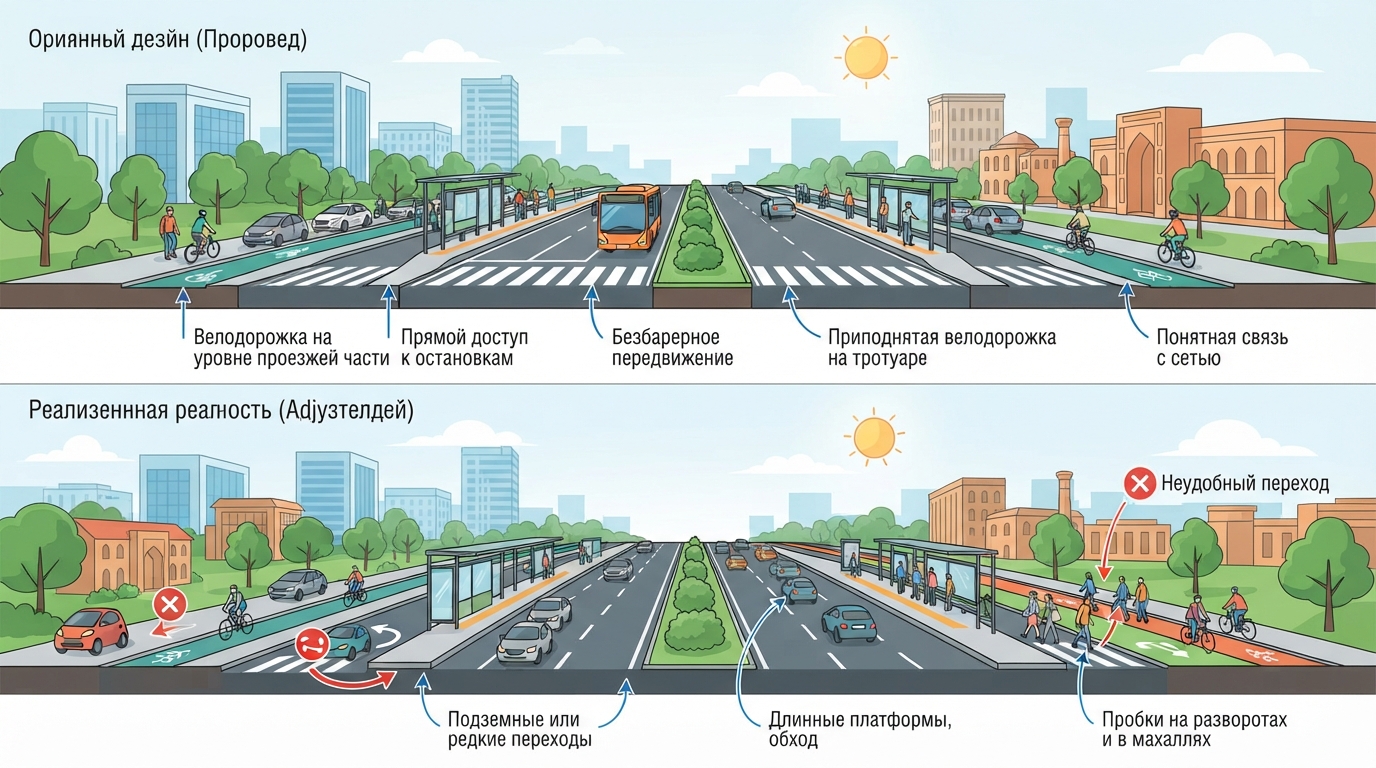
"Initial versions provided for trams, but later this issue was put on hold. Instead, a project for a green corridor for public transport—a BRT system—appeared along the central axis of the street. According to the project, there were supposed to be road crossing points at stops on both sides and at every intersection. Right now I am talking specifically about the project. Convenient stops were also provided for," the urban planner noted.
The total length of the section under consideration was six kilometers. But during the project's implementation, which began in 2025 after the documentation was handed over to the khokimiyat, some of the solutions changed.
"One of the first changes was the arrangement of turn lanes at intersections. Now there is even a joke that if you drive onto Shota Rustaveli Street, you can reach Samarkand without ever being able to turn," Soliev noted.
According to the expert, this became a problem because drivers began turning into small mahallas more often to make U-turns. As a result, traffic jams began to occur not only on the main thoroughfare itself, but also on the internal streets of residential quarters.
Pedestrian crossings became another problem.
"In the original project, we provided for ground-level crossings to all stops. There were underground crossings as well, but in reality everything should have been arranged differently: barrier-free movement should have been ensured. If the length of a stop pavilion is about 50 meters, it should be possible to approach it from both sides. This solution was not implemented either," Soliev noted.
As intended by the designers, bicycle lanes were supposed to run at road level, with a buffer zone provided between them and parking spaces. In the implemented version, elevated bike lanes, according to the architect's assessment, became less safe.
"Despite this, even in its current form, the pilot project yielded positive results. The number of passengers on this section increased by 9% and reached 98 thousand trips per day. The average bus speed grew from 16 to 20 kilometers per hour, that is, by approximately 25%," the urban planner cited data.
The project team conducted a study showing that business revenue grew by 29%. A survey of entrepreneurs revealed that rental rates also increased.
Uzbekiston Ovozi Street was renovated repeatedly, but its radical transformation was laid down by the project of the Russian architectural bureau Lyudi Architects.
"[Previously] it was inconvenient for pedestrians to cross the road, and the sidewalks had numerous elevation changes. Every ten meters you had to go up, down, up again, and down. Walking on such a street was very inconvenient. At that time I lived nearby myself, so I also developed design options for this street and showed them," Soliev shared.
According to him, the street became greener and safer, and conditions for cyclists appeared. Motorists no longer park in two or three rows and cannot leave their cars anywhere. At the same time, the environment has become lively.
The street connects spaces designed for people with different visiting goals. On the one hand, it is connected to the Ecopark, and on the other, to the park behind the Uzbekistan Hotel. At the same time, according to him, shortcomings remain here.
For example, zigzag turns on bike lanes that hinder the movement of cyclists.
"At the end sections of the two streets, a logical continuation of the infrastructure was not provided. Their connection with other streets at the endpoints was also not organized well enough. In general, pilot projects are good. We all feel that the city is changing. But I believe that the right conclusions must be drawn from these projects," the expert noted.
According to Soliev, the mere fact of implementing a pilot project does not yet mean that its solutions should be transferred to other streets without changes.
"We must learn from our own experience so as not to repeat the same mistakes in subsequent projects. Briefly, the sequence should be as follows: pilot project, analysis, error correction, and the creation of an even better quality street at the next stage. It is necessary to develop a design that will create an environment convenient for people," the urban planner said.
As an example, he cited the continuation of the BRT project on the section connecting Shota Rustaveli Street with Shakhrisabz Street, with subsequent access to Amir Temur Street. According to Soliev's assessment, problems arise here again that could have been identified during the analysis of the previous project.
"At the stops, the problem of long platforms remains, along which it is inconvenient for pedestrians to move. People do not want to walk long detours and therefore cross the road from the back of the stops, in places where crossings are not provided. Our brain always seeks the easiest and fastest way. It is necessary to create an urban environment in which it will be convenient and safe for people to move," Soliev suggested.
According to him, other errors persist on Shakhrisabz Street.
"There are problems with green strips and shaded areas. Bike lanes are practically absent, except for those located on the sidewalks. However, taking into account the traffic intensity on Shakhrisabz Street, placing bike lanes on the sidewalk creates a dangerous environment for pedestrians," he noted.
The urban planner added that this increases social tension, with pedestrians dissatisfied with cyclists and vice versa. When bicycles go out onto the roadway, drivers are added to this whirlpool of hostility.
"Such a situation cannot be allowed. It is necessary to create conditions for all road users, but this must be done through a competent and convenient design," Soliev emphasized.
At the end of his speech, the architect invited the audience to compare Uzbekiston Ovozi and Taras Shevchenko streets. According to him, both streets potentially can unite public spaces and green areas, but the quality of implementation of these opportunities differs.
Taras Shevchenko Street, like Uzbekiston Ovozi, is connected to two parks. Soliev believes that a continuous green corridor could be created here by connecting the alley opposite the railway station with the territory toward the Museum of Arts.
Such a route would make it possible not just to improve individual sections, but to combine them into a common system of public spaces with different functions.
At the same time, inconveniences for pedestrians persist on Taras Shevchenko Street. Instead of a barrier-free environment, people have to use stairs and constantly change movement height. Soliev also noted that narrowing turn radii can positively affect safety, as it forces motorists to reduce speed. However, such solutions must be part of a well-thought-out project that takes into account the interests of all road users.
"If we consider a pilot project as a beginning, then after analyzing errors, each subsequent project should become better than the previous one. Over time, the resulting solutions should turn into a standard," the urban planner concluded.